

Gartner expects AI agents to outnumber salespeople 10 to 1 by 2028. Kevin Wilson is betting the other way. As CRO of Skimmer, the operating system for 8,000 pool service businesses, he uses AI to make his reps more human, not fewer: cleaner data, sharper messages, more time on the phone, and more cases of beer dropped at customer shops. Before Skimmer, Kevin scaled sales at Fiix and joined Supermove pre-revenue, helping take it to ~$10M ARR before its Series B. Tune in for a tactical masterclass on vertical go-to-market. We’ll discuss why the AI SDR (as a horizontal idea) often breaks in vertical markets — and how AI generally is making human sales advantages more important.
Today’s Episode
AI is coming after sales. Neo-SDR startups have raised big and Gartner expects agents to outnumber sellers 10x by 2028. Meanwhile, fewer than 40% of those sellers say the agents make them more productive. Cold email reply rates have fallen by at least half in two years, as every inbox fills with machine-written “personalization.”
The AI SDR is a horizontal idea at its heart. A virtual rep, the thinking goes, should be able to learn any space quickly and iterate. But even in big, fragmented markets, buyers have choice. To take Skimmer’s market as an example: there are roughly 79,000 pool cleaning businesses in the US. Once you’ve spammed them with unappetizing, weird AI messaging, you’ve potentially poisoned that account. In physical business categories like this one, the buyer is much more inclined to shake your hand — and feel like you understand them and their market — than open your sequence with half-baked “industry” terminology. As Kevin put it: “Who would’ve thought conferences in person is back?”
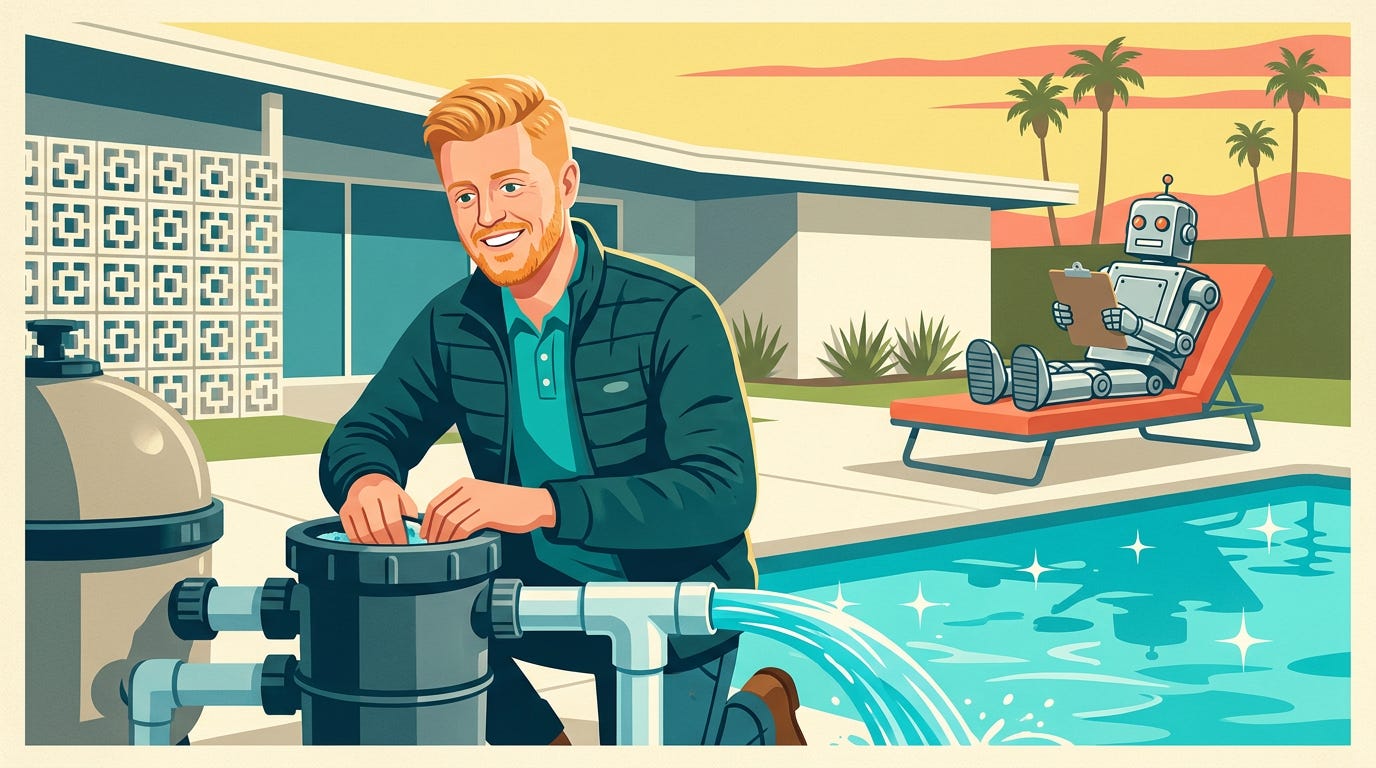
What Kevin describes the best current applications of AI in GTM as plumbing. Clean the data, find the insight only your platform has, and give humans more time and better reasons to talk to customers. The best AI play in his sales org didn’t replace a single rep — it empowered existing ones. The trick is figuring out how to do that in a space with very particular vertical knowledge and a strong sniff-test for outsiders.
AI Theater
Kevin didn’t mince words when asked about AI in the sales stack:
There’s just a lot of AI theater on LinkedIn of all these things that they’re doing. The biggest needle-mover AI play for us was to enrich our third-party and our first-party data.

That theater has a cost. Around the time of their $25M raise, Artisan (you may be familiar with their billboards, shared with TechCrunch that first-generation AI SDRs get a low response rate and see relatively high customer churn, even admitting their own share of customers quitting. That’s not an indictment of the category — moreso of the premise that volume is the bottleneck. When the cost of sending a message falls to zero, volume explodes, and recipients are less likely to pay attention.
Skimmer learned an internal version of this lesson. Their first pass at AI was decentralized: everyone got a license to ChaptGPT, Claude, Replit, etc. The output was what Kevin calls “slop bombs” — at one point, five different ROI calculators were circulating among reps. The fix was organizational: Skimmer hired its first go-to-market engineer, reporting into RevOps, to test plays centrally and ship one production-grade version to the whole team. His takeaway was that AI needs an owner in every function.
The Data Exhaust Ladder
Skimmer processes billing for thousands of pool companies, so it knows what pool cleaning costs in nearly every ZIP code in the country. That data became the basis of an outbound campaign built on what Jordan Crawford of Blueprint calls a PVP, or permissionless value proposition: a message so useful, the prospect would pay to receive it. A high bar.

Subject line: do you know you could charge $45 more per month? Here’s the average of your zip code. Here’s what your competitors are charging. Here’s a freebie. Go raise your prices.
That’s one example. You have to provide clear, actionable value that no one else could have (or isn’t). Kevin called the results “game-changing” for his outbound motion. No external AI SDR could write that email, because the data doesn’t exist outside Skimmer’s billing system. It’s the GTM expression of a point we made in Payments as a Shadow System of Record: owning invoice yields valuable pricing data.
Skimmer’s campaign is one rung on a ladder Vertical SaaS successes have been climbing for years. Each rung moves the platform closer to driving the customer’s own pricing and sales decisions — and further from horizontal replicability.
Here are the rungs Kevin has put to work, or will soon:
1. The annual report
Aggregate data as PR. Jobber’s quarterly Home Service Economic Report draws on 300K+ home service pros; Skimmer’s State of Pool Service surveyed 1,600+ pool pros this year. Useful, citable, and mostly a brand exercise.
2. The free index
Aggregate data as a lead magnet. Skimmer’s Service Rate Index covers 6,500+ ZIP codes and 700K+ pools, free and ungated. Toast launched its Menu Price Monitor in 2025. Owner’s Grader — audit your restaurant site, get a rebuilt one in minutes — is the same idea applied to the prospect’s own data, and 83%+ of Owner’s new customers now start inside an AI product. (We covered the Owner playbook with Kyle Norton.)
3. Permissionless outbound
Aggregate pricing data, tailored to individual account prospects. Same data as the index, but delivered to businesses by ZIP code, with a follow-up call behind it.
4. In-product pricing guidance
Aggregate data as a product feature. Toast’s in-product Benchmarking (2024) compares a restaurant against nearby Toast locations to help it adjust prices. At this rung, the data stops being marketing and starts being a reason to stay.
5. Pricing itself
Powering the customer’s pricing decision itself. RealPage’s 2025 settlement with the DOJ bars it from using competitors’ nonpublic data to set prices in real time or modeling below the state level. “Here’s what your competitors charge” is great marketing at rung three; it’s a legal question at rung five. Vertical platforms climbing this ladder should know where it ends.
A fair objection comes from a16z’s “The Empty Promise of Data Moats”: most companies have data scale, not data network effects, and the marginal data point is worth less than the last. True enough — a rival pool platform with similar scale could publish the same index. But a horizontal AI SDR can’t, and in most verticals the number of platforms with that kind of scale is one or two. In our experience, that’s moat enough for a sales motion, if not for a valuation.
Clean Pipes Before Smart Agents
The less glamorous half of Kevin’s answer was first-party data, and it may matter more. His reps are on four or five customer calls a day, and nearly everything valuable said on those calls used to die in a recording. Skimmer now uses Attention, a Gong competitor, to push that information back into HubSpot automatically. The before-and-after, per Kevin:
100% CRM field accuracy, where fields used to go missing
A forecast that’s ~90% accurate on the first day of every month
190 minutes per rep per week saved on manual CRM work — enough for one or two more customer calls
Pipeline, close rates, and average quota attainment all up
None of that is an agent doing a rep’s job. The AI is just the plumbing, and plumbing he has to get right. Gartner finds that sellers’ trust in AI tools drops 60% when they doubt the underlying data, and B2B contact data decays at roughly 22.5% a year. But the impact on reps is real, and it’s not just Skimmer seeing them. Gartner says AI already saves sellers nearly five hours a week, and 72% of sales orgs fail to reinvest it. Skimmer’s 190 minutes went straight back onto the phones, where 90% of its deals close.
Third-party data follows the same logic. Horizontal databases are thin on owner-operated blue-collar businesses — there’s no published list of every pool guy’s cell number — so vertical teams end up stitching together niche sources like Orbital and DataLane, plus proprietary signals scraped from the web. Kevin wouldn’t share Skimmer’s proxies (“in case our competitors are listening”), which tells you they work. This is the GTM cousin of the decision traces we’ve argued are the real data asset in Vertical AI: the signal is in the operational exhaust, not the headline dataset.
Beer > Bots
For all the talk of data, Kevin’s favorite play is old-school. After peak season, ship a case of beer to the shop. Technicians punch out after a brutal shift, find the beer in the lobby, and crack a few; the owner wanders in and joins them. No CTA, no ask — just “congrats on another peak season, have a beer on us.” A day or two later, the BDR follows up: hope you enjoyed the beers.
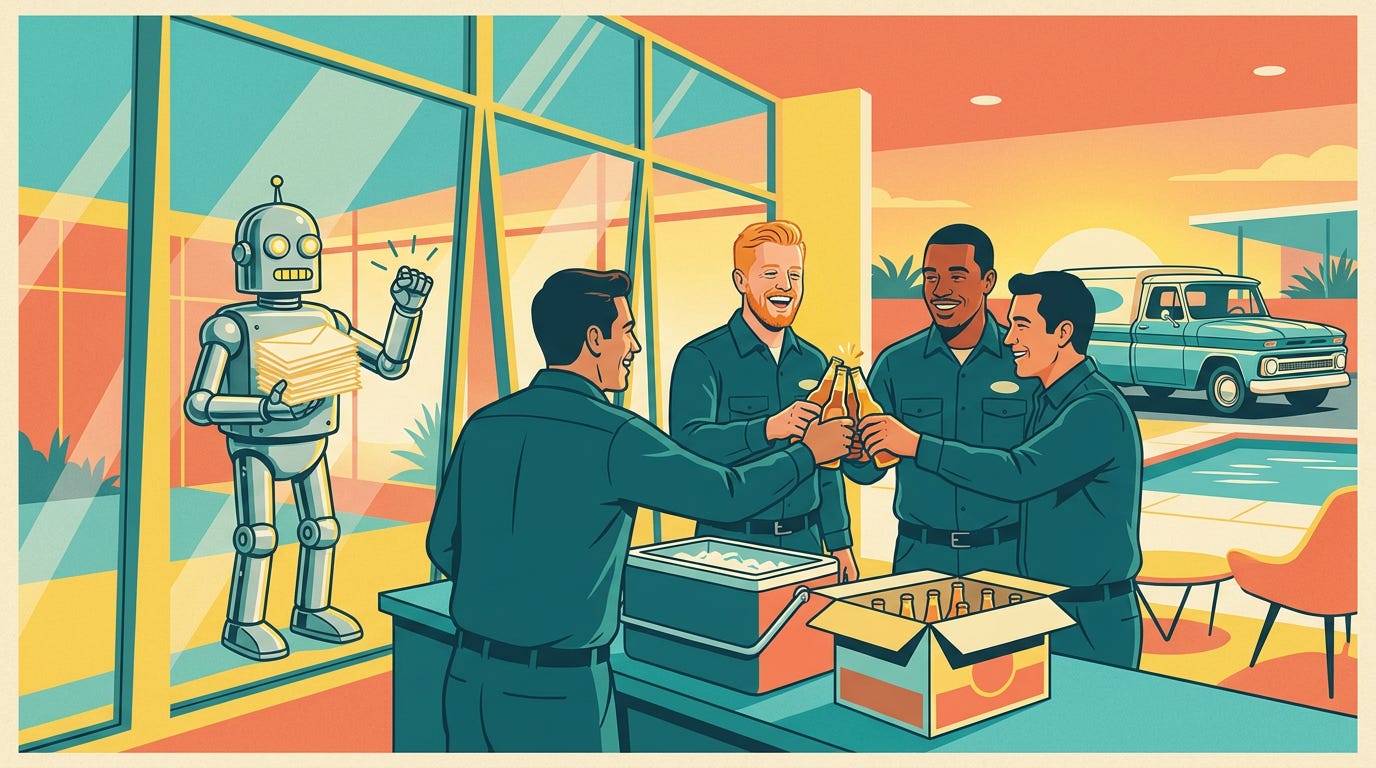
Kevin puts the conversion at 70–75% to demo, and says it has worked at more than one company. It’s a riff on Brex’s famous champagne campaign, where Sam Blond sent ~300 bottles (~$19K all-in) to recently funded startups and got a 75% demo rate, 75% demo-to-close, and 169 customers. Three hundred sends. Compare that to the AI SDR model of three hundred thousand.
The same instinct runs through the rest of Skimmer’s motion. At conferences, a customer advisory board member vetoed the bayou tour in favor of the obvious: “Burger and beer. That’s all it takes.” Above a certain deal size, Skimmer now goes on site and spends a day with the customer’s team. And CEO Jack Nelson still joins the very first call on every enterprise deal — not the negotiation, the first call — at a company approaching $30M in revenue. (Kevin’s broader advice on keeping founders in the deal echoes what we wrote in The Truth About Founder-Led Sales.)
The Takeaway for Vertical Founders
The AI SDR wave was built on a horizontal assumption: that outbound is a volume problem, and sales is a cost center waiting to be automated. In vertical markets, that assumption doesn’t hold. Messy volume can burn your market. And the buyer — a pool pro, a contractor, a shop owner — may not just be skeptical of AI, they may demand a human who speaks their language. So use AI to make your reps more human — but recognize that in terms of AI wholesale replacing human sellers, we’re not there yet.

The value of Ambient AI (a topic we’ll touch on in the future) is rising. So don’t let this human centric message dissuade you ensuring you farm as much data as possible from the job to be done. Get first-party data out of call recordings and into the CRM. Find the aggregate insight only your system of record can produce — prices, volumes, benchmarks — and let your reps lead with it. Give AI in GTM an owner so it ships one good tool instead of five bad ones.
Agents may well outnumber sellers someday. Today, in vertical markets, we’d still bet on the seller who knows the customers better than everyone else — and knows when to show up with an agent, and when to show up with a beer.
See you next week.
Key Moments from this Episode
00:00 — Intro
01:53 — Kevin’s path from banking to vertical SaaS
06:59 — When are you actually ready to scale sales?
08:41 — Why hiring 10 AEs at once almost never works
10:31 — Why founders should never completely leave sales
16:07 — How to hire a great Head of Sales
25:21 — The 4 traits Kevin looks for in every sales rep
29:16 — Why industry veterans often fail in sales
34:40 — Can you spot a bad sales hire in one week?
37:27 — How to sell into a small, finite vertical market
42:32 — The biggest AI opportunity in sales right now
51:32 — Kevin’s AI go-to-market tech stack