

Welcome to The Vertical Museum, our new recurring series on the winners, losers & ledgers from vertical history. Every two weeks, one exhibit: a system purpose-built to run one industry. Many from the modern era, but the collection goes back further than you'd think.
Naturally, we’re starting with the first vertical killer app: beer rationing.
App — Beer Ledger
Vertical — Brewery Operations
Insight — Quantification
Developer — Sumerians in Mesopotamia
Date — ca. 3000 BC
Verdict — Winner: arguably still in production
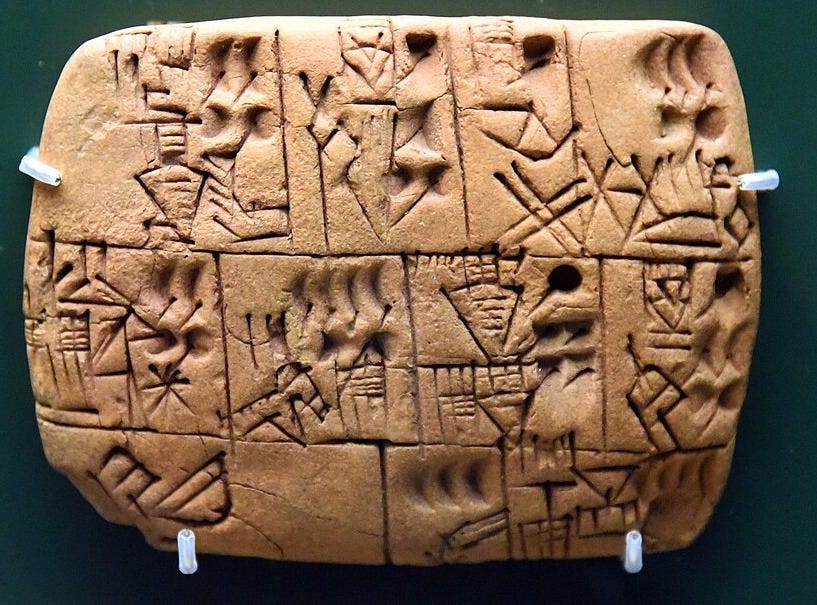

A brewery manager five thousand years ago pressed symbols into wet clay. One is a pointed jar filled with wavy lines: beer. Another shows a bowl tipped toward a human head—the sign to eat, marking this as a ration account. These are among the earliest writings found anywhere in the world.
It was pressed around 3000 BC in Mesopotamia, modern-day Iraq. The tablet records beer issued to workers as daily rations—a thick, starchy brew, essentially liquid bread.
The Job
A Copper Age village of just a few dozen people had no need for formal records. By the late fourth millennium BC, the first city-states emerged in southern Mesopotamia, some with populations approaching 100,000, defined social hierarchies, and specialized divisions of labor. Every individual had specific obligations and entitlements. Questions arose: who owed what to whom? What was stored, and what disbursements were required?
And this wasn’t one lonely beer tablet. Another recovered tablet tracked 37 months of barley deliveries to an official named Kushim. One set of tablets recorded barley delivered to the brewery; another recorded beer leaving as rations. The first vertical system of record arose from the need to manage this inter-organizational ledger.
Kushim may have been a person, a title, or an office. If it were a person, Kushim is a candidate for the earliest surviving personal name. History’s first recorded name survived five millennia by diligently signing off on inventory statements.
In full disclosure, Kushim’s work had flaws. Early arithmetic was error-prone: it had just been invented! The first name recorded in history also committed the first accounting mistake. The profession has been living it down ever since.
The Clever Bit
The first system relied on tokens, but the Sumerians recognized that their complex operations required a centralized ledger. Unfortunately, the general-purpose alphabet would not arrive for millennia. So the vertical schema shipped first: they recorded objects—beer, barley, workers, offices—and quantities.
The scribes of Uruk initially labored under an accounting regime that would give any modern auditor a migraine: not one number system but roughly a dozen, each tied to its own class of goods. The same wedge in the clay, in other words, meant one thing for barley and another for sheep — measuring jars rather than any universal quantity. Historians have identified nine types of beer tracked by Sumerian scribes of this era so far, mostly through signs depicting various types of beer jugs.
The upshot is that the first ledger was counting things, not numbers. The abstract integer being a luxury they had not yet thought to invent. But over the course of about a thousand years — and plenty of beer — the Sumerians would evolve their humble ledger into a mathematical powerhouse: the sexagesimal (or Base 60) place-value system.
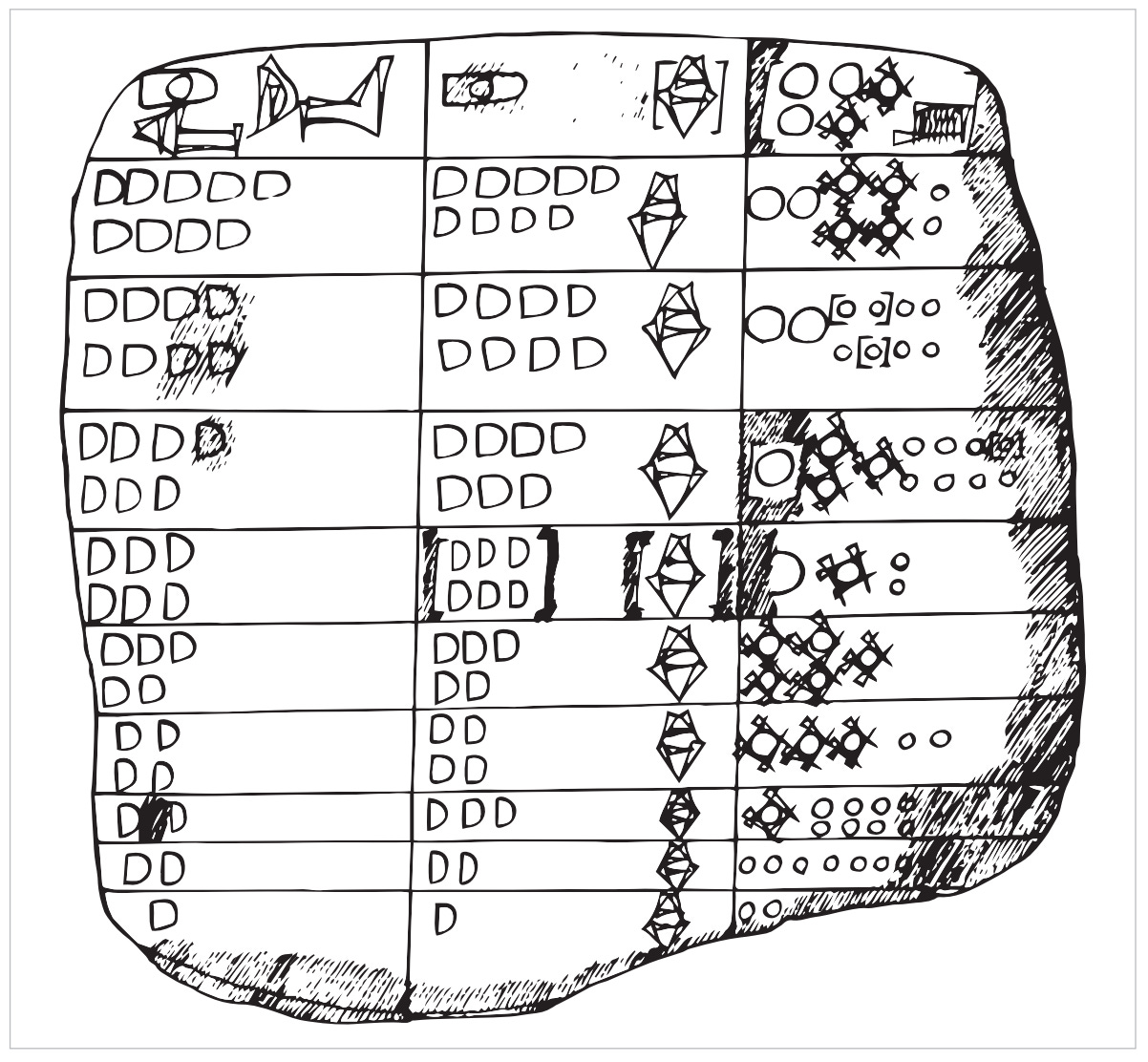
Base 60 was perfect for beer accounting — over our decimal, or Base 10 system — because sixty divides so many ways that ugly fractions come out clean. It’s great for quotidian counting systems and it’s not as unintuitive as it seems. You have Kushim’s ledger, after all, to thank for there being 60 seconds in a minute.
Why It’s in the Museum
Calling this a vertical system of record is doing a little work, but the job is unmistakable: raw materials in, finished product out, and the people, obligations, and records connecting them.
In the end, the ledger outlasted the beer. Keeping it required the development of one of the earliest traditions of writing and bookkeeping. Their notation system developed into cuneiform, which combined word signs with syllabic signs and remained in use for more than 3,000 years. Some 1,300 years after the beer tablet, the Code of Hammurabi was carved in cuneiform on a seven-foot rock slab in nearby Babylon. Kushim walked so Harvey could run.
Another important innovation: tracking rations was essentially the precursor to payroll. It also served as a useful form of labor control. Workers were paid rations based on output. Systems of record have had politics since version one.
Every Vertical AI pitch ends the same way: and then we become the system of record. Fair enough. Just remember, the competition is sometimes really old, and some of the first users were paid in beer.
The Catalog So Far
You’ve missed nothing. The museum just opened.
Next fortnight, we jump 5,000 years forward: the AI that won Jeopardy! and promised to cure cancer. It was later sold for parts.
Thanks for reading The Verticalist. If you're building a system of record with a better retention curve than clay, we'd love to hear from you.
very creative concept and a great choice for the first entry!