

This episode is brought to you by Parafin. $14.5B in financing offers extended. $100M+ annualized revenue. $360M in fresh capital. 85% repeat rates from merchants. Parafin turns your platform’s transaction data into embedded capital that small businesses actually use — and come back for. Amazon, Walmart, DoorDash, Jobber, and Kajabi already have.
Click here to see what Parafin can do for your platform →
This Week’s Episode
There’s a good chance growth equity brings to mind a time-tested framework: analysts screen the top of the funnel, cold-call their way through, compete to sniff out hidden winners first, and slowly escalate conviction up to GPs. Along the way, the CRM is a filing cabinet — a retrospective store of data. Thesis and conviction live in hallways and IC meetings. And it works. But sometimes — and perhaps especially in this new era of AI acceleration — there’s risk of winners slipping for the wrong reasons… because someone once said “construction tech is too cyclical” or “gross margins below 85% are unacceptable” once and it stuck.
Dave Pandullo and Scott Hoch, General Partners at AQL Growth — a growth-stage fund launching from Frontier Growth focused exclusively on vertical software and vertical AI — decided to launch their firm with a different backbone. They built Eagle Vision, an internal AI sourcing platform that encodes their investment thesis into a system of judgment at scale. Their results are early but compelling: partners on planes before the first call, and a portfolio company (Albi) sourced, scored, and closed end-to-end.
This week, we share their story and a peek into their playbook. And we get their view on the future of systems of record, RCM, scribes, and much more.
This Week’s Guests
Dave & Scott of AQL Growth
AQL didn’t start with a blank sheet of paper. Frontier Growth has been investing in software since 1999, and the team’s vertical conviction traces back to 2007, when Frontier backed Daxko — club management software for YMCAs and JCCs that looked, at the time, like a “tiny little market.” They exited too early. Daxko went on to become the dominant platform in sports and recreation, now north of $250-300 million in ARR. It made a lasting impression: niche verticals that look small from the outside often harbor enormous, defensible TAM once you’re inside the workflow.
Dave — who previously co-founded a mobile telehealth software company — and Scott, a 20-year growth equity veteran who came up through investment banking, spent years building pattern recognition across verticals inside Frontier’s broader strategy. Trades, sports and entertainment, state and local government, outpatient healthcare — eight investments in the last 12 months alone. The thesis tightened: modern systems of record evolving into systems of action, AI-native wedge solutions, capital-efficient growth, and verticals with a right to win. The problem was that this thesis lived in partner conversations and judgment calls — not in a system.
The spark came when Scott ran a CRM audit and discovered, to his and Dave’s dismay, that it was “a filing cabinet with the wrong information in it.” They couldn’t identify their top 100 targets. They couldn’t answer basic questions: Who is our ICP? How many of them are there? How do we stack-rank them? So they reframed the problem entirely. Capital, they reasoned, is increasingly commoditized — it’s a product. Founders are the customer. And like any good vertical software company, AQL needed to know its total addressable market. That realization — treating themselves as a product company, not just a fund — became the genesis of Eagle Vision.
The name AQL itself, derived from Aquila (Latin for eagle), encodes the ethos: sharp vision, intense focus. They write $5-30M minority checks into post-product-market-fit companies at $2-3M+ ARR, and they needed their sourcing engine to match the precision of their strategy.
The Vertical Playbook
Building an AI-Powered Investment Engine
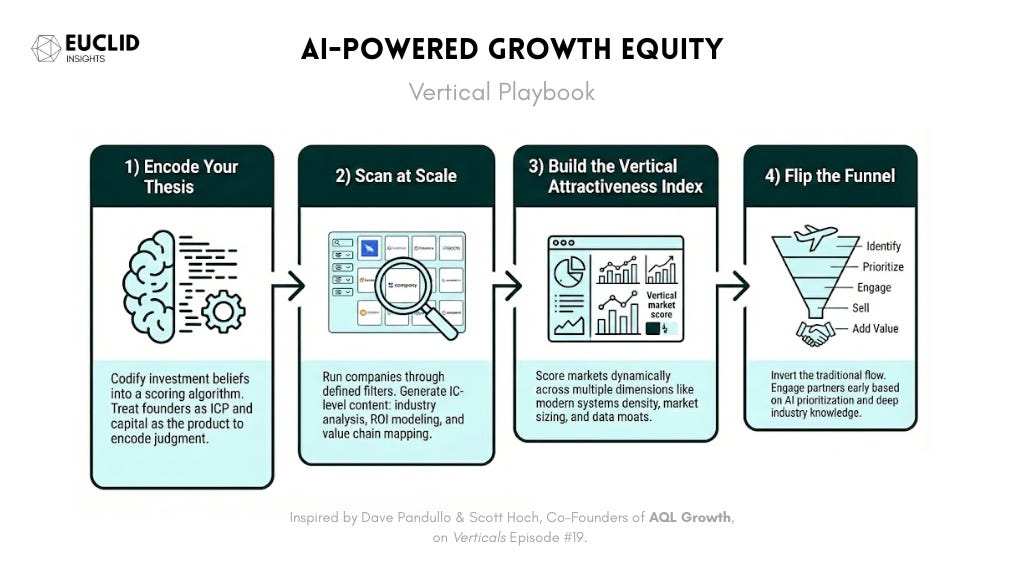
Step 1: Encode Your Thesis
AQL’s first attempt at AI sourcing “completely whiffed.” They fed a model their website, strategy, and past investments and asked it to evaluate targets. The output was unusable. The problem wasn’t the model — it was that their thesis lived in partner conversations and judgment calls, not in a system.
So they reversed the approach. Instead of asking AI to evaluate companies against a vague mandate, they codified exactly what they believe: modern systems of record evolving into systems of action, AI-native wedge solutions, capital-efficient growth, and verticals with a right to win. They then encoded those criteria into a scoring algorithm, treating founders as their ICP and capital as their product. As Scott put it: the goal was “not to replace our judgment, but to encode what we really believed.”
Step 2: Scan at Scale
With a codified thesis, AQL ran 25,000 software companies through Eagle Vision’s filters. The output: a TAM of 6,500 vertical software companies fitting their strategy. Overnight, they went from not being able to identify their top 100 targets to knowing exactly who their ICP was and how to stack-rank them. The system simultaneously generated IC-level content for each target — customer industry analysis, jobs-to-be-done breakdowns, ROI modeling, vertical and software value chain mapping — that Scott described as “deeper and richer than IC presentations I had seen in my 20-year career.”
Step 3: Build Your “Attractiveness Index”
Knowing which companies fit the thesis wasn’t enough. AQL needed to know which verticals were worth the bet — and how attractiveness shifted over time. They built a Vertical Attractiveness Index (VAI) scoring markets across multiple dimensions: density of modern systems of record, market sizing and white space, data moats around the solution type, competitive landscape, customer satisfaction with incumbents, product roadmap trajectories, M&A activity, capital raises, and competitive hires. Critically, the VAI is dynamic — recalculated as competitive moves, funding events, and talent shifts hit the market. The CRM went from a static filing cabinet to a living intelligence layer.
Step 4: Flip the Funnel
The traditional growth equity funnel runs: analyst screens → cold outreach → slow escalation → senior engagement. Eagle Vision inverts it. Because the scoring algorithm so tightly encodes partner-level judgment, “we’re getting partners on planes before we’ve even had a conversation with a company,” Dave explained. The new flow is: identify, prioritize, engage, sell, add value. AQL’s investment in Albi — a business management platform for damage restoration — was the proof point. Eagle Vision identified and prioritized it; the team moved fast, shared deep industry knowledge with founder Alex Duda on first contact, and saw past surface-level retention metrics that scared off other investors. Nine months post-close, retention had dramatically improved — exactly as the model predicted.
The Takeaway for Vertical Founders
AQL’s Eagle Vision isn’t a product they plan to sell — it’s their investment thesis encoded as software. But the meta-lesson applies to any vertical operator: the best AI won’t replace domain expertise, but rather systematize it. The most data or the biggest models certainly help. Startups that also abstract subjective judgment into scalable systems — turning that tribal, rarefied knowledge into an edge — are building truly powerful moats.
Thanks for reading Euclid Insights and for tuning in to Verticals! Drop us a line below with your thoughts. And don’t forget to subscribe to the show wherever you watch and listen:
Keep Reading…
Why all paths aren’t equal in the search for AI-proof vertical moats.
The Dispatcher Problem

The enterprise technology landscape is currently navigating a structural transformation that rivals the shift from on-premise servers to cloud computing. For nearly two decades, the Software-as-a-Service (SaaS) model — predicated on recurring revenue, seat-based licensing, and user engagement as a proxy for value — has served as the bedrock of the techn…