

Quinn Litherland is the Founder and CEO of Revin, an AI voice and SMS platform deploying automated agents into home services operations across HVAC, plumbing, roofing, and remodeling. NYC-based, the company has raised just over $10M to date, across two rounds led by Stellation Capital and Toyota Ventures.
Tune in to hear Quinn lay out the two failure modes he sees killing forward-deployed strategies across Vertical AI, the specific operator profile that makes FDE actually work, and what happens when your agents outperform the customer’s best human rep on day one.
Today’s Episode
Forward-deployed engineering has been the strategy of the moment in Vertical AI for well over a year. It’s almost a universal feature at this point: sending technical staff on-site, embedding in customer workflows, learning the business from the inside, handling CS, even driving product. Palantir made the model famous, and now everyone is copying it.
The appeal is straightforward. You have to understand how a $50M HVAC company qualifies leads; how a local business manages a sales cycle across SMS, email, and voice; how manufacturing owners with 30 years of muscle memory react when X happens. That understanding is rarely written down — live, in situ is the only way.
Quinn and his team at Revin have built this motion from the ground up in a $650B+ industry. His forward-deployed team goes on-site, embeds in customer operations, and deploys AI agents that routinely become the top-performing “rep” in the call center on day one. Customers see $5M+ in net new revenue and start asking for more workflows, more automation, more of their front office run by agents.
But Palantir’s CTO made fun of the copycats for a reason. Most companies running forward-deployed motions are, in his words, “just sales engineers dressed up.” Quinn sees two specific ways the strategy goes wrong, which we’ll cover below. Before we get into today's episode though, a quick observation:
It seems FDE is becoming something different altogether. It’s a role historically thought of as primarily technical but with strong customer success mandates — implementation, problem solving, keeping the customer happy. Modern FDE is taking on roles traditionally associated with Ops, Sales, even Product. They are increasingly independent. What sort of background do you look for when your FDE essentially has to do a little bit of everything? More and more, they resemble mini-founders. Perhaps they’re due for a title upgrade.
Trap #1: Consultant Fever
You send smart, technical people into customer sites. They do great work. The customer is happy. Revenue grows. But you never institutionalize what you learn. Every new account — maybe every site or team — requires not only a fresh deployment, but a net-new feature. Your FDE team scales linearly with revenue. Your gross margin looks like Accenture, not Palantir. “It’s 100% an excuse not to build great product or repeatable systems,” Quinn says. “That’s the hard truth.” Your customer can’t live without you — but you also can’t get any leverage on the business.
This is the risk we flagged in Service-Level Disagreement: the arbitrage between service delivery and product automation is real, but is ultimately limited by ACV. If you’re still hand-deploying every customer in year three, you didn’t build a product company. You built a consulting firm that happens to use AI.
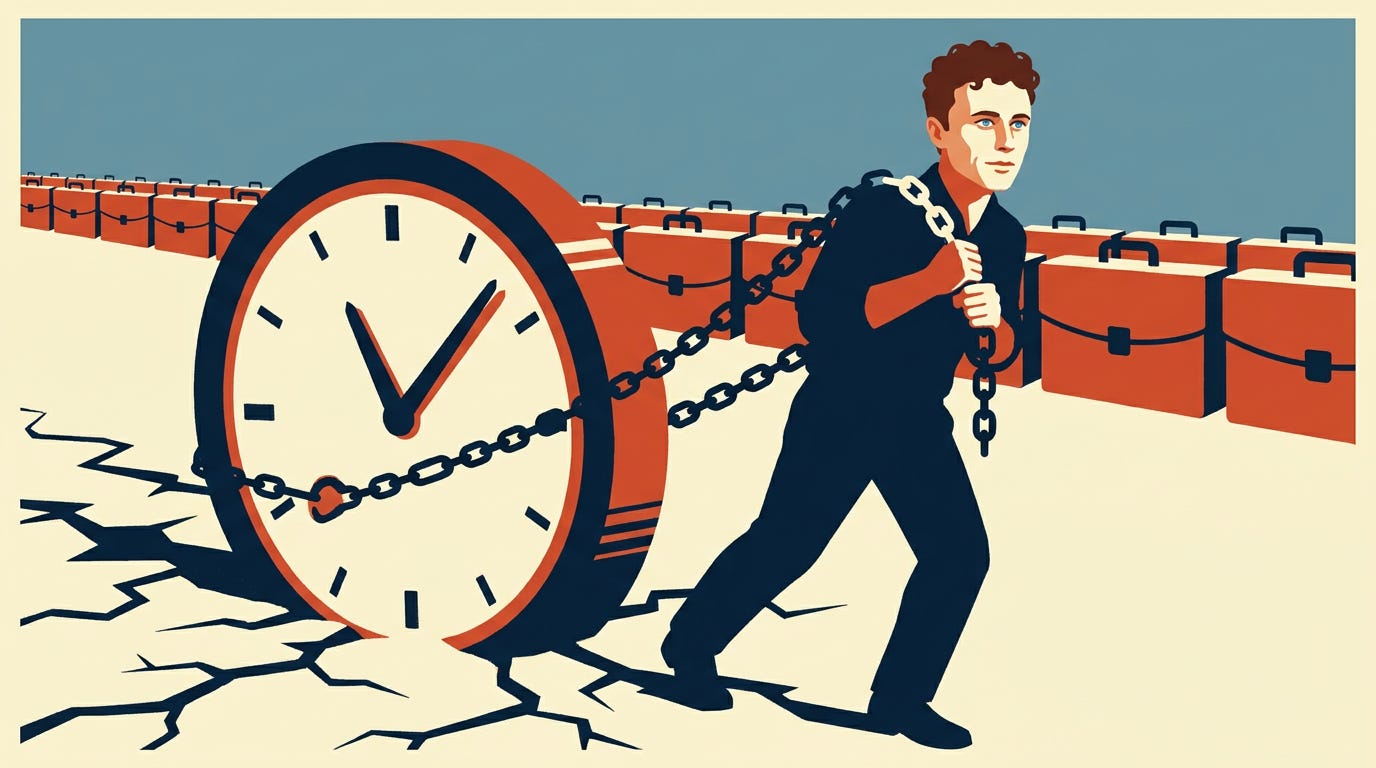
For some, this is a business model that makes sense (beyond the obvious McKinseys and Bains). Earlier this year, OpenAI spun out DeployCo and Anthropic launched Ode, both implementation arms designed to drive model consumption. Their incentive is to go in, deploy AI for $10M, and leave — or better yet, stay and continue to develop new use cases for their LLMs. For them, almost any version is a success: more tokens consumed, more API revenue, no middleman. For startups, this only works if you have a consumption-based product with sufficient gross margin that the customer can build more use cases around. If the only margin you capture above AI infrastructure costs is ephemeral implementation work, you’re a subcontractor for the model labs. Here’s how Quinn thinks about it:
No one’s coming to save you. The venture market’s so weird right now. Teams need to be a lot more intentional about where they’re spending their cash and how they’re building repeatable workflows versus having this grand vision but insane costs around the human beings they’re sending on-site.
Trap #2: Forward-Deployed Chaos
The second failure mode of FDE is organizational in nature. Half of your FTEs are running around customer sites, putting out fires, closing deals… and nobody is translating learnings into repeatable product. Poorly managed, the FDE motion can become an excuse for organizational chaos rather than a deliberate product strategy.
The solve begins with a tight “templatization” process. In other words, a disciplined pipeline of FDE, to product, to engineering. Today, when a $50M HVAC company signs up for Revin, the team already knows 99% of what their qualification process looks like, how job type matching works, and how to integrate with ServiceTitan. The onboarding that used to require on-site setup from scratch now runs through pre-built templates. A human still oversees it, but the repeatable scaffolding is in place.

“Every month, my FDEs need to be able to take on more and more,” Quinn says. The metric that matters is accounts per FDE, not headcount. If that ratio isn’t improving, you’re scaling a services org, not a product.
The second half of the solution centers on responsibility design. Quinn believes FDEs should sit under product, not engineering or sales. The field team generates real-time feedback every day. If that signal doesn’t flow directly into what you’re building, you’ve turned your most expensive employees into an expensive suggestion box. “If your engineering leader isn’t product-centric enough to learn from the team in the field, you’re always going to be surface level,” he says. The secondary implication of this is that defined roles for engineering vs. product may become important earlier than in the past. FDEs surfacing insights from their particular customer and building them is efficient. Unless those additions are constrained to an individual customer or deployment, however — hopefully an exception rather than a rule, per trap #1 — product roadmaps can get incoherent, fast.
Founders need to strike a balance that corrals chaos, without kneecapping the power FDE to drive natural product expansion. It can be a real problem when market pull is high, and resources are constrained. As Quinn shared, customers who see Revin crush 2-3 workflows want 6 more. Each new workflow may touch new systems, new data sources, hard technical problems the team hasn’t solved yet. Quinn is honest about the tension: “How do you make sure you don’t lose trust by overpromising, overcommitting, just being there and saying, yeah, we can build that?” Saying no to expansion revenue is painful. Saying yes before the product is ready — or before you’ve confirmed it’s something the broader ICP could use — risks triggering both traps at once.
A Quick Word
…from our sponsor, Parafin. Now past $100M in revenue and backed by a Goldman Sachs-led credit facility, Parafin powers embedded lending, cards, and insurance for the likes of DoorDash, Jobber, TikTok Shop, and dozens of vertical leaders. Purpose-built for platforms serving SMBs, no infra required.
Explore a custom program with Parafin today →

Click above to hear it from Parafin’s CEO, Sahill, on a recent episode of Verticals.
Optimizing Your FDE Strategy
Quinn’s best deployment lead, Paul, ran a car detailing business in Austin before joining Revin. He bootstrapped it to ~$500k / month, sold the business, and developed a gut-level understanding of how operators in the space thought. He now manages accounts representing billions of dollars in roofing enterprise value. He could, Quinn says, “leave Revin right now and probably go run a roofing roll-up better than 95% of the folks in private equity.”
The FDE role is becoming an increasingly demanding one, requiring industry expertise, product intuition, sales ability, and empathy for operators who’ve often run their businesses the same way for decades. The person who fills this role can deploy agents on-site, manage upsell conversations, and feed product insights back to the team in the same week. The FDE is much more than an engineer who occasionally talks to customers, or a CSM who occasionally files tickets. They must understand two things simultaneously:
They’re there to help customers change the way they do business through AI.
There is real wisdom in their decades of praxis — and that wisdom needs to be learned and incorporated if you want to be true Vertical AI.

Some startups are rebranding the FDE. We’ve heard: AI deployment strategist, forward-deployed architect / specialist, GTM engineer, and even AI coach. In Vertical AI, customers are thinking about this role differently. No longer is the FDE just an extension of customer support — in some cases, they are the breath of fresh air, someone versed in AI who will finally listen to them and help them build. They’re a conduit for the years of ideas this practitioner has had. “Who am I going to be working with?” is now part of the sales process.
Economics have to be central to your FDE considerations. In forward-deployed Vertical AI, CS is structurally more expensive — we estimate ~50% more than the SaaS baseline. But from what we’ve seen thus far, the ACV opportunity is also significantly greater, as solutions can do more of the work, and absorb consultant, advisor, even CXO roles. If the FDE has commission on renewals and expansion, and a $100K account can grow to $1M, you have a profit center disguised as a support function. Quinn points to Decagon as another company getting the incentive structure right: “How do you make sure your FDEs walk into the office every day thinking, I can make a million dollars this year if I renew every account and expand them?” Of course, pricing / customer (or ARPA) potential must be factored in. If your average ICP business grosses $500K in revenue, there is a natural ceiling to how much FTE spend makes sense. If you’re working with enterprises that have top-lines in the billions, a la Palantir, persistent logo-specific teams are easily justified.
What You Get When FDE Works
It’s become common to draw a distinction between the system of record (in Quinn’s space, ServiceTitan, Housecall Pro, Salesforce FSM) and the system of action. As Revin sees it, the historical system of action was humans. Now, agents have the potential to absorb much of that layer.

Quinn’s math: if Revin drives $5M in net new revenue to a customer’s bottom line and charges $70K, the product may be dramatically underpriced. The boost in willingness to pay for handling a workflow soup-to-nuts — versus asking someone to train up on a new dashboard to manage it themselves — is very real. Operators are already paying consultants and fractionals multiples, if not orders of magnitude, more than SaaS vendors.
While traditional vertical SaaS concerned itself with dominating the UI layer — “spend time in my platform” — FDE-led Vertical AI is focused on eating the action layer underneath. Take the Podium-ServiceTitan situation: ServiceTitan shut off Podium not because Podium was running agents, but because Podium was building a competing FSM. Quinn’s read: “As long as you don’t try to stab the bear, you’re probably going to be fine.” If you own the work, that may earn you the right to own the UI and the database. But as an early stage startup, that can risk provoking the ire of sharp-elbowed moneyed incumbents — some of which you may be better off partnering with. More simply: own the workflows, don’t worry about the rest. If a primary concern of FDEs is implementation, understanding, even playing nice with existing legacy SoRs is critical.
Quinn’s vision of where this could lead for Vertical AI customers: a $500M roofing company run by 5 people and a fleet of agents. The C-suite and key relationship owners — or wherever the centers of core competency lie — remain. Much of everything else can be automated. Quinn believes old-school operators, historically relegated to “legacy” in the SaaS era, are now discovering some of the “coolest, most badass ways to grow their business.” FDEs are the vanguard of that massive opportunity in Vertical AI.
The Takeaway for Vertical Founders
Quinn shared his three most critical hires for an AI-native vertical company:
FDE — an AI Deployment Strategist with the profile of an ex-founder who can go on-site, build trust, and deploy agents while identifying expansion opportunities.
Sales — an industry-native seller who knows every conference, every Facebook group, every distribution channel in the vertical, not a generalist SDR.
Engineering — visionary technical leadership who can scale systems for the long term (not just ship features) and help manage the increasingly tricky FDE-product-development interface.
Notice what’s missing: no product manager; no designer; no head of marketing. We asked Quinn for his top three, so this is not to say those roles aren’t important. For very early stage startups, however, the FDE can wear many of those #4+ hats. And that allows the customer to play an important role as well. As Quinn put it, our FDE is the product manager, the customer is the designer, and the agents’ performance is the marketing.

Done right, forward-deployed engineering can teache you which workflows to own, how to institutionalize them, how to price the value you create, and give you the customer perspective and language to understand how to sell and market. Use FDE as a crutch and you risk becoming a consulting firm (a dev shop, rather than a true AINS1). Use FDE with reckless abandon and you may end up with a sprawling roadmap and an incoherent product without compounding value. The best Vertical AI founders will use FDE as a CT scan — parsing granular customer operations, iterating to generalizable product, and unearthing the action layer of an industry.
See you next week.
Key Moments from this Episode
00:00 — What Revin does and why home services is a $650B+ opportunity
05:05 — How AI is flattening the startup org chart
07:03 — How Revin runs the forward-deployed motion
13:03 — The ex-operator who became the best FDE in roofing
18:33 — The two traps that kill forward-deployed strategies
23:48 — Why model labs are spinning up implementation arms
26:24 — The M&A wave coming for Vertical AI
33:40 — How to structure FDE incentives so your best people stay
44:25 — Why 90% of companies are fighting over the wrong layer
49:57 — UI is not defensible, so what replaces it?
55:38 — The headless company: $500M, five people, all agents
59:07 — Three hires to start an AI-native vertical company
AI Native Service. We’ve written plenty about AINS, including Service-Level Disagreement.