

B2B2C (business-to-business-to-consumer) is one of the most powerful — and most nuanced — models in vertical software & AI. When it works, the consumer touchpoint creates a flywheel that reinforces the B2B sale. Affirm’s consumer brand drives merchant demand. Plaid’s trust with consumers is the moat. Toast sells to restaurants but owns the diner-facing experience. This means you are building with two critical user bases from Day One.
This brings us to the hard question for B2B2C founders: how do you prioritize and balance the “B” (business) and the “C” (consumer) in your model? In practice, trying to do both is how startups lose focus and alienate their core buyer. Like in any multi-sided vertical business model, you need to ensure you have at least one stakeholder prioritized at any point, and ultimately, locked in. Andres Robelo, Founder & CEO of Playbypoint, spent ten years learning this in racket sports — tennis, pickleball, padel — and built a playbook for navigating the tightrope.
Check out our latest episode of Verticals with Andres. And continue below to get our vertical playbook, inspired by the Playbypoint — Navigating Vertical B2B2C.
A quick word from our sponsor on the Verticals podcast, Parafin. They’ve surpassed $100M in revs, extending >$25B in financing to their customers’ customers… B2B2C, even B2B2B. They power embedded capital for platforms like DoorDash and Jobber, and are purpose-built for vertical platforms. Click here to explore a custom program for your platform today.

A Pickleball Story: From Hobby to Obsession
Andres founded Playbypoint in 2016 after a consumer frustration: he couldn’t book a tennis court from his phone. His instinct was marketplace — be the OpenTable of courts. His first customer was a Miami municipal park, which took nine months of lobbying city commissioners for a free pilot.
The marketplace thesis broke fast. Booking was only 10% of a club’s operation. The supply side wasn’t digitized — membership management, lesson scheduling, junior academies, F&B — so there was nothing to aggregate. Playbypoint pivoted from connecting consumers to courts to building an end-to-end OS for the business. Today they serve over a thousand clubs across 37 countries, growing 80% year-over-year, backed by Blueprint Equity. Pickleball’s massive US explosion hasn’t hurt either.
The B2B2C Alignment Map
Most founders assume that more consumer orientation means a stronger B2B2C flywheel. But that’s not always the case — founders should instead look to understand what kind of market they’re playing in. Consider how “C” (consumer)-oriented you should be, based on how supply- or demand-constrained your “B” (businesses you serve directly in your vertical) is.
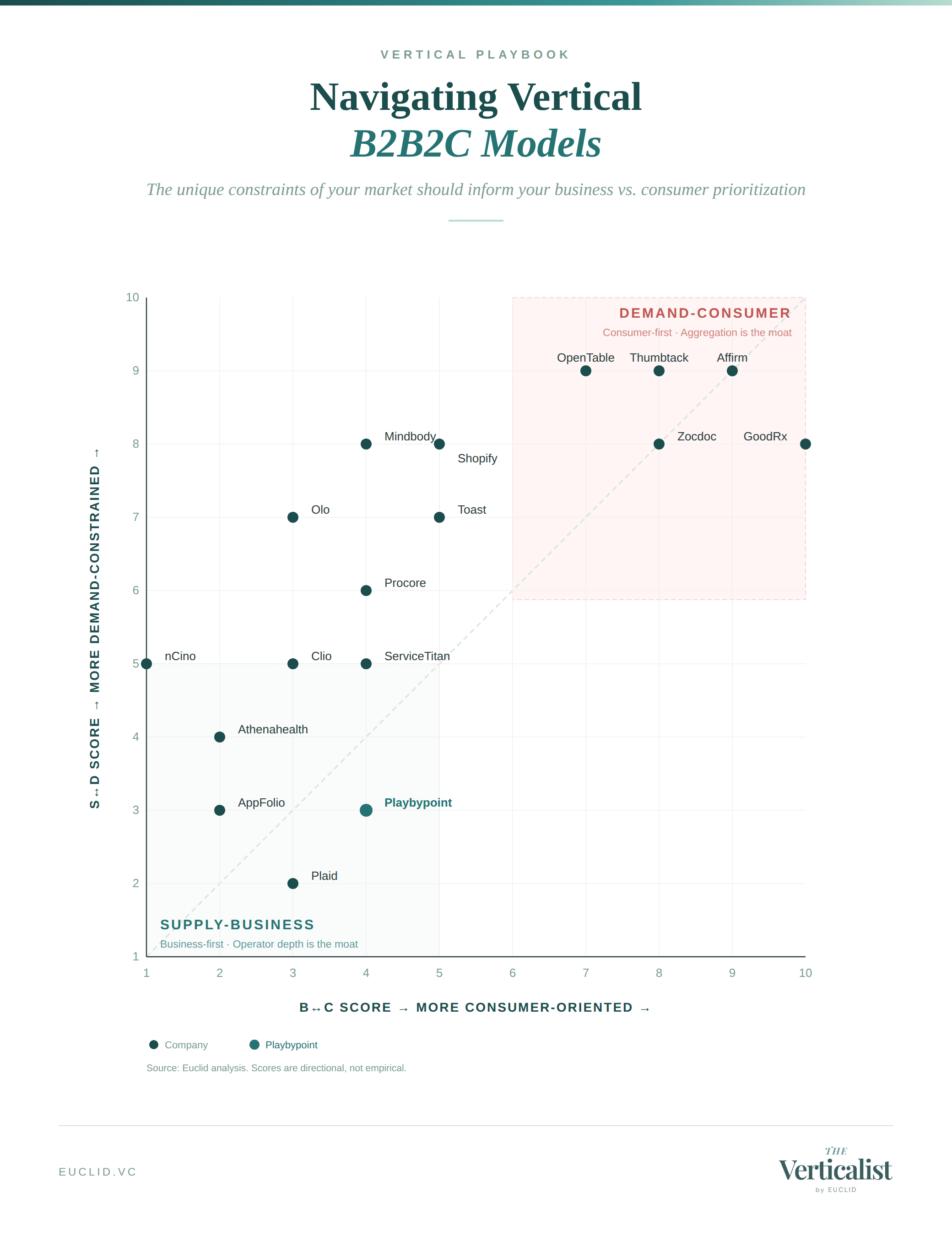
The strongest B2B2C roughly follow the diagonal — their consumer investment matches their market’s constraint. Zocdoc and Affirm are highly consumer-facing because their businesses are demand-constrained: providers need patients, buyers need financing. Consumer value and / or aggregation is the moat.
At the other end, Appfolio and Playbypoint are business-first because their markets are supply-constrained: courts are hard to scale, demand for housing is high. Our point is that your B↔C positioning should be informed by whether your vertical is supply- or demand-constrained. Andres understood this instinctively — here’s how he built a strategy around it.
The Vertical Playbook: Navigating B2B2C
Step 1: Pick a Side — and Mean It
A thousand clubs means millions of players, and the B2C pitch is sexier on a fundraising deck. Andres deliberately chose not to chase it. Shifting to a consumer model would put Playbypoint in competition with its own customers — a structural misalignment that erodes trust in SMB verticals. His positioning: if the platform enables operators to monetize and retain their players, the consumer value follows. The B sells the C. That’s the sequence.
Step 2: Is Your “B” Supply-Constrained or Demand-Constrained?
Most B2B2C founders assume the business needs more demand — so they build consumer-facing discovery and lead gen. Andres discovered the opposite. Racket sports clubs are supply-constrained: courts are physical real estate, and demand outstrips capacity. At 6:59am, 200 people are queued for a 7am booking window. So Playbypoint built demand-limiting tools — capping reservations per player, enforcing membership-tier access, managing waitlists. A Mindbody would never build these because the TAM looked too small. That specificity is what makes the product irreplaceable. On the alignment map, this is why Playbypoint sits in the bottom-left quadrant alongside AthenaHealth — and why it would be a mistake to push it toward the top-right by over-pivoting on the consumer.
Step 3: Use “C”-Side Data to Make Your B Smarter
Playbypoint‘s consumer layer generates enormous data: player preferences, booking patterns, churn signals, social connections. The key is routing that intelligence to the operator, not around them. Andres is now launching a marketing and retention kit — the company’s first true add-on — that uses player data to help clubs proactively retain members. AI collapses the build time (a matchmaking algorithm that would have taken months now takes days), but the value accrues to the B. That’s what separates a real B2B2C flywheel from a pass-through.
Step 4: Monetize Through the B’s Workflow, Not the C’s Transaction
Playbypoint is 80% SaaS revenue, 20% payments — the inverse of what most vertical SaaS founders target. Andres deliberately avoided over-indexing on payments because it’s a race to the bottom. SaaS stickiness built on deep workflow — the customizable rule engine hardened across a thousand clubs — is harder to dislodge. When a competitor recently offered clubs cash to switch, Andres didn’t match. He kept compounding domain depth. The switching cost isn’t the contract; it’s the thousand edge cases baked into the system.
The Takeaway for Vertical Founders
The racket sports market has been growing wildly. From 2.5M US pickleball players to over 25M in under a decade, with a new wave emerging in padel. Playbypoint caught that wave — but only after eight years of bootstrapped grind. But when the TAM exploded, Andres’ business / consumer positioning was well-oiled. His central lesson is B2B2C discipline: pick the B, understand its constraints, use the C to make the B smarter, and resist monetization shortcuts that look good on a pitch deck but erode the relationship holding the whole model together.
Thanks for reading the Verticalist! Subscribe to our show, Verticals, wherever you watch or listen. Dive deep into Vertical AI strategy with a new founder, every Wednesday.
another interesting thing about playbypoint is that their enterprise pricing is a number, not "book a call"