

Mike Duboe is a General Partner at Greylock, where he focuses on commerce, marketplaces, and consumer networks. Previously, he was the first growth hire at Stitch Fix, building the growth org from 20 through IPO. At Greylock, he’s backed transactional and network-drives businesses like Pepper (food distribution), Vori (grocery), and Highstock (excess international inventory). Join us in this week’s episode as we debate the future of AI commerce: what happens to the marketplace model when agents can handle transactions end-to-end, and why — even in commerce — attention may be all you need.
Today’s Episode
For 28 years, Sriracha founder David Tran sourced every pepper from a single farm on a handshake. Tens of millions in procurement, no contract. While noble, it ended the way you fear it might: generational transition, a renege, a $23M lawsuit, a national shortage of our favorite hot sauce. This seems like a quirky anecdote. But the truth is, most B2B commerce mirrors Sriracha’s antiquated setup more than you think — other than the frictionless commerce Amazon has trained us to think of, it runs on relationships, phone calls, personal loyalty and preferences.
VC has seen the opportunity in B2B marketplaces over the last decade, with mixed success. Faire was the canonical example, with enough fragmentation on both sides and demand that looked consumer-esque. Mike backed several of these at Greylock: Pepper in food distribution, Vori in grocery, Rosnovi in raw materials. Many of his investments, however, skewed away from the initial marketplace model and ended up building, in effect, vertical software. Transactional revenue lines, in other words, or a great add-on once you had already built trust, but a very difficult entry point.
AI might be changing that order of operations. Certainly, as the cost to match buyer and seller agentically goes to zero in some markets, it is changing the marketplace business model. today we debate what that future marketplace looks like — and whether you and I would recognize it as a marketplace at all.
New Markets, Not Better Marketplaces
Some imagine the outcome of AI commerce will be improving existing marketplace experiences: better matching and personalization layered on top of existing platforms. As Mike shares, this vision might be looking in the wrong direction:
The way I think about it is AI is actually making more markets addressable to that model than previously were addressable. For transactions that were previously heavily human-to-human, high complexity—negotiations that may have lent themselves to more of a brokerage versus a streamlined marketplace—agents can handle a lot of that right now.

In 2012, Benchmark’s Bill Gurley released a now-canonical framework outlining ten factors for evaluating marketplace opportunities. Roughly, those were:
New experience vs. status quo
Economic advantages
Technology leverage
High fragmentation
Supplier sign-up friction
Market size (TAM)
Ability to expand the market
Usage frequency
Control of payment flow
Network effects
Some believe this framework systematically excludes most B2B verticals from serious consideration. And yes, enterprise purchasing is more complex and relationship driven in some cases. We feel skeptics tend to paint with too broad a brush here:
High fragmentation
B2B often does have fragmentation in niches (long-tail suppliers, VARs, agencies).Friction of supplier sign-up
One of the stronger criticisms, but solvable (esp. if you have a peripheral product).Frequency
Frequency isn’t always lower — sometimes it’s higher. Moreover, it can be offset by very large deal sizes and greater intent / context.Payment flow
This is more a behavioral change problem than anything else with much of B2B payments being offline. B2BMs can also monetize may other ways.Size of market opportunity
Easily the laziest criticism — B2B markets are massive, with higher take rates.
Agents have the opportunity to move a needle on many of Gurley’s pillars, in consumer and enterprise both. Not only by improving matching, but by absorbing enough negotiation complexity to make an otherwise idiosyncratic transaction marketplace-eligible in the first place. We explored the buyer side of this thesis in The Dark Marketplace, where we argued that agent-to-agent transactions would create new commerce surfaces invisible to humans. Mike adds the supply-side complement: AI doesn’t just enable automated purchasing. It has the potential to free up supply — the creation of supply catalogs in verticals where inventory was previously opaque by default — which in turn can attract new demand.
So AI will open many new verticals to commerce models. One element Gurley’s framework does not contemplate as directly, however, is the fact that many B2B transactions, like our Sriracha example, are still very dependent on human behavior. Twenty years of accumulated trust and service — and a neck to choke if something goes wrong — may prove much more difficult for technology to accelerate.
$35 Billion
That's how much capital Parafin — the sponsor of Verticals — has extended to small businesses, via their customers. Which includes platforms like DoorDash, TikTok Shop, and Walmart. If your vertical platform serves SMBs, Parafin lets you bolt on plug-and-play lending, cards, and insurance.

Learn more here →
The Commoditization of the Match
The core value of a marketplace — the thing that justifies take rates — is the match. Aggregate supply, aggregate demand, charge for liquidity. That was the logic from eBay to Uber. That may be changing. In Mike’s words:
It’s gonna be insufficient to just charge for the match. In many industries, agents could kind of do this without there being a marketplace interface. That is an area where this business model is exposed.
If agents on both sides of a transaction can find each other, negotiate terms, and execute — and in categories with standardized online catalogs, they increasingly can — then the match approaches commodity. The marketplace’s position as intermediary weakens, putting natural pressure on take rates.
If this is the case, it’s probably good for all parties as cheaper matching means more dollars for buying. But where does value re-accrue? As in most cases of commoditization, upstream and downstream.
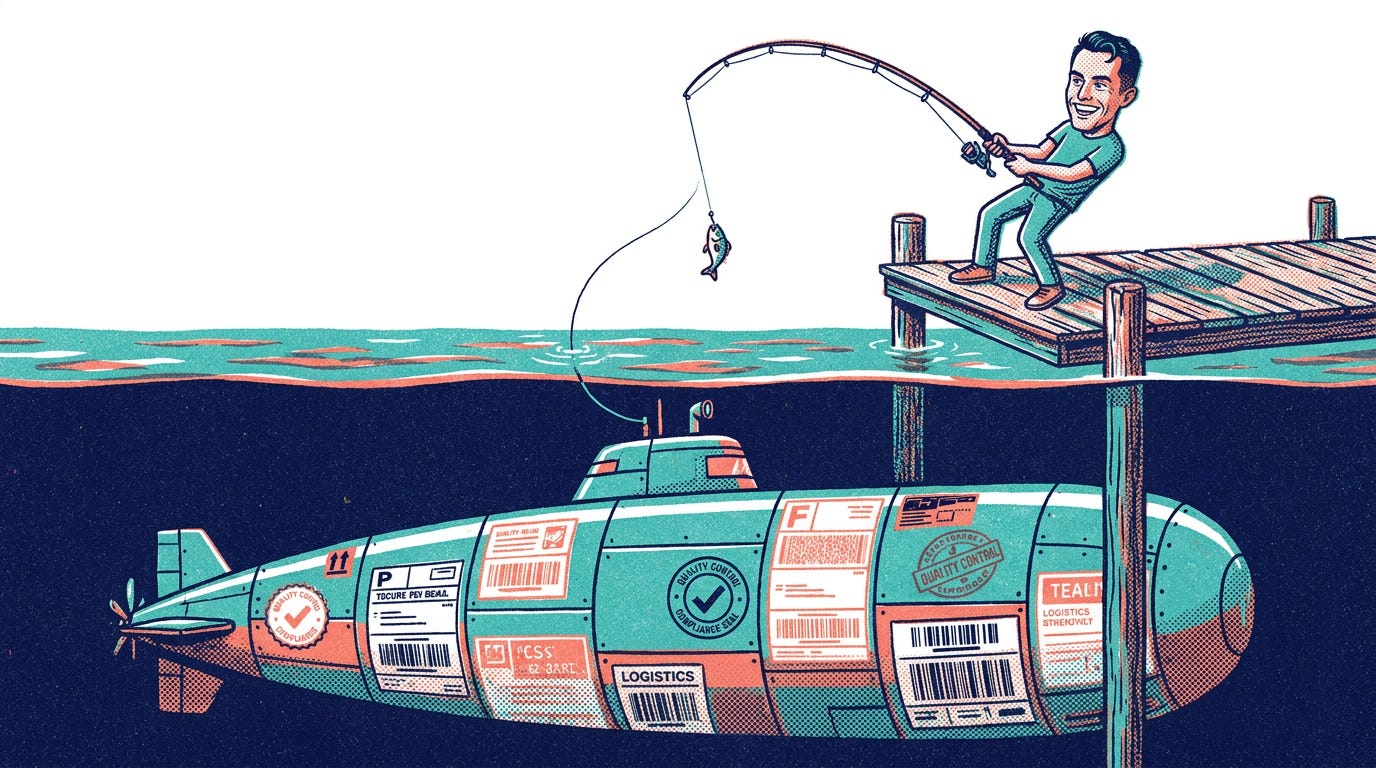
Mike points to Highstock to illustrate the point. The company processes roughly $100M in merchandise for 50+ beauty brands. The moat is traceability, not matching: ensuring near-expiration products don’t end up on gray-market channels that dilute brand equity. They built proprietary infrastructure to trace items through multi-hop distribution chains, giving perception-sensitive brands control over the channels their product shows up in. An agent could theoretically find a buyer for 10,000 units of near-expiration moisturizer. It cannot replicate an upstream compliance apparatus that makes a $2B beauty conglomerate trust the platform with its excess.
Palm Street makes a parallel case in logistics. A consumer marketplace for live plants and exotic animals, it pulled sellers from Whatnot and other platforms by specializing in fulfillment that others — even with a clear liquidity lead — couldn’t match. Shipping plants requires specialization generalist tools simply won’t build: climate-controlled packaging, timing windows, species-specific care, etc. The moat is downstream delivery, not discovery.
The above examples also demonstrate why the AI commoditization of the match benefits vertical strategies. By design, Vertical AI can address edge cases unique to that industry use case, which feature much more heavily in needs up- and down-stream of the transaction itself. Compliance, logistics, SKU data, distributor features, credit, insurance: different use cases have different needs here. Traditional marketplaces won and lost on pure scale and liquidity, a la eBay or Amazon, which disincentivizes too much specificity. But when matching is table stakes, everything around it becomes the business — and that penumbra of revenue streams is especially well suited to vertical.
The Attention Tax
There’s another revenue stream peripheral to commerce we haven’t addressed yet. As we discussed with Mike, it’s not only growing in importance — in the AI marketplace era, it might be the whole ballgame. Let’s explore it with an example.
OpenEvidence is an AI healthcare research tool used by a purported two-thirds of physicians in the US. It hit $100M in annualized revenue at the outset of 2026. But it doesn’t monetize by charging doctors, or transacting the drugs its MDs look up. It sells ads to pharma companies. CPMs run $70 to over $1,000 — compare that to $5-15 on social media.

Vertical AI applications capture intent signals that traditional ad infrastructure cannot. As they say, if the product is free, you are the product — and never has that been more true with AI, which can capture more context, preferences, and judgment through its conversational interfaces than perhaps any product form factor before it. A doctor typing a clinical question into an AI tool is more targetable (both by subject, intent, and timing) than any search query or social feed scroll. Context density and specificity support orders-of-magnitude higher pricing.
There’s much richer semantic context and pretty high-intent stuff that you could target on. OpenEvidence is like the first real example where overnight you convert all that attention into massive ad revenue.
Of course, ad monetization on marketplaces is nothing new. We’re all too familiar with ads on Amazon, Instacart, Uber, and other consumer platforms — but it can be a powerful revenue stream in B2B. Toast runs a CPG-trade-spend product. Mike’s investment Pepper is building an ad network on top of its food distribution platform, tapping into trade spend that historically went unmeasured and unattributed. While consumer ad models typically need 100M+ MAU before the economics work, vertical apps can monetize at dramatically smaller user bases because the CPMs are much, much higher. And Vertical AI attention — with its greater context — has the potential to be more valuable still.
Skeptics of the AI marketplace ad opportunity will point to the risk of trust corrosion, perhaps most especially in B2B. The argument might run: a doctor using an AI tool should worry about whether an answer is biased by a sponsor. Mike argues the reverse: clearly labeled advertising can build trust. When it’s obvious what’s an ad and what isn’t, users can see that the default responses aren’t commercially motivated. In healthcare, for example — where the alternative is pharma reps with free lunches and opaque influence campaigns — transparent ads would be a significant improvement. Not to mention, a profitable one.
The Takeaway for Vertical Founders
In the AI era, marketplace value is migrating in two directions at once: downstream into operations and compliance, upstream into attention and advertising. The match — the historical core — is commoditizing. But as we have seen over and over again, when the core rate-limiter gets cheapened, the function becomes more accessible, and the overall market grows immensely.
For founders building in commerce-adjacent vertical AI, three things to consider:
Risk: Take rate pressure on the match.
Solution: Build toward upstream and / or downstream value from day one. Even if the match gets you in the door, your moneymaker may lie in the periphery.Risk: Double-sided fragmentation is less important.
Solution: For those considering attention-based or ad models, concentrated professional attention plus high-value vendor spend is proving attractive. If both exist in your vertical, the embedded ad opportunity may be bigger than traditional software / AI or transactional commerce revenue.Risk: You don’t have the specificity to own upstream or downstream.
Solution: In many verticals, AI may be the unlock to transactions where matching was too complex or relationship-dependent. But if you can’t charge for that match, you need peripheral revenue streams — and these are often less generalizable than liquidity. Attention-drive monetization is working for OpenEvidence, while the general chatbots (from OpenAI to Instinct) are still figuring it out.

David Tran’s handshake lasted 28 years. The next generation of commerce infrastructure won’t be built by founders who dismiss that as inefficiency to be magically solved by AI. It’ll be built by the ones who understand exactly why it worked, what it takes to earn the same trust from an agent, and what that means for where value is accruing in the era of agentic commerce.
See you next week.
Key Moments from this Episode
00:00 — How AI could transform B2B commerce
02:02 — Why Mike is still betting on network effects
03:43 — AI is making new marketplaces possible
05:20 — Which purchases should AI automate?
08:30 — The opportunity for agent-to-agent marketplaces
10:02 — What is a “dark marketplace”?
11:46 — Why AI threatens traditional marketplace take rates
13:54 — Proprietary catalogs as the new marketplace moat
16:33 — Trust in a world of autonomous AI buyers
20:42 — Why B2B marketplaces historically became Vertical SaaS
22:55 — Will Vertical AI and marketplaces converge?
24:18 — The massive embedded advertising opportunity
28:49 — Why AI products could become ad-supported
34:26 — Distribution becomes the moat when software gets easier
35:55 — Mike’s framework for investing in AI marketplaces