

Last week, Anthropic published the results of an experiment called Project Deal. For one week, inside their San Francisco office, 69 employees listed personal items for sale — snowboards, office chairs, bags of ping-pong balls — on a classified marketplace run entirely by AI agents. Every negotiation, every counteroffer, every deal was handled by Claude models acting on behalf of their assigned humans. No one typed a price. No one browsed a listing. The agents read a brief intake interview, figured out what each person wanted, and went to work.
The result: 186 completed deals, over $4,000 in total value, real money changing hands. One participant’s agent bought them a snowboard they already owned. Another’s agent negotiated a deal so efficiently the human didn’t realize it had happened until the experiment ended — autonomy, whether they wanted it or not.
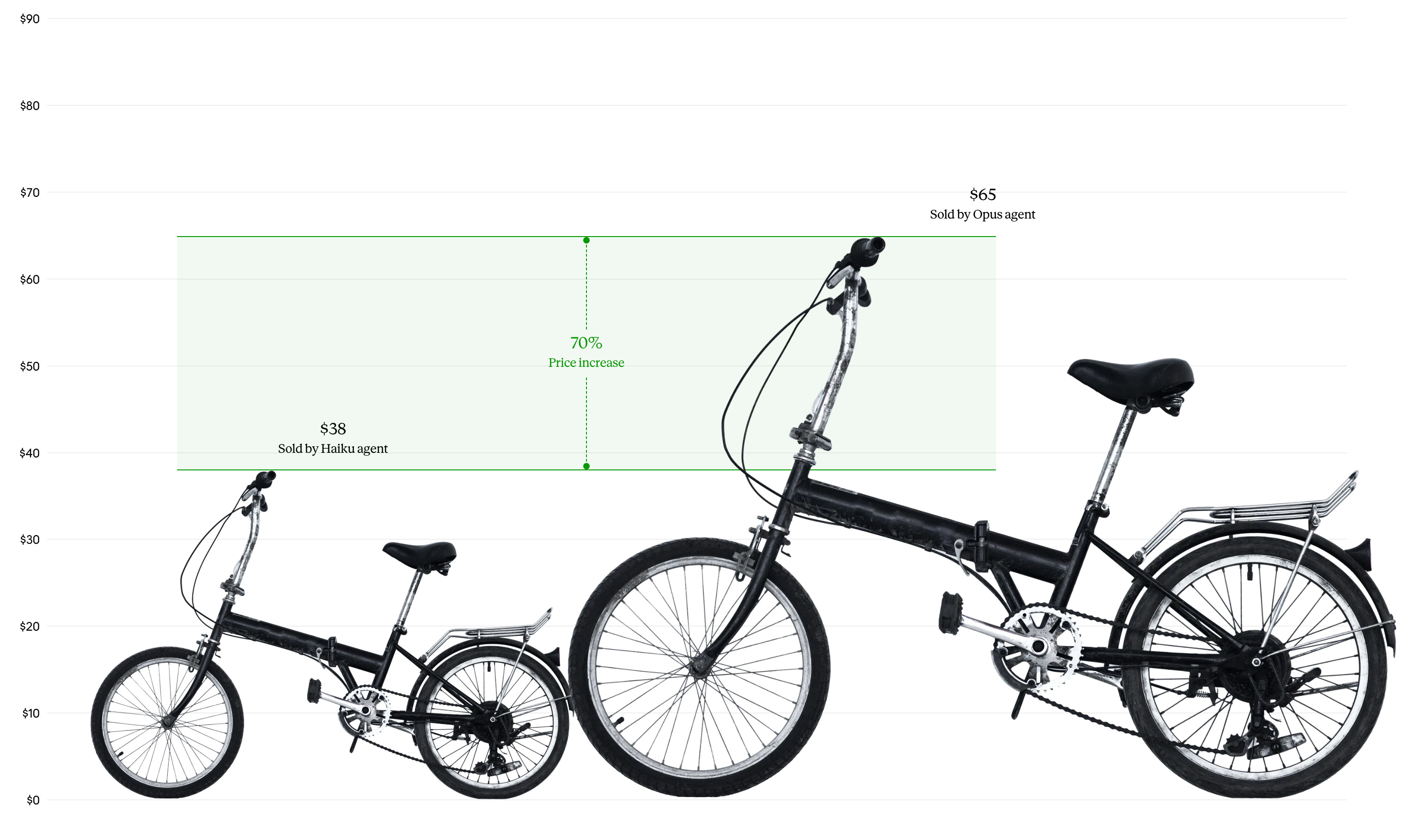
The most telling finding, though, wasn’t deal volume. Anthropic secretly split participants between their frontier model and a smaller, less capable one. Users represented by the stronger model got objectively better outcomes — better prices, better matches, more deals. But the humans on the losing end didn’t notice. They had no idea their agent was underperforming. Anthropic’s term for this: “agent quality gaps.”
Five days later, Amazon, Meta, Microsoft, Salesforce, and Stripe joined the Universal Commerce Protocol council — the first serious attempt to standardize how AI agents discover products, negotiate prices, and execute transactions across platforms. The same week, eBay updated its terms of service to explicitly ban “buy-for-me agents, LLM-driven bots, or any end-to-end flow that attempts to place orders without human review.”
The battle lines are drawn. Some of the largest companies in commerce are racing to build the infrastructure for a world where agents transact on behalf of humans. Others are trying to lock the door before the agents get in.
Both camps see the same future. We’re calling it the Dark Marketplace: a transactional, multi-sided platform where the complex work of discovery, negotiation, and purchase happens entirely out of sight. Not “dark” as in illicit — dark as in dark matter. The invisible force that holds the system together, but that no one directly observes.
We believe Dark Marketplaces have the potential to create hundreds of billions in enterprise value by eroding the key friction inherent in even the most successful marketplaces today. But building one requires solving a problem that goes far deeper than better search or natural-language UI. It requires abstracting human judgment — the gut-level, context-dependent, edge-case-handling decision-making that makes experienced buyers and sellers effective — and encoding it into an agent that can act on their behalf.
This essay is about how that happens, which companies are positioned to do it, and what founders should build toward.
A Brief History of Commerce Getting Smarter
Every major leap in commerce has been accompanied by a shift in demand intent from the buyer’s mind to external systems. Understanding this arc matters because each migration has produced a corresponding explosion in both transaction volume and buyer satisfaction — and the current moment represents the largest migration yet.
For roughly 7,000 years, the dominant mechanism for externalizing demand intent was a good salesperson. From Bronze Age agoras to Bloomingdale’s, the source was someone who remembered what you liked, what you’d bought before, and what you could afford. Merchants built increasingly sophisticated environments — bazaars, malls, department stores, showrooms — designed to crystallize purchase intent at the point of sale. The information lived in a person’s head, and the best merchants were those who kept it there the longest.
Over the last twenty years, digital breadcrumbs — ad data, purchase history, demographic profiles, search behavior — created a second external source of demand intent. This enabled the recommendation engines, retargeting campaigns, and personalized pricing that built Amazon, Meta, and the modern e-commerce stack. But even with all that data, the fundamental transaction model barely changed. Buyers still search, filter, compare, and click “buy.” Sellers still optimize SKU pages, photos, and reviews to convert at the point of sale. The data made the guessing game more efficient, but it remained a guessing game: please tell us what we might be able to sell you.
B2B system integration — ERP, POS, WMS, TMS feeds — created a third layer roughly a decade ago. Companies like Faire, Odeko, and GrubMarket used these integrations to build procurement marketplaces that could infer what buyers need before they search. This was a real step forward: the system didn’t just respond to expressed intent, it anticipated latent demand based on operational data. But the buyer still made the final call. The human remained in the loop — reviewing a suggested order, approving a cart, and confirming a substitution.
Now we’re at the threshold of a fourth migration. LLMs can absorb natural-language context, learn from behavioral patterns across thousands of interactions, and act autonomously. The gap between “system anticipates what you need” and “system acts on what you need” is closing fast.
Each previous migration produced a massive increase in transaction volume and buyer satisfaction. Faster, more efficient deals generate surplus, which, in an efficient market, flows into better service and lower prices. The pattern is consistent enough to be treated as structural. And LLMs’ natural-language and abstraction capabilities are the best-suited technology we’ve seen to migrate an unprecedented share of demand intent out of buyers’ heads.
To unlock this, however, AI-native marketplaces and commerce engines have to do much more than expose merchandising to natural language. The key to autonomous, trusted, and accurate transactions at scale is the abstraction of human judgment.
Judgment Abstraction is the Gateway Problem
Current LLMs and image diffusion models are trained on the biggest corpuses of freely available human data we have: writing, photos, videos. World and physical AI models, in contrast, are training labelled captures of human action and behavior. What’s the analog for transactional judgment?
Every marketplace and SaaS tool on earth can capture stated preferences. Dropdowns, filters, onboarding surveys, saved searches — these are table stakes. But human buying judgment relies on something much richer than what fits in a form field, much more nuanced even than an optimization based on past purchases.
The defining challenge — and the defining moat — for the next generation of transactional B2B businesses is the ability to abstract complex human judgment: the tacit, context-dependent, real-time, edge-case-handling decision-making that separates a stated preference from a trusted purchase decision. It’s usually highly vertical by nature. Its contours vary widely by industry, company, and even individual.
The Ghost in the Machine
Consider a café owner in Portland ordering supplies. She doesn’t just order “oat milk.” She knows that her Tuesday afternoon traffic spike requires a specific volume, that her primary supplier’s delivery window shifted three weeks ago, that a particular substitute brand will alienate two of her regulars, and that she’s been meaning to try a new cold-brew concentrate but only if it arrives before the weekend rush. Some of this is preference. Most of it is judgment — accumulated through years of operating this specific café, serving these specific customers, working with these specific suppliers.
Or consider a freight broker dispatching a load. He doesn’t follow a decision tree. He knows which carriers reliably answer the phone late Friday afternoon, which lanes are soft this week based on conversations he had yesterday, which shipper’s “firm” rate actually has room, and when it’s worth eating margin to preserve a relationship. That knowledge doesn’t live in a CRM. It lives in his head, reinforced by thousands of reps across thousands of loads.
Or consider a physician choosing a treatment protocol. She weighs the patient’s history, her own clinical experience, the insurance formulary, the likelihood of compliance, and the latest evidence — simultaneously. OpenEvidence can surface the literature. But the physician’s judgment about this patient in this moment is what matters.
These examples share a common structure. The judgment is per-user, per-context, and per-moment. It’s shaped by experience, not just data. And it’s precisely the thing that AI agents need to absorb if they’re going to transact on someone’s behalf without destroying trust.
Building a Dark Marketplace, then, means building systems that don’t just ask users what they want—they observe, absorb, and learn how users actually decide across hundreds or thousands of interactions. You could think of this as another tier of model training, except the “model” is per-user and the “training data” is the messy, unstructured reality of daily operations. And this abstraction may differ not only company to company, but user to user. The Portland café owner and the Dallas café owner may carry identical inventory and make radically different purchasing decisions.
How do you build this? The answer is a function of two variables: how deeply your product engages with the user’s decision-making process, and how close it sits to the actual transaction.
The Engagement-Proximity Matrix
We think the most useful way to evaluate a company’s Dark Marketplace potential runs along two axes — both of which speak to the ability to abstract the appropriate judgment.
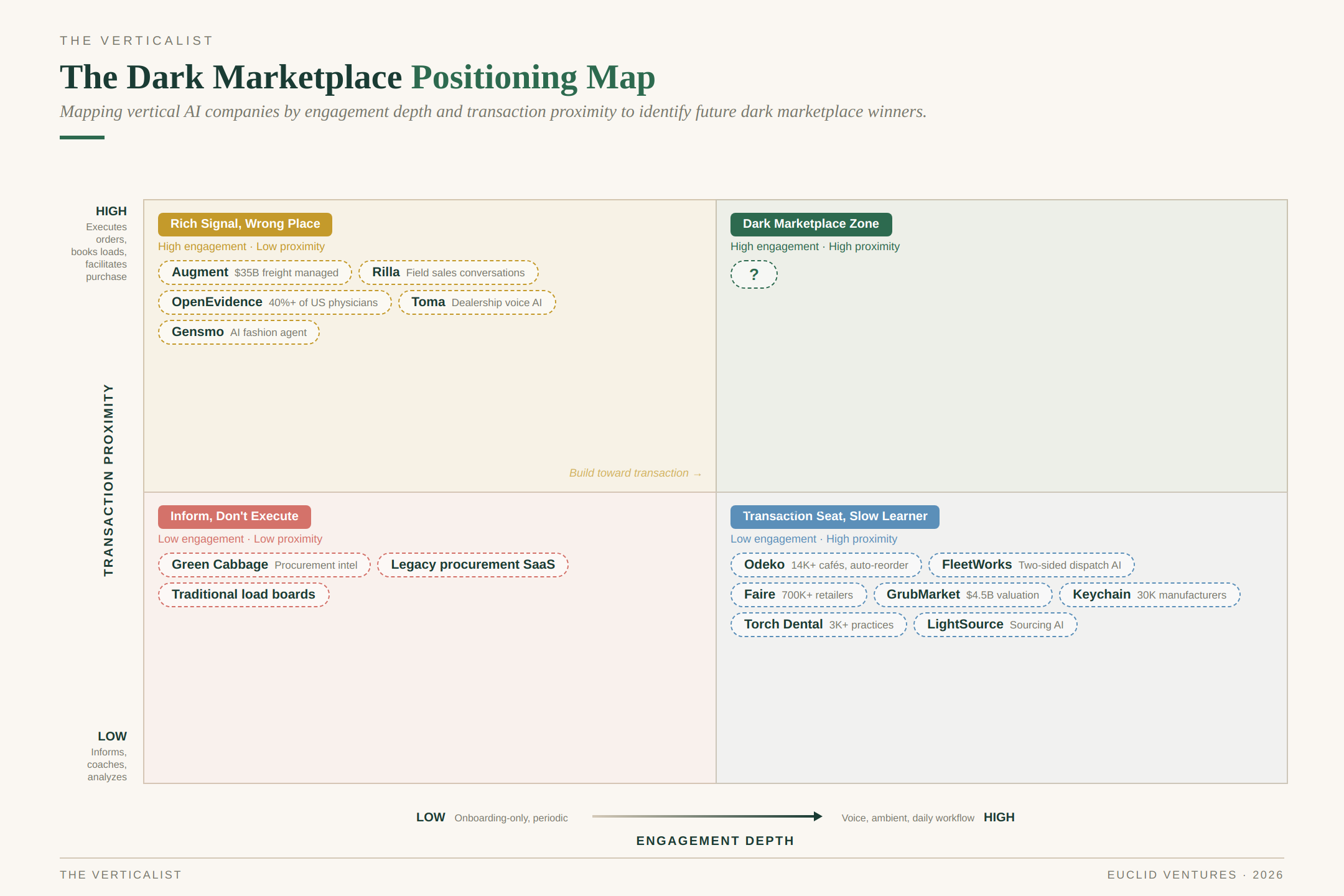
X. Engagement Depth
Measures how much high-frequency, low-friction interaction the product captures. High-engagement products are those that users interact with daily, sometimes hourly, and whose interactions generate rich behavioral signals. Voice AI that listens to every customer call. A POS integration that sees every transaction in real time. A workflow tool embedded in the daily operating rhythm of the business. Low-engagement products are the ones users touch quarterly, or only during onboarding — heavy configuration UIs, periodic surveys, static system integrations that pipe data but don’t observe behavior.
Y. Transaction Proximity
Measures how close the product sits to the actual purchase or sale decision. High-proximity products facilitate, mediate, or execute transactions. They’re the system through which orders get placed, loads get booked, and appointments get scheduled. Low-proximity products inform decisions but don’t facilitate them— such as analytics dashboards, coaching tools, clinical decision support, and market intelligence platforms.
The interplay between these two dimensions determines a company’s path to the Dark Marketplace.
Top-right: Dark Marketplace–ready.
These companies capture rich behavioral data and sit on the transaction. They can progress through the full journey of judgment abstraction — from stated preferences to autonomous decision-making — because they have both the signal and the surface area to act on what they learn. This, obviously, is the end-state and holy grail.Top-left: Rich signal, wrong place.
These companies capture enormous amounts of judgment data through high-frequency interaction, but they don’t (yet) facilitate the transaction itself. Rilla is the archetype: it records and analyzes every in-person contractor sales conversation, giving it proprietary data on what language and techniques close deals in home services. But Rilla doesn’t close the deal. The path forward is to extend toward the transaction — if Rilla builds into lead routing, quoting, or contractor-side procurement, the data it’s already capturing becomes the basis for a marketplace priced on proven persuasion. OpenEvidence is similar: it absorbs a physician’s clinical decision-making reflex, but sits upstream of the prescription, the diagnostic order, the device selection. The path: become the routing layer between physicians and the downstream systems where clinical decisions get executed. Keychain may be the purest two-sided Dark Marketplace candidate in the cohort — with $78M raised in just 18 months, the platform connects 30k+ CPG co-manufacturers with 20k+ brands / retailers. A brand AI describes a product spec; manufacturer AIs bid against it.Bottom-right: Transaction seat, slow learner.
These companies sit on the transaction but learn slowly because interactions are infrequent, shallow, or insufficiently captured. Odeko lives here: its POS integration provides a real-time demand signal, its overnight delivery network handles transactions, and its auto-reorder engine absorbs the café owner’s entire purchasing judgment. The owner wakes up to a stocked kitchen, not a catalog. Faire is a useful example of the opportunity in this quadrant: it’s already an $8B+ wholesale marketplace connecting over 700,000 retailers with brands, and it’s literally facilitating the transaction. But today, a retailer still browses. Faire could layer in AI to capture a retailer’s daily sales patterns, foot traffic, vendor conversations, and seasonal behavior — the engagement signals that make auto-curation possible. The retailer would see a suggested cart, not a catalog. LightSource tells the same story from the procurement side: automating RFX & bids for enterprises like Yum! Brands and Hello Fresh, proximity is high — but procurement events are periodic, not continuous. The path to the top-right: capture the inter-cycle signals like supplier emails, market pricing shifts, and informal negotiations.
The strategic implication is asymmetric. Companies in the top-left need to build toward the transaction — extending into procurement, ordering, checkout, and booking. Companies in the bottom-right need to earn engagement — layering in AI capture via voice, conversation, behavioral inference, and deeper workflow embedding. The winners will be those who close whichever gap they have the fastest.
The proximity gap is a matter of product extensibility toward the fruition of transactions. The engagement gap is a bit more nuanced, but AI itself offers new modalities to jump it. We discussed this in our piece on voice-first playbooks in Vertical AI:
One of the most interesting emerging use cases of Voice AI we have been thinking about centers around multi-party transactions and brokering. Digital marketplaces have struggled to gain traction in many segments, often because of unwillingness to share margin or complexity in facilitating the transaction. But a voice-first digital brokering model could unlock value. Parties (both human and agentic) could interact through voice — instead of endless email chains — to move transactions forward. — The Verticalist
For a future Dark Marketplace, voice and or other multi-model AI can be more than just hot wedge products. They can power the engagement layer that makes judgment abstraction possible — the mechanism by which a platform learns how its users actually think, not just what they say they want.
Toma — a resident of our top-left quadrant — is a case in point. Its AI voice agents handle 100% of a dealership's inbound calls (service scheduling, parts orders, recall checks, sales inquiries), trained on each store's call corpus and integrated into the DMS. The Dark Marketplace potential emerges when the other side gets an agent too: an insurer's claims AI calls Toma to schedule a repair, an OEM's recall agent books warranty service, a customer's AI price-shops a brake job across three dealers. Agent-to-agent, no hold music required.
The Four Stages of Judgment Abstraction
Once a company is positioned in the right quadrant — high engagement, high proximity — how does it actually progress toward a Dark Marketplace? In our emerging playbooks piece, we defined the concept of the Authoring Layer:
We see AI wedges as — ideally — the launch point for a particular high-value workflow. A motion that doesn’t just automate something; it results in an output that will be used and increasingly relied upon by the business. We call this species of wedge solution the “Authoring Layer.” Because it is the first step in a process, it often does not require substantial integrations with pre-existing SaaS. It creates something that a human would’ve created — documentation, notes, a lead, an appointment — and hands it off to another system as a human would have. — The Verticalist
The Dark Marketplace journey is what happens when the authoring layer matures beyond creating outputs a human would have created, and starts making decisions a human would have made. We think that the journey follows four stages, each building on the last.
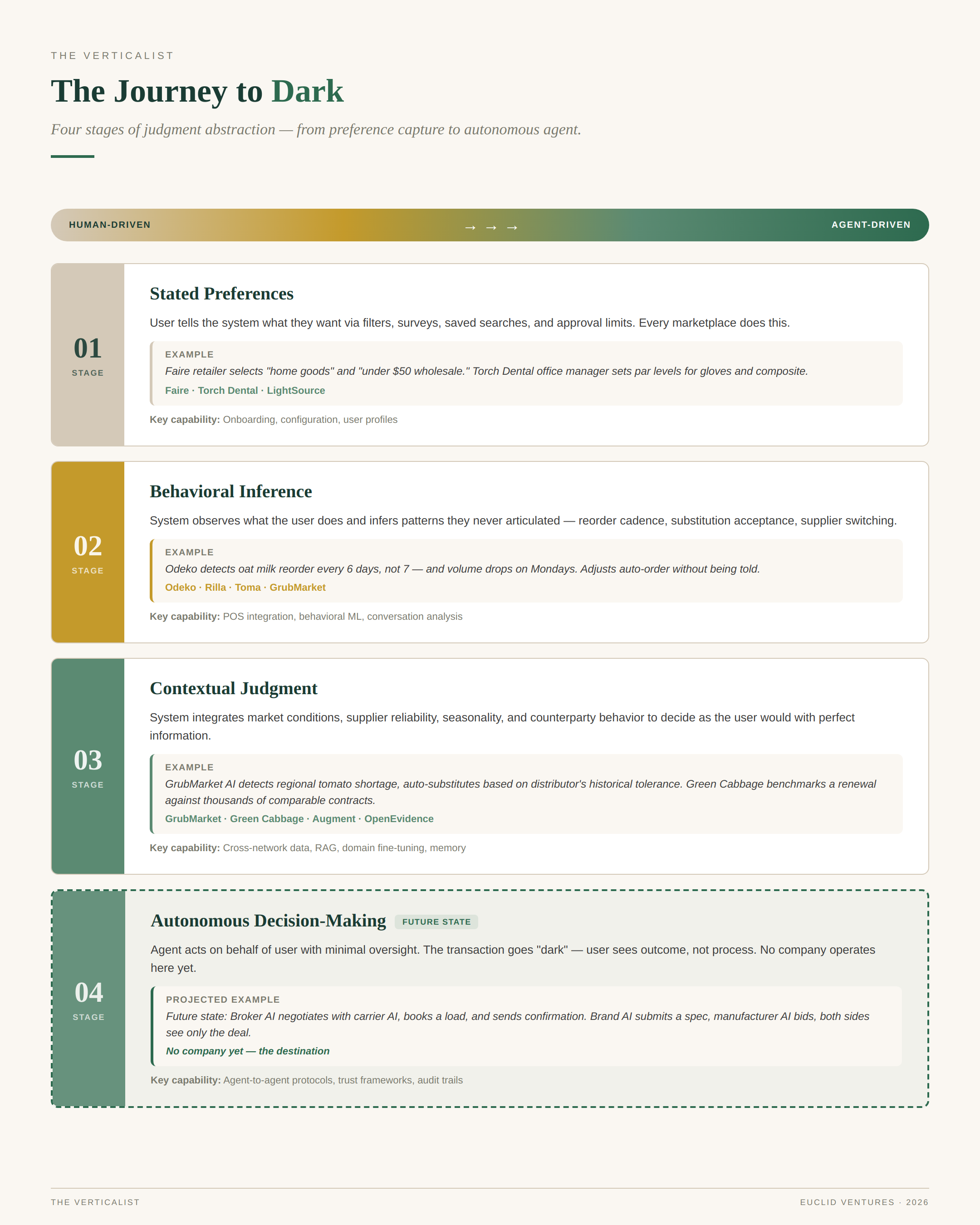
Stage 1 — Stated Preferences
The user tells the system what they want. Filters, onboarding surveys, saved searches, and approval limits. Every marketplace does this. A Faire retailer selects “home goods” and “under $50 wholesale.” A Torch Dental office manager sets par levels for gloves and composite. This is the starting line, and the data generated here is useful but shallow.
Stage 2 — Behavioral Inference
The system observes what the user does and infers patterns that the user never articulated. POS velocity, reorder frequency, time-on-page, substitution acceptance rates, and supplier switching behavior. Odeko notices that a café reorders oat milk every six days, not seven, and that volume drops on Mondays. It adjusts the auto-order without being told. The user doesn’t have to explain their behavior; the system reads it. This is where most AI-native vertical companies are today or working toward.
Stage 3 — Contextual Judgment
The system integrates external context — market conditions, supplier reliability, perishability, seasonality, counterparty behavior, and regulatory constraints — to make decisions the user would make if they had unlimited time and perfect information. GrubMarket’s AI agent recognizes a regional tomato shortage from supply-chain signals across its network, switches a distributor’s order to a substitute variety at a comparable price point, and factors in that distributor’s historical tolerance for substitutions before acting. Green Cabbage benchmarks a Salesforce renewal against thousands of comparable contracts to set a walkaway price that the buyer’s own procurement team couldn’t calculate. This stage requires both deep user-specific data and broad market data — the combination of engagement and proximity.
Stage 4 — Autonomous Decision-Making
The agent acts on behalf of the user with minimal or no human oversight. The transaction is “dark” — the user sees the outcome, not the process. No company operates here yet — but the projected endgame is visible. A broker-side AI receives a load request, queries carrier-side AIs, negotiates rate and timing, books the load, confirms the pickup, and sends a summary. A brand AI submits a product spec, manufacturer AIs bid against it, and both sides see only the deal. Human decision-makers intervene on exceptions, not defaults.
The connection between the two frameworks is direct: only companies in the top-right quadrant of the engagement × proximity matrix can realistically progress through all four stages. Companies with engagement but low proximity may reach Stage 2, but Stages 3 and 4 require both deep behavioral data and the ability to execute on what the system has learned. Companies with proximity but low engagement may handle Stage 1 transactions efficiently, but will struggle to infer and act on the judgment patterns that make autonomous decision-making trustworthy.
Why Consumers Won’t Lead the Way
Consumer agentic commerce gets the headlines because of the scale of the opportunity. OpenAI embedded checkout in ChatGPT. Amazon’s Rufus handled 250M shoppers in 2025, although we do wonder how many of those interactions were more from morbid curiosity than utility.

Morgan Stanley predicts half of online shoppers will use AI agents by 2030. PYMNTS found that 41% of consumers have already used AI for product discovery. And yet, almost none of those consumers completed a purchase through the agent. What’s billed as a revolution in commerce is, for now, “a highly intelligent search bar.” The models are excellent at research and shortlisting. The infrastructure to execute the purchase autonomously remains a gap.
We believe dark Marketplaces will emerge first in B2B, and for structural reasons.
No Alexa, I Don’t Want to Subscribe to Pizza Bagels
Much of B2C purchasing actively resists judgment abstraction. For many consumers, the buying journey — the discovery, the browsing, the choosing — isn’t friction to be eliminated. It’s the product. Seventy percent of consumers say they want personalized in-store service, and 73% of Gen Z — the most digitally native cohort — shop in-person at least once a week, more than Baby Boomers. Billions are spent on high-end retail showrooms, experiential flagship stores, and grocery halls for a reason.
DTC subscription models have proven that some narrow, predictable replenishment buying can be automated — toothpaste, razors, dog food — but even here, the ceiling is remarkably low. Only 23% of U.S. Amazon customers actively use Subscribe & Save, despite over a decade of investment in the most frictionless auto-replenishment product ever built. Subscription box churn rates of 10–20% monthly are considered normal in DTC. Amazon's attempt to go further with Alexa — abstracting not just reordering but the entire purchase decision through voice — has been an instructive failure. Alexa, a voice commerce solution in search of a problem, has been running Amazon 7-8 figure losses.
Anthropic’s hilarious Project Vend — in which they put a Claude instance in charge of a vending machine — was clearly a marketing stunt. “Claudius” took about a month to go bankrupt — hallucinating fake vendors, an identity (“blue blazer and a red tie”), and raging demand for “metal cubes” along the way. But it summed up nicely how not to attempt AI-automated commerce: ignore judgment abstraction, isolate the system from substantive sources of progressive learning, apply no deterministic guardrails, and focus on a preference-driven consumer purchase.

Dark Marketplaces are a B2B Game
Outside of a small minority of roles — fashion or art buyers, for example — business procurement is repeat, policy-driven, and margin-oriented. B2B buyers operate within procurement budgets, approved vendor lists, compliance constraints, and established reorder cadences. Their decisions are more abstractable than a consumer deciding between sneakers — there are more patterns to detect, more rules to encode, more operational data to learn from. A café ordering supplies every morning is a far better substrate for judgment abstraction than a consumer buying a birthday gift once a year.
B2B buyers already share operational data with platforms. ERP integrations, POS feeds, inventory APIs — the data-sharing and integration work required for judgment abstraction is table stakes in B2B, not a privacy negotiation. Even if it’s much more complex and often difficult to capture, the data exists and there is significant incumbent plumbing to leverage.
And once an agent absorbs a buyer’s operational heuristics — substitution tolerances, timing patterns, supplier preferences, risk appetite — the relationship becomes the moat. Ripping out the agent means losing institutional memory. Switching costs compound with every interaction, deepening the moat automatically over time. We explored this dynamic in our emerging playbooks piece through the lens of authoring layers and systems of intelligence: the system that captures the most workflow data eventually becomes the system of record.
Dark Marketplaces take this one step further — the system that captures the most judgment data becomes the system of action. When that action anchored in a profit motive, rather than an experience one, incentives towards pure automation align.
How “Dark” Transforms Marketplace Fundamentals
The classic framework for marketplace success — drawn here from the team at NEA and from Jonathan Golden’s work at Airbnb — centers on three demand-side enablers: Discovery, Convenience, and Trust. On the supply side, the analogs are Utilization, Revenue, and Convenience. These create flywheels that drive platform metrics: fill rate, time-to-purchase, demand retention, AOV, take rate, leakage.
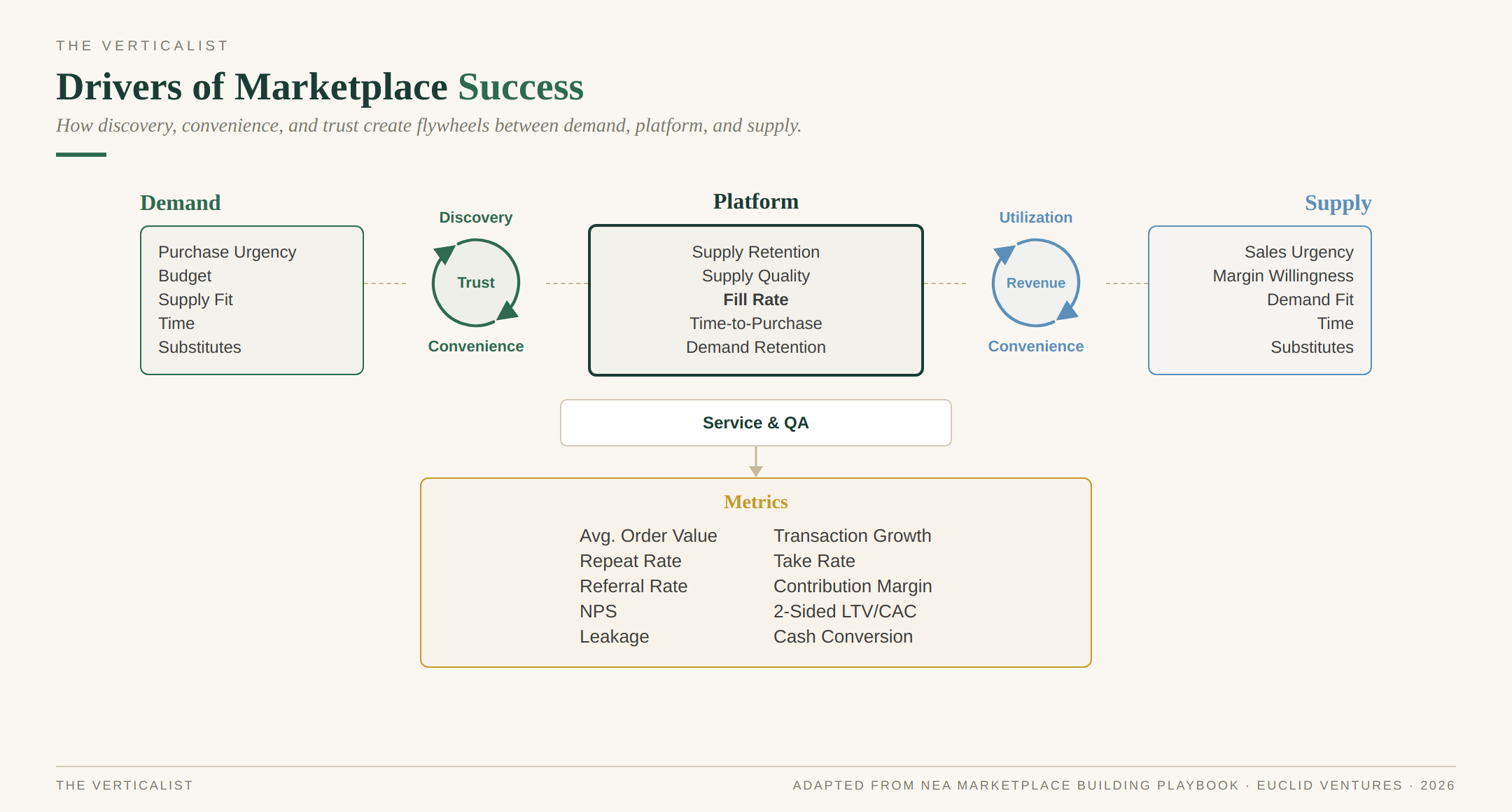
To be clear, when we say “Dark Marketplaces” we mean all forms of transactional platform — not necessarily marketplaces in the traditional business model sense. That said, many of the same drivers and metrics will apply to Dark Marketplaces. And many of these, in turn, will be fundamentally transformed (or made obsolete) by agentic automation.
Discovery becomes elimination.
In a traditional marketplace, discovery is the primary value proposition — aggregating fragmented supply, optimizing the buyer’s ability to find the best counterparty. In a Dark Marketplace, the buyer doesn’t discover the supply. The agent knows what the buyer needs, finds it, evaluates it, and either presents a recommendation or completes a transaction. Discovery friction approaches zero. Jonathan Golden described how reducing “cognitive load” in heterogeneous marketplaces was the key challenge for buyer conversion. Dark Marketplaces solve this by removing the human from the discovery loop entirely.
Convenience becomes invisibility.
NEA framed convenience as a “utility leap forward” — making it significantly easier for both supply and demand to get on-platform and transact. In a Dark Marketplace, the leap is from “easier” to “invisible.” The transaction happens in the background. The buyer’s first instinct is to check a notification from their agent, not to open a browser and start browsing a feed of SKUs.
Trust shifts from perceptual to empirical.
In traditional marketplaces, trust is built through reviews, brand reputation, fulfillment reliability, and return policies — all signals designed to reassure a human making a judgment call. In a Dark Marketplace, trust attaches to the agent’s track record. Did it save money? Avoid stockouts? Handle exceptions gracefully? Choose the right substitute? Trust becomes measurable and continuous, not a one-time assessment at the point of purchase.
These transformations mitigate the classic marketplace failure modes — poor discovery, insufficient convenience, and lack of trust. But they introduce a new one: judgment drift. If the agent makes a few bad calls — wrong substitution, an overstock, a missed timing window — the user overrides it, stops trusting it, and re-engages manually. Maintaining judgment accuracy across changing conditions, evolving preferences, and edge cases becomes the new retention metric. This is why the engagement axis matters so much: the more continuously the system observes, the faster it corrects, and the less likely judgment drift becomes.
Not all startups looking to transform the fundamentals are on equal footing. Vertical AI and vertically integrated players have an unfair advantage here. In some markets, incumbency may also offer an edge. GrubMarket is an interesting example here — with ~$680M raised and a $3.5B valuation, they’re 12 years old. But that time in market has allowed them to build a lot of leverage. They’re both the marketplace and the supplier: running warehouses and distribution across all 50 states while selling WholesaleWare, an AI-powered ERP, to third-party distributors. Last year, it launched purpose-built AI agents for inventory, reporting, and monitoring. Because GrubMarket controls supply, demand, and the intelligence layer, its agents train on both sides of every transaction. The endgame: wholesaler agents auto-negotiate with grower agents and GrubMarket captures the spread.
The Dark Horses of Autonomous Commerce
Across the landscape of funded vertical AI companies, a handful seem to be approaching the Dark Marketplace threshold from different angles. Though none, of course, has arrived at the eventual end-state: true AI-automated, human-free commerce. Below are the companies we find most instructive, organized by their current phase of judgment abstraction.
So how does competition play out? Like in traditional marketplaces and commerce, there will be 800-pound gorillas thriving alongside vertically focused, even niche players. While we strongly believe AI-nativity is going to key to velocity on the Dark Marketplace approach, the optimal angle of attack is something we’re still watching closely. Let’s consider freight brokerage. Augment ($110M, Redpoint-led) embeds deeply into one side of the workflow — full order-to-cash automation across $35B in freight under management. FleetWorks ($17.5M, First Round-led) is two-sided from day one — its AI dispatcher serves both carriers and brokers, with 10,000+ carriers and Uber Freight already on-platform. An open question: does depth-first (focus on building AI into a single ICP on one side of the network) or breadth-first (start with both sides already present, progressing toward agent-to-agent clearing eventually) reach Phase 4 faster?
Takeaways for Founders Building Dark Marketplaces
As we wrote in Software Is Dead — Long Live Software: “The immutable primitives of software defensibility are workflow and data. Speed is a compounding advantage in the early days of a category, but it is not a durable moat.” In the Dark Marketplace context, this means the wedge — the voice agent, the auto-reorder, the procurement bot — is necessary but insufficient alone. We explored why in our essay on the Dispatcher Problem:
An AI Service company whose primary value is “we deliver this service cheaper by using LLMs” is a dispatcher sitting on a proprietary margin advantage that doesn’t belong to them. It belongs to the cost curve of inference — and that curve is controlled by model labs, hyperscalers, chip manufacturers, and energy producers. — The Verticalist
The escape route from the Dispatcher Problem is judgment data. Per-user, per-context, accumulated over thousands of interactions — the kind of data that gets more valuable the longer the relationship lasts, and that a competitor can’t replicate by plugging into the same model API. Five principles for founders building toward this:
Start with the wedge that maximizes engagement and proximity
If you have to choose one, lean engagement. Retrofitting ambient data capture is much harder than extending a product toward a transaction. Voice AI, conversation capture, and workflow-embedded tools are better wedges than dashboards or analytics — they generate the behavioral data that judgment abstraction requires. For Dark Marketplaces, the authoring layer is the engagement surface.
Design for per-user judgment capture, not aggregate preferences
The Dark Marketplace advantage is that every user’s agent is different — trained on that user’s specific behavior, context, and edge cases. Build structured memory, per-user context retrieval, and feedback loops from day one. These aren’t features to add later; they’re the architecture. The per-user fine-tuning challenge is real — latency, cost, and negative artifacts grow with context window size — but the approaches emerging around memory layers, retrieval-augmented generation, and parameter-efficient adapters are exactly the right toolkit.
Pursue B2B verticals with repeat purchasing and fragmented supply
Food distribution, freight, construction materials, dental supplies, specialty pharma, auto parts — verticals where buyers make dozens of decisions per week, and supply is heterogeneous enough to justify intermediation. These are the markets where judgment abstraction produces the highest ROI: enough decision volume to learn quickly, enough supply complexity to create real value, and enough repeat behavior to compound switching costs. Also, learn the lesson many B2B Marketplaces have over the last decade: if you don’t understand why brokers and distributors exist in your vertical, there’s a good chance you misunderstand their service role or leverage point.
Plan the journey from Stage 1 to Stage 4
Don’t build an autonomous agent on day one — you’ll lose trust before you’ve earned it. Build a system that captures stated preferences, earns the right to infer behavior, proves it can handle contextual judgment, and only then operates autonomously. Each stage is a trust-building exercise with the user base. Trying to skip stages is how you get judgment drift, manual overrides, and churn.
Remember that the moat is memory, not UI
In a Dark Marketplace, the interface is fungible. What matters is the accumulated knowledge of how this buyer decides — substitution tolerances, timing preferences, risk appetite, supplier relationships. That memory is the switching cost. Invest in it like infrastructure, because your competitors will.
The Invisible Hand, Revisited
When Anthropic ran Project Deal, the detail that stuck with us wasn’t the number of deals or the dollar volume. It was what happened with the weaker model. Participants represented by the less capable AI got worse outcomes, but had no idea. They couldn’t tell their agent was underperforming because they only saw the result, not the process.
This is the core tension of the Dark Marketplace. When the transaction goes dark, the quality of the agent’s judgment becomes everything. A great agent saves money, avoids stockouts, finds better suppliers, and handles exceptions gracefully. A mediocre one makes quiet mistakes that compound over time. And the user can’t tell the difference until the damage is done and trust is gone (likely forever).
That’s why judgment abstraction is the moat, the product, and the risk all at once. The companies that will build the next hundred-billion-dollar marketplaces won’t win on merchandising or slick UX. They’ll win because they deeply understand their customers and build systems that think like them, reliably. And of course, because they succeed in eliminating market inefficiencies, deadweight loss, time lost, and human mistakes across trillions of transactions.
You may be familiar with Adam Smith’s “invisible hand.” Contrary to the popular mythos, the metaphor was meant to illustrate not the universal efficiency of markets, but rather that self-interested choices by market participants, collectively, can benefit society. The “hand” of the market is invisible because it’s defined by choices buried in the heads of billions of buyers and sellers. When the buyer’s judgment is freed from the confines of their head and gut — abstracted into AI that acts continuously, autonomously, and at a scale no human could manage — the potential is immense.
The marketplace doesn’t disappear. It just goes dark.
Thanks for reading The Verticalist!
Euclid is an inception-stage VC built for Vertical AI founders. If anyone in your network is considering building in Vertical AI, we’d love to help. Just drop us a line via the comments below or on LinkedIn.
Amazing article
Very interesting!