

a16z’s investor relations team published an essay a few weeks ago arguing that institutional LPs are underexposed to venture—especially to the “best managers,” who can access the best companies and outlier outcomes. Unsurprisingly, the remedy is to increase allocations to the “best” (i.e., brand-name) funds. The piece’s premises are mostly right, but almost every step from those premises to its conclusion is weakly supported.
A chart from the essay did much of the work, going semi-viral on LinkedIn and Twitter and generating some… interesting discourse. Its claim: venture isn’t really an asset class at all, just a handful of managers who capture nearly all the returns. It’s a convenient argument. Unfortunately, the data in the chart doesn’t actually support it.
One disclosure first: arguing the countercase serves our interests as an emerging manager, regardless of what we think of a16z’s argument. We trust you to judge both arguments on their merits.
The Case for More Venture
a16z’s argument, compressed: value creation has moved to the private markets and returns are concentrated in a few managers. So the question isn’t whether to allocate more — it’s who you’re allocating it to. Guess who.
We would certainly not dispute the broader case for more venture exposure. Companies can now build enormous businesses before going public, leaving much of their growth outside the reach of investors buying publicly traded shares. SpaceX, Stripe, Anthropic, and OpenAI illustrate the scale of that shift. It is reasonable for LPs to revisit allocation frameworks built for a much smaller venture industry.
Buyout is under pressure, particularly in software. If AI weakens margins or retention, it also threatens the terminal value of assets bought on the assumption that recurring revenue was unusually durable. Robert Smith’s line that “software contracts are better than first-lien debt” is harder to take for granted.
a16z argues that venture is better suited to this uncertainty: it can back the companies driving the disruption, and a handful of winners can offset losses across the rest of the portfolio. The essay also argues that an LP can have a large legacy venture portfolio yet little exposure to the companies driving the current wave of growth.
None of this will surprise institutional allocators, and we agree with many of the lead-in premises. The argument depends on the next step: getting from “technology ate the economy” and “you are underweight to the ‘best’ managers” to “that’s why you should give the megafunds more money.”
Of course, not every established firm or GP agree with a16z. Menlo's Venky Ganesan shares a particularly impactful rebuttal. More on this later.
What the Chart Actually Measures
The essay’s structural argument rests on an analysis from Jackson and Strebulaev’s July 2026 NBER paper, “Human Capital in Venture Capital: Evidence From 100,000 Venture Capitalists.”
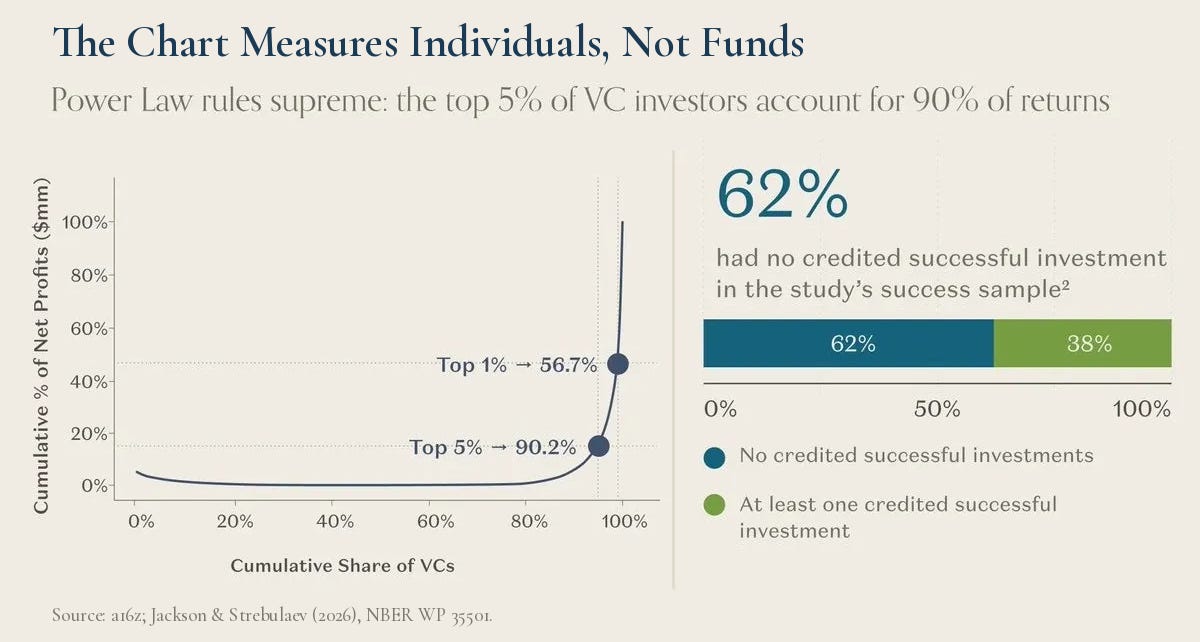
The headline finding is striking: 5% of venture capitalists account for 90% of investment profits. a16z’s chart turns this into “Venture Is Not an Asset Class, It Is a Handful of Managers.” We borrowed the construction and changed one word, for reasons that should be clear in a minute.
So what does the study actually measure, and how does it support the case the essay makes?
The Study Measures People, Not Funds
The result behind a16z’s chart ranks individual investors by cumulative investment profits, then treats that concentration as a finding about funds. The paper examines fund-level returns elsewhere, but that is not what this chart shows:
We study human capital in venture capital (VC) using a new dataset covering over 100,000 professionals affiliated with U.S. VC firms. Investment success is extremely concentrated: fewer than 40% of VCs with any investments are ever credited with a successful investment, and 90% of investment profits are generated by 5% of VCs.
a16z turns that finding into a claim about funds: “in continuing the theme of power law, it’s not just a smaller number of companies generating the returns. It’s a smaller number of funds with exposure to those companies.”
That conclusion requires a separate analysis. Concentrated profits among individual investors do not establish how those profits are distributed across funds or what returns those funds deliver to LPs.
When a few companies generate most of the gains, the investors in those companies will account for most of the profit dollars. The concentration figure alone cannot tell us how much is due to skill, access, luck, or time in the market. The authors examine skill and access elsewhere, but this chart cannot bear the fund-level conclusion a16z puts on it.
Dan Gray made a similar argument in a recent post, describing the “only a handful of startups matter” and “the power law keeps getting stronger” as a statistical mirage:
These statements are all economically illiterate, but there’s just enough of a statistical mirage to pass with VCs and create FOMO among LPs if delivered with confidence. Tragically, because of the high levels of institutional insecurity, even if a majority of other VCs suspect this is an unsustainable strategy, they’ll choose to participate anyway because of (the unfortunately named) principal–agent conflict.
The cumulative methodology adds another limitation. The paper tracks 12,151 VCs across 143,096 investments from 1996 to 2025. By aggregating across that entire period, the ranking gives investors with longer careers more years and investments over which to accumulate profits. It does not isolate investment skill from time in the market.
Profit Dollars Are Not Returns
The chart’s subtitle says the top 5% of VC investors account for 90% of returns. The paper says they account for 90% of net profits.
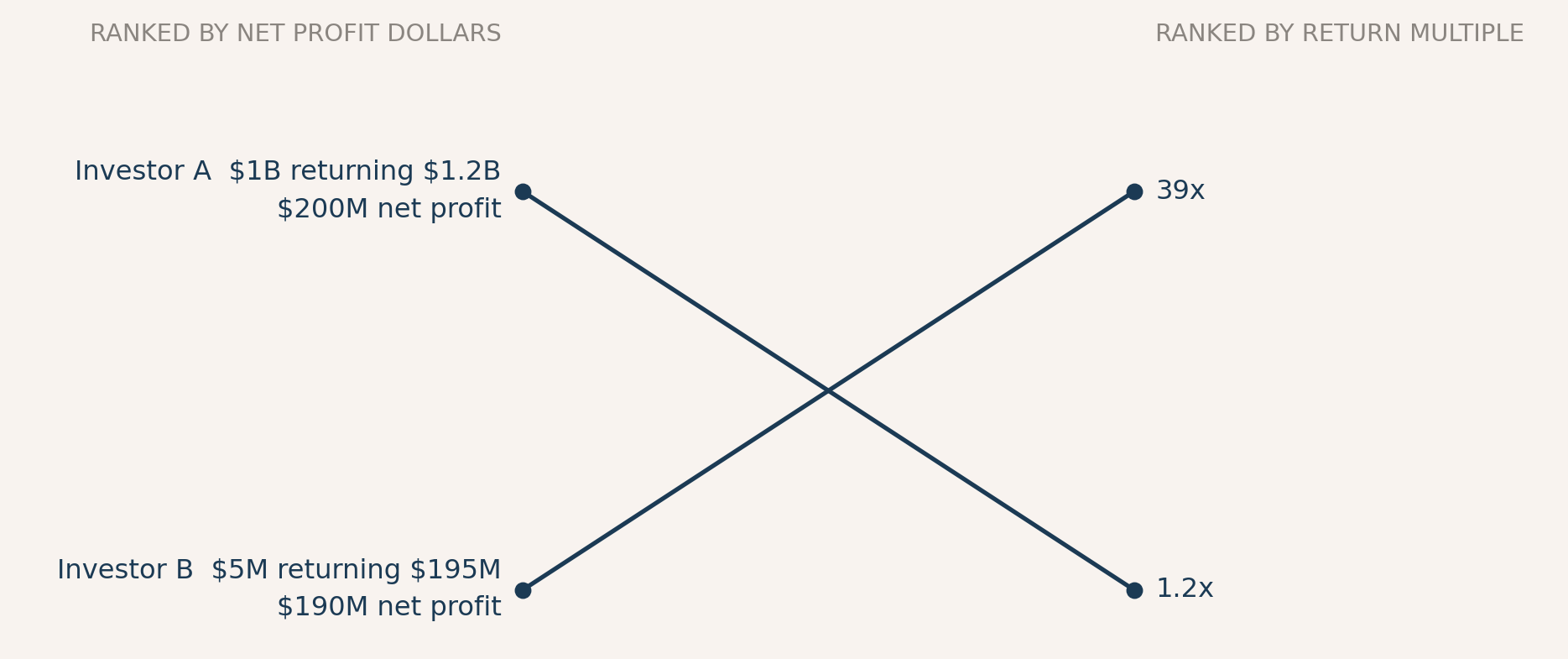
Net profit is the estimated value of an investor’s diluted stake in 2024 dollars, less the capital invested. The chart does not measure TVPI or IRR. It rewards absolute dollars generated without adjusting for invested capital or time. By this measure, $1B returning $1.2B ranks above $5M returning $195M: $200M in profit versus $190M, despite multiples of 1.2x and 39x.
Michael Jordan scoring 40 points tells you he had a great game. You still have to check the final score before declaring the Bulls the winner. Likewise, the paper’s 5% figure tells us which individual VCs were credited with the most cumulative profit dollars. It doesn’t tell us which funds delivered the best net returns to LPs.
For example, would anyone argue that later-stage Uber investors outperformed the first-round investors because they generated more dollars at a fraction of the multiple?
None of this is a flaw in the paper. The authors are measuring aggregate economic value, and they say so. The flaw is in the conclusion drawn from that measure, which the paper neither justifies nor implies.
The Missing Link to Fund Returns
The paper also tests whether funds with “successful” investors deliver better net returns. It finds little statistically significant evidence that they do.
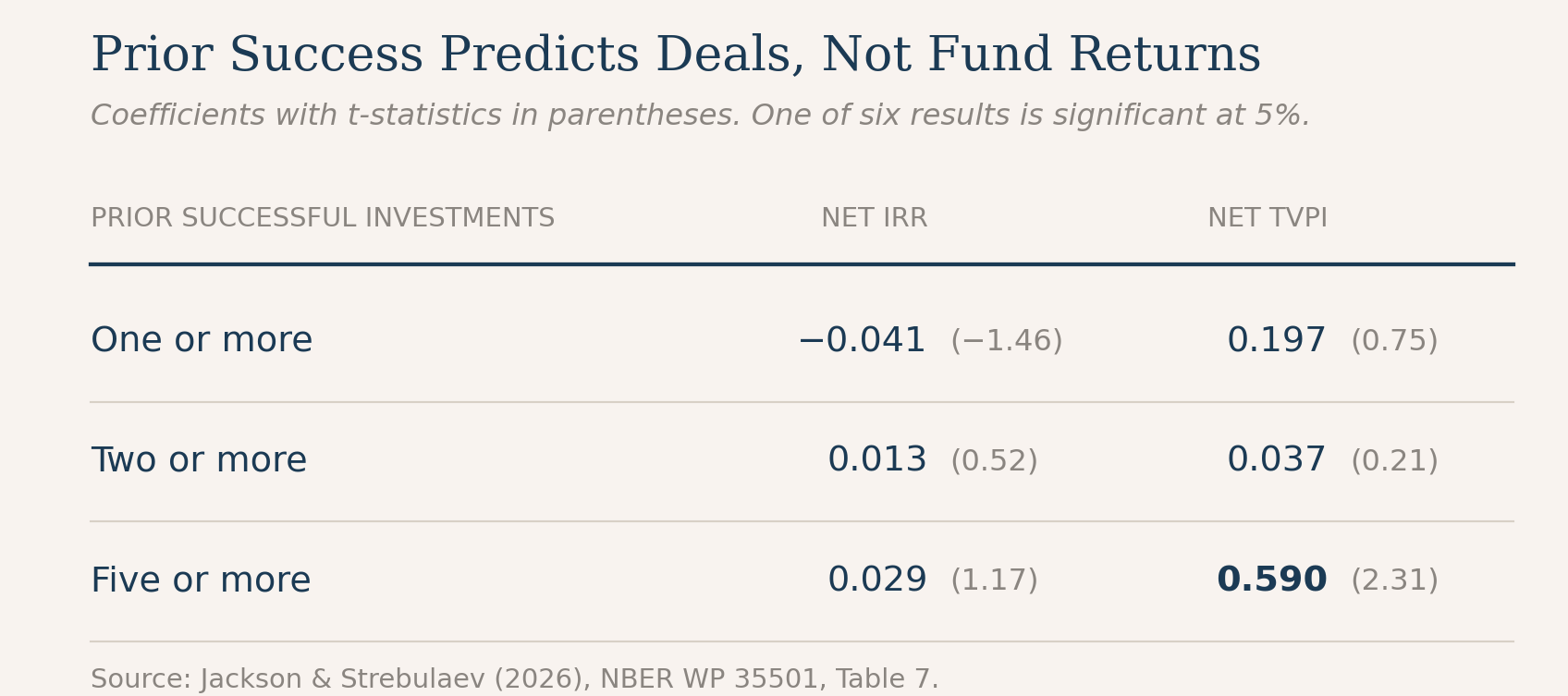
Across six tests—three thresholds of prior success measured against net IRR and net TVPI—only one result is statistically significant. None of the IRR results is significant. The lone significant TVPI result appears at the five-or-more-successes threshold; by itself, that does not establish a practical manager-selection rule. Tests limited to smaller teams show a similar pattern.
“Successful” means having invested in companies that went public, reached a unicorn valuation, or were acquired for at least five times their total capital raised. The narrower finding is that prior individual success generally did not significantly predict better net LP returns in this sample.
The authors suggest that fees and carry may absorb the gains, or that the available data may lack the power to detect a relationship. Our conjecture is that large fund sizes dilute any individual investor’s effect on fund-level returns. Either way, the study cited as evidence tested “success” against LP returns and mostly found no relationship.
Brand Is Not a Selection Criterion
Later in the essay, a16z cites Accolade and PitchBook: of roughly 3,000 US venture firms, 20 have consistently delivered a 3x net return over two decades. Among 2,143 global funds from 2000–2018 vintages with reported DPI, 17% returned 2x, 6.7% reached 3x, and 2.4% reached 5x.
The essay presents these figures as support for increasing allocations to megafunds: “It’s worth saying out loud that only the best funds have the access, the power, or the muscle to repeatedly find, nurture, and exit a behemoth.”
The logic runs as follows: venture is a power-law business; only the best funds can repeatedly capture power-law outcomes and deliver consistent returns; therefore, LPs should concentrate capital in the megafunds with access to those deals. From the essay:
The fat-tail of outcomes is happening within a small group of companies held by a small group of funds. Top-quartile 5-year IRR is now double the median for the most recent vintage. Even more recently, the top decile funds by IRR have never been farther away from the top quartile:
Recent-vintage IRR is weak evidence of durable manager dispersion. These funds are still being deployed and marked; interim valuations, deployment pace, and stage mix can move the rankings substantially before positions resolve. The youngest vintages have not had five years to mature.
The period also includes the 2020–2022 fundraising surge, when capital reached firms that might have struggled to raise in a more normal market. A wider spread among recent funds could reflect that cycle as much as a durable increase in manager skill. The charts do not distinguish the two.
That is the narrower objection. The historical record also complicates the idea of a fixed circle of firms controlling venture’s biggest winners.
Concentration does two jobs in this argument. First, a few companies generate most of the gains, making access to them essential. That premise then becomes a reason to concentrate LP capital in established firms. What is missing is evidence that those firms will continue finding the winners and convert that access into attractive net returns at today’s entry prices and fund sizes. The essay asserts that link rather than demonstrating it.
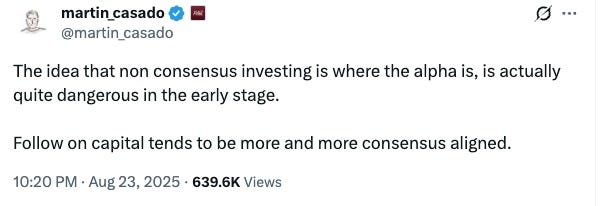
The price question is central here. In an August 2025 interview, a16z’s Martin Casado recently argued that startups that eventually succeed tend to have raised at higher prices in their early rounds than startups that fail. He also called the idea that non-consensus investing produces alpha “actually quite dangerous in the early stage.”
That is a claim about early prices predicting later success, not about prices rising once success is apparent. Even if it holds, an investor can pick a winner and still earn a poor return by overpaying.
The claim also assumes that early prices are a reliable signal of value. Price discovery depends on investors making independent judgments. When large funds price rounds using the same signals, a high valuation may tell you more about consensus than about the return still available.
Menlo’s Venky Ganesan made the counterpoint this month: investors can be right about a company and still be “wrong about the price by a factor of ten.”
As we’ve written before:
The aspiration of the efficient market is that many players with diverse views, resources, and means compete to drive discovery of a price aligned with intrinsic value. That “crowd-sourced” benefit falls away when there are too few buyers, or buyers who fail to decision independently. Tulip bulbs in 1635 Amsterdam didn’t turn out to have much more value than a common flower, but with hordes of unthinking investors chasing the same commodity, prices skyrocketed.
A market where a handful of large funds price off the same signals is the opposite of that crowd. It’s an inefficient planned economy. If everyone buys the consensus names, no one is differentiated, and price stops telling you much about value.
The second claim is harder to square with how returns work. Alpha is what you earn from being right when the market isn’t, and a consensus position is one the market has already priced.
We’ve Heard This Argument Before
We addressed a similar argument from Lux Capital’s Josh Wolfe in The Mind-Virus of Big Venture in 2024:
We expect LPs to adjust their allocations accordingly, leading to widespread contraction in the number of venture firms and consolidation of LP dollars into fewer, name-brand managers... VC is and will remain a rarified ecosystem where only a select cadre of firms consistently access the most promising opportunities.
Two years later, venture fundraising is more concentrated. That can be rational for an individual allocator: familiar names make a difficult selection decision feel safer. But those flows show where LPs put their money, not which managers will outperform.
Older fund-size studies complicate the claim that scale reliably produces stronger net returns. Cambridge Associates found that funds under $150M outperformed larger funds in 19 of 30 vintages from 1981 to 2010. In a review of roughly 100 funds in its own portfolio, the Kauffman Foundation found that none above $500M returned more than 2x net. These are historical cohorts, but the arithmetic still matters: the same exit moves a small fund’s multiple far more, so a larger fund needs bigger exits, more ownership, or more winners to match it.
Menlo’s Venky Ganesan sees the same pattern forming in the current cycle. The firms that missed the early rounds and are now catching up by writing very large checks very late are, in his view, the most likely to turn a miss into an actual loss. The winners of the next decade, he argues, will be the firms that treat position sizing as seriously as sourcing — a very different prescription from concentrating capital with whoever can write the biggest checks.
Today’s opportunity set may be large enough to support a few funds of that scale. It isn’t large enough to support an entire industry reorganizing around them.
Underwriting the Next Generation
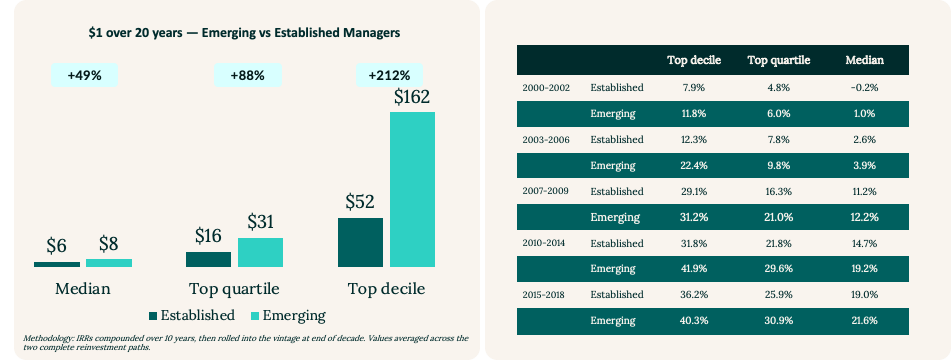
We think LPs have good reason to take emerging managers seriously. A 2024 PitchBook study found that emerging VC managers delivered higher median IRRs than established managers in every vintage cohort from 1997 onward, though with greater volatility. Cambridge Associates also found new and developing managers consistently represented among the ten best-performing US venture funds in each vintage from 2004–2016, ranked by net TVPI as of June 2019.
The challenge is identifying the next generation’s winners as they emerge. That means underwriting the people, their strategy, fund size, and portfolio model. A familiar name doesn’t answer any of those questions.
So why single out this essay? Because this argument is winning. Its recommended destination for LP capital also happens to be the firm making it. Choosing the biggest names makes a hard selection problem seem simpler. But the evidence they cite doesn’t support the case they’re making.
The case for concentrating capital in the largest firms would turn venture into an asset-management business, where scale is the product and discovery is a legacy feature. Call it the Blackstonification of venture.
The next generation of storied firms is being built now by investors who see an opportunity to invest differently. Allocators help make that possible by backing their judgment before their names become the obvious ones.
Thanks for reading The Verticalist. Euclid is an inception-stage VC built for Vertical AI founders. If someone in your network is building in the space, we’d love to help — drop us a line in the comments or on LinkedIn.
References
Jackson & Strebulaev, NBER WP 35501.
NBER, TITLE, 2026, Table 7.Martin Casado interview. Newcomer, Martin Casado Isn’t Backing Down, 2026.
Ewing Marion Kauffman Foundation, We Have Met the Enemy… and He Is Us: Lessons from Twenty Years of the Kauffman Foundation's Investments in Venture Capital Funds and the Triumph of Hope over Experience, May 2012.
a16z: “Catching the Venture Bus'” September 14, 2026.
Menlo Ventures: Venky Ganesan, September 2026.

StepStone Group: “Venture capital: Shedding the ‘access class’ label,” April 2026. https://www.stepstonegroup.com/news-insights/venture-capital-shedding-the-access-class-label/
Odin: Dan Gray, “Setting Rogue Agents on Venture Capital,” September 22, 2026.