

On September 23, we hosted the second annual Verticalist Summit in San Francisco, a half-day, invite-only gathering of founders, operators, and investors building Vertical AI. Over the next few weeks, we'll publish every session, along with a post on each session's key learnings and takeaways.
Today, Nov 3: The State of Vertical AI. Nic Poulos on where AI value will accrue. Three standout moments from the video presentation below:
0:35 — Harvey’s $15.5B round and Astra for Law, a week apart
5:17 — “We were literally nothing more than a wrapper”
12:05 — Job byproduct rewards, and why the price of entry is workflow depth
Nov 10: Scaling Vertical AI.
From founder-led sales to repeatable GTM, moderated by Mike Powers (BuildVision) with Justin Levine (Shepherd), Kyle Norton (Lassie), Cecilia Ziniti (GC AI) and Roland Ligtenberg (Housecall Pro).Nov 17: AI in Healthcare.
Moderated by Charles Hudson (Precursor Ventures) with Christophe Rimann (Camber), Mike Kopko (Pearl Health), Daniel Kador (OpenAI) and Eddie Czech (Indie Health).Nov 24: AI-Native Marketplaces.
Moderated by Mike Duboe (Greylock) with Matt Greenberg (Handshake), Ludo Antonov (SuperMe) and Andrew Silard (OpenRouter).Dec 1: The VC Panel.
How investors are underwriting Vertical AI, moderated by Omar Elayat (Euclid) with Dave Yuan (Tidemark), Brian Feinstein (Bessemer), Hunter Walk (Homebrew) and Nikhil Basu Trivedi (Footwork).
Big thanks to our sponsors for making the day happen: Stifel, Latham & Watkins, DialStack, Founder Shield, and Tight.com.
Where Will Value Accrue in AI?
Two headlines framed the question for us in September. Harvey raised again at a $15.5B post-money valuation, a couple of months after its last round and right after launching Tenet, its own post-trained legal model built on open weights. About a week later, OpenAI launched Astra for Law.
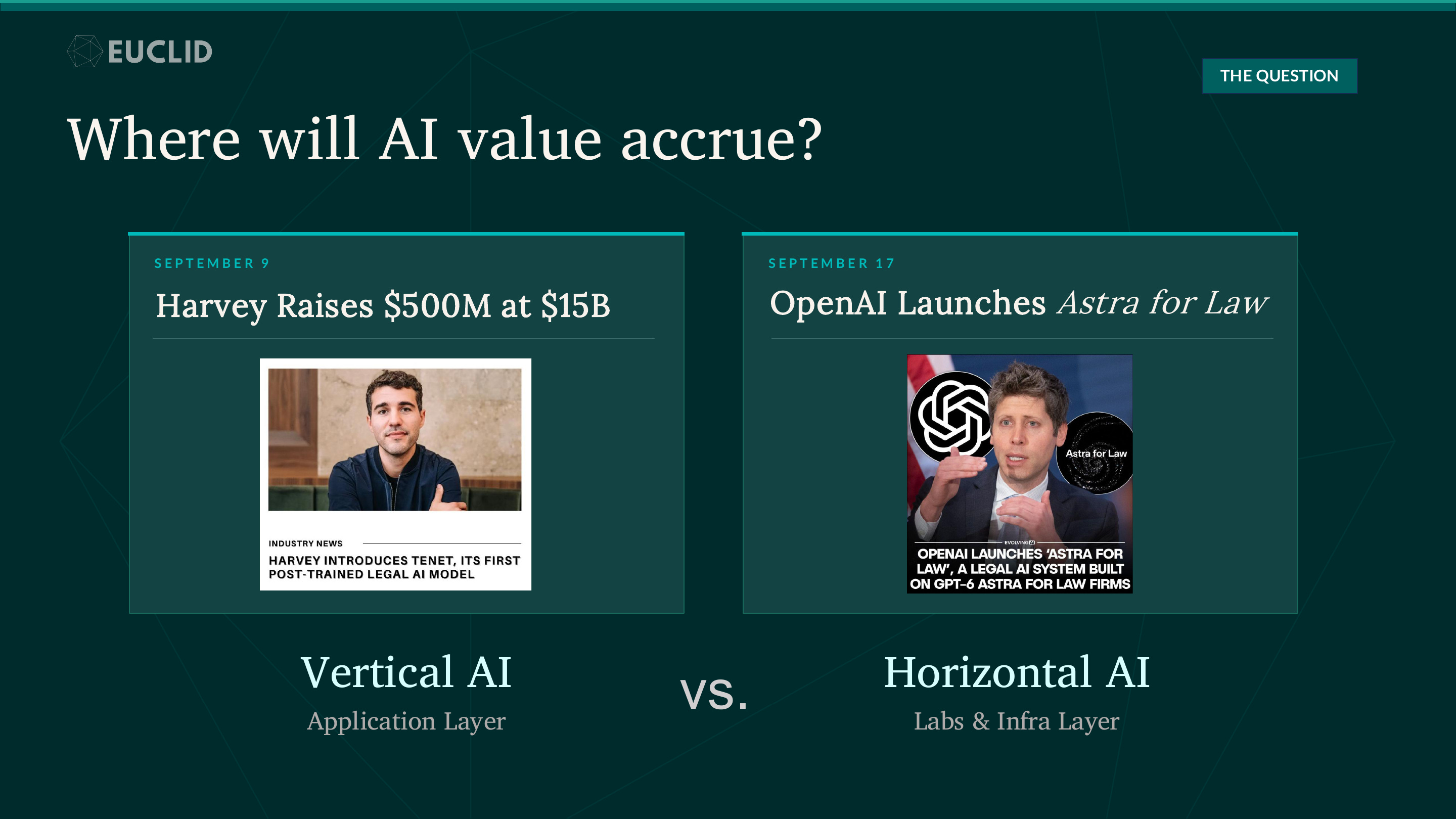
Two well-funded players, both building proprietary models, both chasing the same lawyers. If you’re building Vertical AI, that’s the question that keeps you up at night: when labs enter your market, where does the value go?
Nic opened The Verticalist Summit with exactly that question. Our answer is the application layer, and Vertical AI takes most of it. Yes, we’re biased. So he started by steelmanning the other side.
The Skeptic’s Case
It comes in three parts. Vertical AI is thin wrappers paying a tax back to the labs. The labs will eat the application layer anyway. And the market has spoken: software stocks cratered in the SaaSpocalypse, and 43% of venture dollars in the first half of 2026 went to the labs. Underneath it all is one idea. The labs are just too well-capitalized.
1. Vertical AI is all wrappers
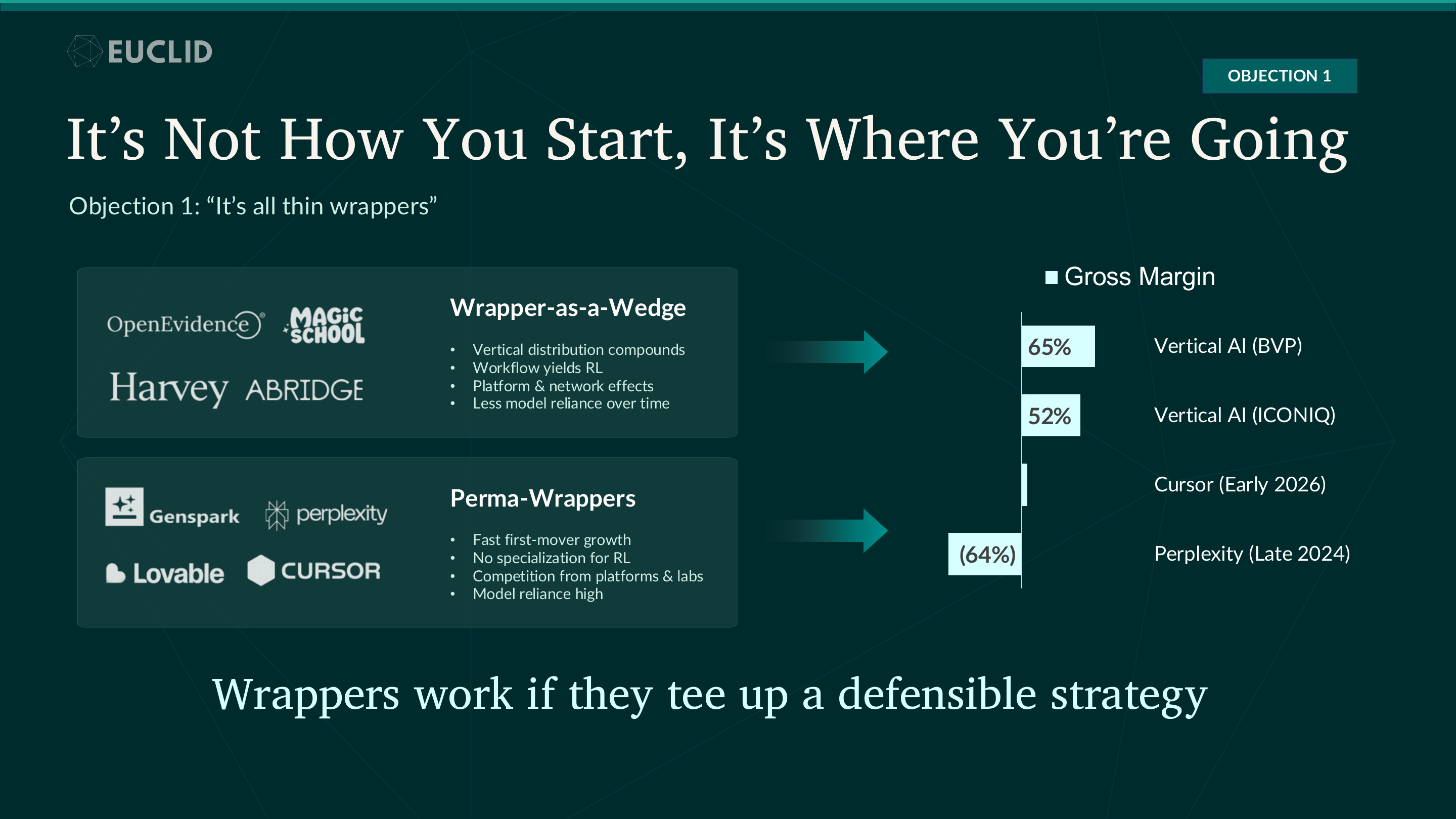
Plenty of the best Vertical AI companies did start as wrappers. OpenEvidence and Harvey, now valued between $5B and $20B, more or less did. MagicSchool’s founder told us on the podcast, “We were literally nothing more than a wrapper.”
The wrapper, however, bought them distribution. OpenEvidence reports that most US physicians use it. Harvey says 80% of the Am Law 100 use it. They used that position to ship more features and build lock-in, and in OpenEvidence’s case, a network effect it waited years to monetize.
The thing to avoid is the perma-wrapper: pure inference layer, no path to own the space, often competing head-on with the labs that sell it the model. Cursor is our example, and it isn’t a knock, since a $60B exit is an incredible outcome. But it spent its life competing with its wholesalers. Where perma-wrappers run at low or no gross margin, Vertical AI tends to land 10 to 20 points below great software margins.
2. The labs will eat the application layer
If you want to build an independent business next to the labs, you need a reason they don’t win. Data moats aren’t the only kind, but they’re the one people mean here, and right now reinforcement learning is how you build one. Feed the model outcomes, reward what worked.
So where do the rewards come from? We sorted them into three buckets:
Synthetic. Simulated and verified at scale. Code compiles. The browser found the page.
Purchasable. Bought or outsourced. Annotated case law, labeled blueprints, radiology reads. Several unicorn and decacorn companies now just hire experts to label data for the labs.
Job byproduct. Only exists because someone did the work. Did the loan default? Was the claim approved? Did the building pass inspection? Did the product sell?
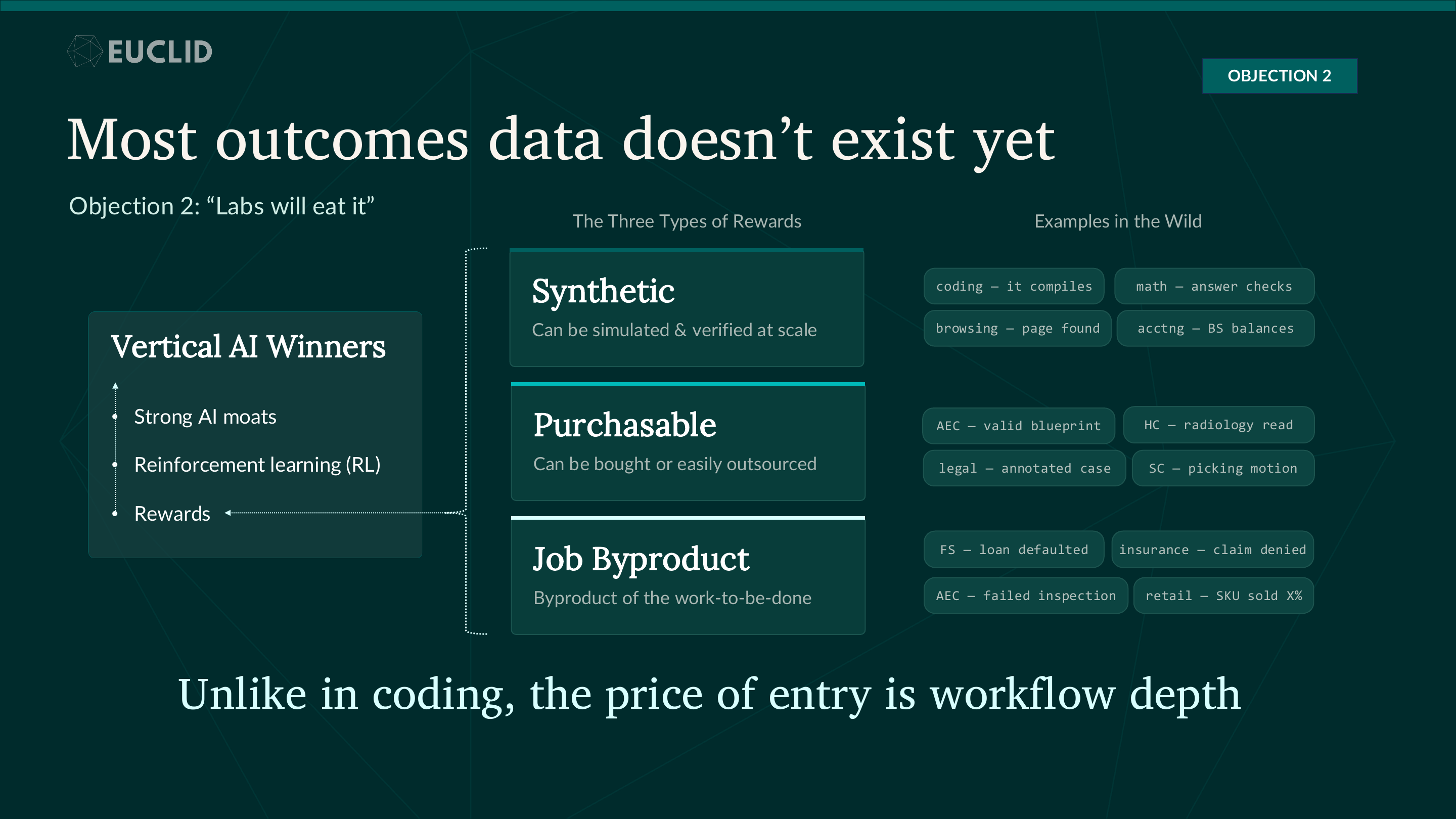
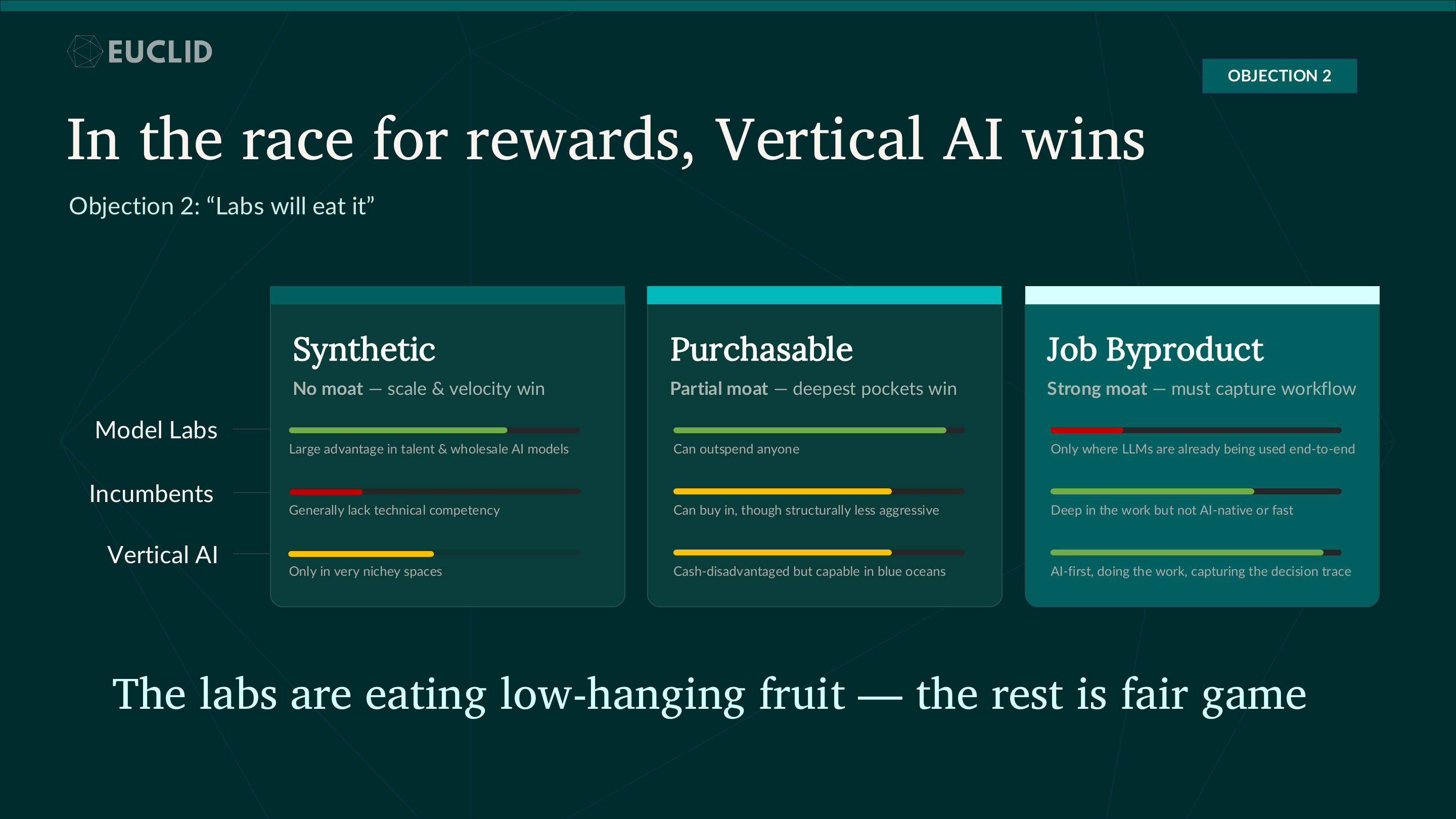
Everything AI has broken out on so far, language and especially coding, sits in the synthetic bucket, and that suits the labs perfectly. Purchasable leans their way too, because they have the most money. But as Nic put it, “most of the valuable outcome data out there cannot be simulated or bought.”
We’re in the early days of a gold rush for dark data — the most valuable data, which can’t easily be bought or simulated. The price of entry is workflow depth, and that’s perhaps the best single argument for Vertical AI.
3. The market has spoken
Software stocks have recovered, and the vertical premium never left. Joe Floyd at Emergence found that 92% of public vertical software companies run above 100% NRR, while about a third of horizontal public apps are contracting. In the same NRR band, vertical names trade at about 2x the revenue multiple. We dug into this in SaaSpocalypse Now What?
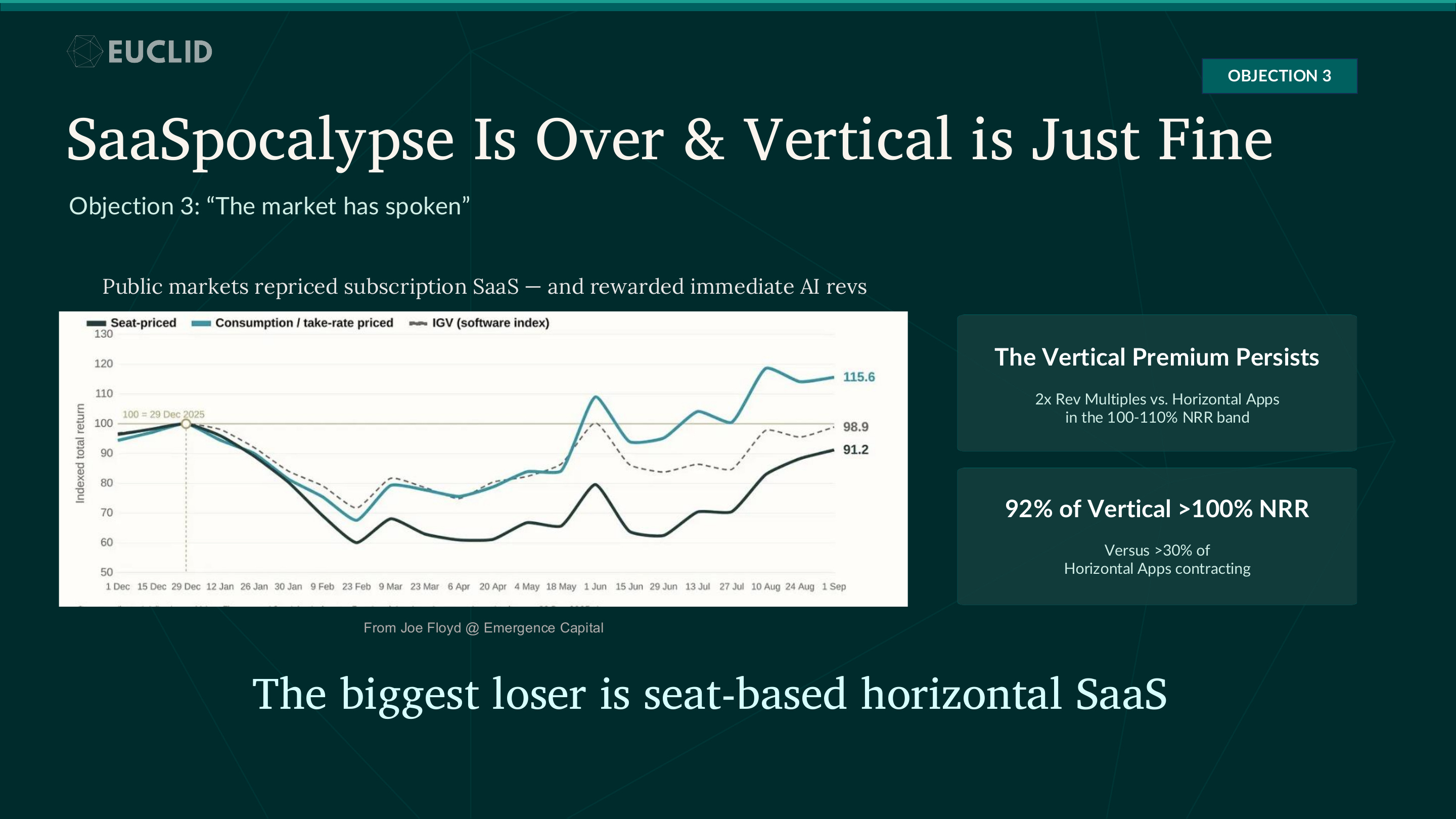
Private investors agree. Harvey’s raise landed while the labs shipped several products aimed squarely at legal. And $500M+ rounds in Vertical AI are up 2x year over year, with late-stage money backing the first generation and early-stage money backing the next.
What to Do With This
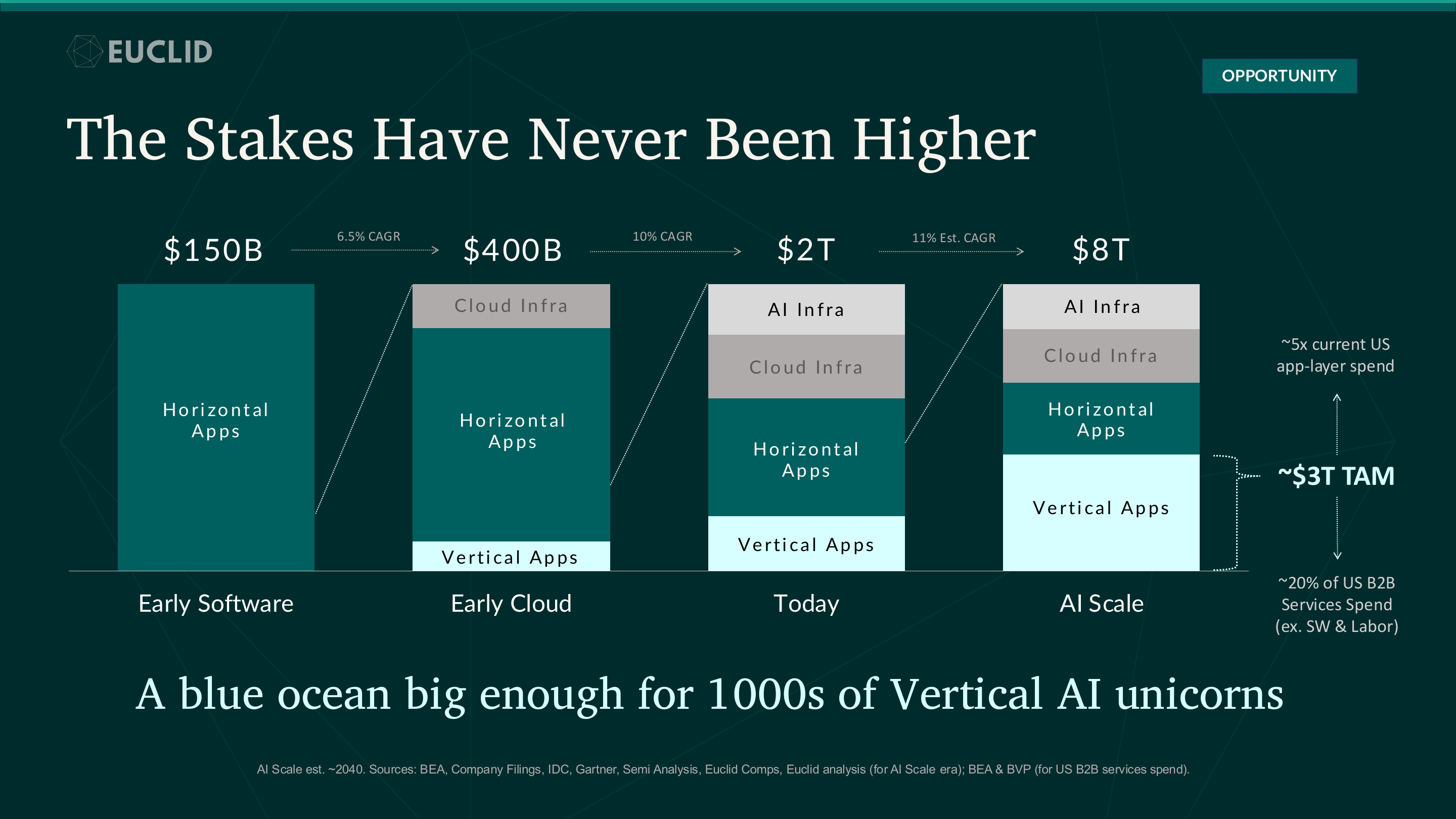
At AI scale, Vertical AI is roughly a $3T opportunity. That sounds absurd until you build it from the bottom up: it’s about 20% of today’s US B2B services spend (excluding software and labor) and about five times what businesses spend on SaaS today. As Nic explains, it’s “a blue ocean that is big enough for thousands of Vertical AI unicorns.”
Here’s a quick heuristic: list every outcome your product touches and sort each one into a bucket. If most land in synthetic or purchasable, you’re in the labs’ lane and speed is your only defense. If they’re job byproducts, build so you’re present when the outcome happens, and capture it as structured data from day one.