

Abstract
Software prices whipsawed over the past year, but NRR held at a median of 109%. Customers haven’t left — at least not yet.
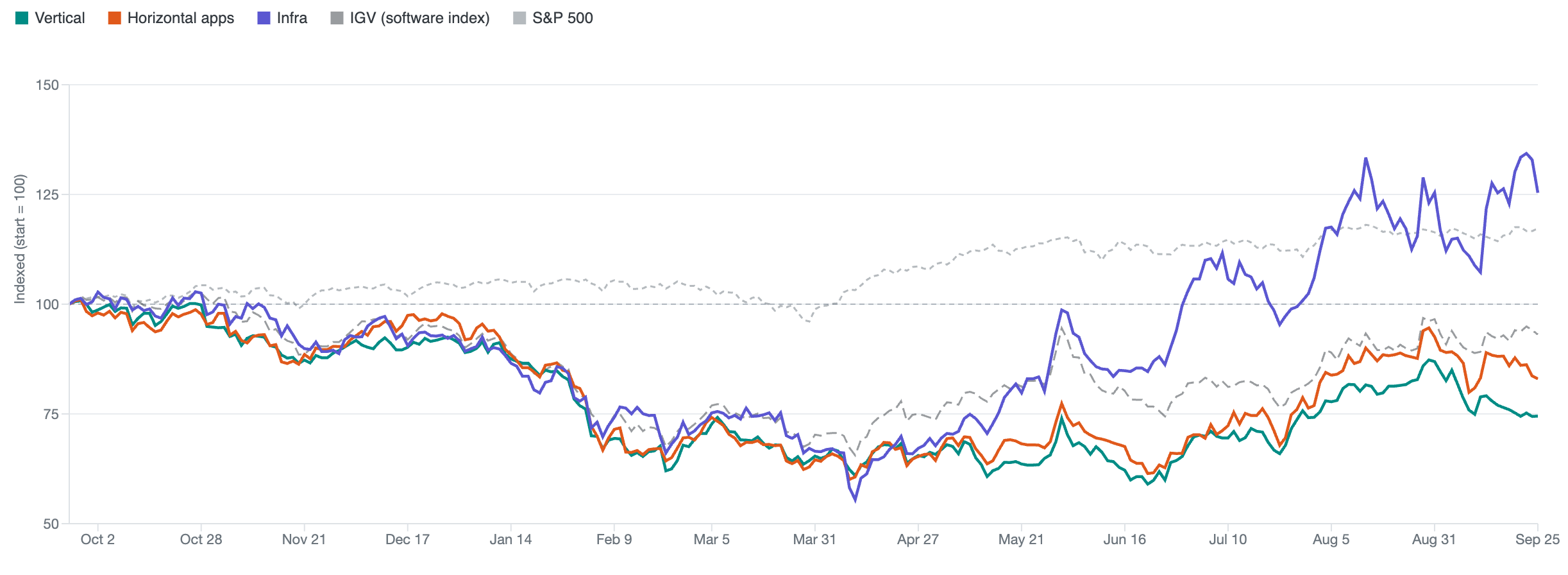
The rebound has been uneven. Infrastructure has pulled away, and vertical software has been the least bought back.
The market seems to be pricing verticals by industry. “Knowledge work” verticals fell much harder (without respect for AI addressability) as a group, while physical verticals saw a much bigger bounce-back.
Our view on the market dislocation and what it means for founders & VCs.
Announcing Euclid Comps
With this piece, we’re also opening up Euclid Comps: an interactive comparables dataset covering ~140 public application-layer equities across all key financial (EV, revs, margins, multiples), operational (customers, ACVs, NRR), and AI (AI Tailwind Factors, AI-Addressable Work Score) measures. Plus tools to visualize your own cuts of the data. Updated quarterly and free for all subscribers of The Verticalist!

Back in May, we wrote SaaSpocalypse Now, which argued that public-market investors were pricing in the immediate revenue upside of AI, rather than the eventual steady state. In the eventual equilibrium, businesses that leverage valuable data, workflows, and distribution advantages to own AI diffusion in their domain will flourish. Those that cling tightly to SaaS product form factors and pricing models will atrophy. To see how we are tracking against this future, we revisited our software comp set following the late-summer earnings season to assess where we are in the cycle and how the long-term vertical advantages we identified this spring are tracking.
One effect caught our eye: prices whipsawed, but retention didn’t. Between New Year’s and April, our three cohorts fell together, by roughly a quarter to a third. Since late March, infrastructure is up 87%, horizontal apps 31%, and verticals 16%. Over the full year, the median stock in our set is still down 16%, while IGV, the market-cap-weighted software ETF, is down just 7%.
Net Revenue Retention (NRR) barely moved through all of it. Median NRR across our set — reported by just over half of the ~140 tickers — sits at 109% today, the same as in our early-2026 snapshot. That’s a few points below the 112–115% that software investors treated as healthy in the final decade of the SaaS era, but it’s steady. Of the 74 companies we tracked across both periods, 38 were flat, 19 improved, and 17 declined. Of course, general macro turbulence can push NRRs up and down a few points, and NRR is a lagging indicator: contracts renew annually, so real displacement would show up a few quarters after the fear does.1 But so far, customers aren’t leaving.
That stability, however, is the least interesting part of the story. There’s much more to be learned from looking at which stocks were bought back and which weren’t. There is one business attribute that appears more determinant of performance than the rest — and it has nothing to do with horizontal vs. vertical.
The Consumption-Based Tailwind
In SaaSpocalypse Now, we argued that investors were rewarding immediate AI beneficiaries while discounting the less visible strengths of vertical platforms. We also made a more specific claim:
Consumption-based access & pricing models were the clearest driver of software performance over the last several months.
Joe Floyd at Emergence put together an analysis that appears consistent with that view, showing that consumption-priced companies outperformed their seat-priced peers. Our own latest data, 6 months later, corroborates it across all ~140 stocks in our comps; the pricing model is the single biggest separator we found:

The outperformance of businesses with consumption-based pricing is fairly easy to understand. If you’re “infrastructure for AI,” and AI scales up extremely quickly without the need for human intervention, you benefit as companies test new agents and LLMs — if you happen to price on usage, you capture more of that upswing, faster and with less friction. That’s a big part of why infrastructure has pulled away from applications altogether. Non-infrastructure businesses with consumption-based models can see (and are seeing, anecdotally) the same benefit from AI tailwinds. There aren’t many of them public yet, outside of nascent revenue streams from subscription-heavy SaaS players testing the waters.2
Enthusiasm for immediate AI beneficiaries can coexist with durable demand for vertical apps. The retention data are consistent with that: existing-customer spending looks more resilient in verticals and infrastructure than in horizontal applications. That doesn’t establish AI as the cause, but it gives us evidence beyond stock returns to examine.
Sold as a Block, Bought Back Unevenly
Vertical software stocks have underperformed over the last year — with the slowest recovery from the SaaSpocalypse. They’ve seen a one-year return of −26% vs −17% for horizontal apps, and +29% for infrastructure. But revenue growth rates tell a different story.
Median vertical revenue growth was 12.7%, in line with horizontal applications’ 12.9%. By our estimate, vertical valuation multiples compressed by roughly 40% over the year, against roughly 30% for horizontal applications and almost nothing for infrastructure.3 Retention doesn’t explain it either: verticals retain at a 109% median against 105% for horizontal apps, and only one vertical company in our set (Docebo) sits below 100%. It appears the market has been marking down vertical software on narrative rather than fundamentals.
The obvious explanations don’t hold up. Verticals fell 25–27% whether they were under $2B, $2–10B, or above $10B in enterprise value. Old versus new-generation verticals fell by the same amount. Starting valuation barely matters — the expensive verticals didn’t fall much further than the cheap ones. Pricing model matters at the margin (verticals whose revenue scales with usage held up better than seat-heavy peers), but it doesn’t explain the gap with horizontal apps: comparing subscription businesses only, verticals are still down 27% against 21%.
The Pernicious Fear of Replacement
Industry, on the other hand, explains a lot. If you split our verticals into physical-operations businesses (supply chain, manufacturing, hospitality, retail) and everyone else, the physical-operations group is down 7%, and the rest are down 31%. Retention is the same in both, around 109% (though only three of the physical-operations companies disclose it).
At first glance, that looks like the market pricing AI risk sensibly. Physical work is hard to hand to an LLM; legal research and claims correspondence aren’t. To test it company by company, we built a new score for Euclid Comps: AI-Addressable Work, the share of what a company’s customers pay for that is language-in, language-out work an LLM can do today.4 It’s deliberately separate from our AI Tailwind score. High addressability is a threat to a company that sells seats to the people doing the work, and an opportunity for a company that owns the workflow and can charge for the work itself.
The score does sort the two groups. The physical-operations verticals score a median of 10%, the rest 20%. But inside the “everyone else” group, it explains almost nothing: the least addressable companies fell just as hard as the rest, and some fell harder.
Bentley Systems is a good example. Its infrastructure-engineering software runs on simulation and analysis engines where exactness is the product, so it scores just 10% on addressability. It beat estimates in Q1, yet it’s down 39% on the year, with coverage pinning the slide on the “seat compression” narrative: fewer engineers, fewer seats. Guidewire (30%) tells a similar story. It fell 36%, and some of its worst days came from sector-wide AI sell-offs, though a soft ARR print didn’t help. The market seems to have looked at the industry and priced the whole category as AI-exposed.
Horizontal software got a more careful read. Among horizontal apps, the least addressable fell 12% and the most addressable 25%. Twilio and RingCentral have users doing plenty of language work, but customers actually pay for the underlying network and usage. The market picked up on it, with Twilio up 179% over the year and RingCentral up 158%.
So in the same market, over the same year, horizontals got company-by-company analysis, and verticals got a broad brush. The market has made a broad assumption about the replaceability of LLMs in knowledge-work industries. It’s unlikely that such a coarse measure is accurate.
But AI replacement is a generalized fear that’s hard to overcome. The market sold off all software earlier this year, save names it was sure would get immediate boosts from the agentic boom (i.e., infra and consumption-based pricing). When it came time to buy back, that single big fear loomed5, making knowledge-work verticals less palatable.
A Smaller Vertical Premium, but Still a Premium
None of this means the market has stopped paying for vertical moats. When you consider the 100–109% retention band — a massive one by volume, comprising 40% of the companies that disclose NRR — it’s pretty interesting to note that vertical businesses out-trade horizontal apps by roughly 1.7x.
In that fat middle band, verticals trade at 4.8x EV/Revenue, while horizontal app peers trade at 2.9x. Why would the market pay a ~65% premium for the same retention rate, when there’s no substantive difference in other fundamental metrics (lower, in fact, from a growth perspective: 12.8% vs 13.4%)? A likely answer, in our view, is that the market still believes a vertical company at 107% NRR is more likely to stay there than a horizontal company at the same number. In a world still questioning to what extent historical conceptions of moats — vertical and otherwise — hold up, that’s a pretty significant nugget.
Across our whole set, retention tracks valuation multiples closely but has had almost nothing to do with this year’s returns.6 The market prices stickiness into the multiple and then trades on narrative. The market feels something is holding up about the vertical moat, even if it isn’t willing to pay the same premium it once did. The premium was higher a year ago, and it has shrunk for the group as a whole, even as retention underneath it held steady. If the market is misreading LLM replaceability in knowledge-work verticals, the premium is smaller than it should be. And we’d argue it’s not even about being vertical per se. It’s about specificity, and the nature of the lock-in it enables.
The AI Effect? Horizontal Apps Are Bifurcating
To break retention down, we split the 75 companies in our comp set that disclose NRR into three cohorts: infrastructure (security, observability, identity, data layer), vertical (industry-specific application software), and horizontal application (workflow tools serving broad buyer bases).
Infrastructure holds with a median NRR of 114%. Only one company in that group, PagerDuty, sits below 100%. 72% retain at 110% or above. We’ve discussed the reason (or at least the narrative) in past pieces — most recently, SaaSpocalypse Now. Agents need tools and piping (data, web search, security perimeters, VoIP connectivity, observability, etc.) and can use them on a consumption basis as they scale ad infinitum. The favorable sentiment is probably a bit too generously spread, but the AI tailwind here is real and easy to see.
Horizontal apps are in a very different position. With a median NRR of 105%, more than a quarter of the cohort falls below 100% — meaning customers are spending less year over year, net of expansion. ZoomInfo at 89%; Weave at 92%;7 EverCommerce, Yext, and Asana all contracting. From project management and help desk to BI and marketing automation, these products organize workflows a capable knowledge worker — or, increasingly, an AI agent — can approximate. When the core value proposition is “help humans do a task through a UI,” and that task is moving into the model’s strike zone, the UI stops being the moat.
But the cohort isn’t sinking together. The same share, 26%, retains at 110% or better: Figma at 136%, ServiceNow at 125%, Atlassian at 120%, Twilio at 116%. Horizontal apps are splitting apart, and that’s a big slice of the horizontal world on each side of the line.
Doing the Work: Mo’ Money, Mo’ Traces
For founders, AI-Addressable Work reads differently. The public market is pricing high addressability as a threat to incumbents. For a startup, it’s the point of attack: because AI-native products can do the work, rather than enable it as did SaaS, the LLM-addressable function itself is just the first arrow in your quiver.
However, such points of attack may also be commoditized soon, if they aren’t already. The same models are available to every competitor and every incumbent. And with the rise of open-weight models, the ease of distillation, and the resulting perpetual pricing pressure on AI infrastructure, any quantum of intelligence is highly deflationary. So that point of attack needs to build into a moat quickly because competitors and incumbents will be coming, and their price of entry drops weekly.
The good news is that customers appear to pay more for doing the work than for enabling it — and that effect is starting to show up in public numbers. CS Disco now earns 92% of its revenue on a usage basis, with per-use GenAI review at a record. Five9’s AI agent revenue is 15% of subscription and growing 78%. HubSpot has moved several agents to outcome-based pricing. More than 80% of Figma’s $10K+ customers consume paid AI credits every week. These aren’t ever the best examples of businesses truly owning outcomes and taking on what might’ve historically been services or in-house, human-owned deliverables — but there’s no shortage of breakout examples in the startup world, AI-Native Services (AINS) or otherwise.
Doing the work should not only increase ACVs but also give you access to more decision traces. For example, whether the draft was accepted, the claim was paid, or the retail product sold through. Those traces — especially byproducts of the job that are impossible to scrape and hard to buy — drive reinforcement learning, expansion into adjacent workflows, and appear to be the most compelling path to AI-native moats. A tool that only assists a human never sees the full workflow, and it very rarely sees the ultimate business outcome in full context. That’s how addressable work becomes a data moat, though it takes a strong vision to get there: knowing which workflow to own first, and why doing it produces data nobody else will have.
What’s Actually Changing
In one sense, the data lines up with the expected pressures of AI: software whose primary value is organizing information through a UI is under real pressure. It’s looking, however, like horizontal apps are the best exemplars of that soft underbelly. As defensibility of the middle of the stack — namely software UI — is commoditized, peripheral layers of the stack grow in importance. Below: infrastructure that AI agents have to route through. Above: vertical systems of record with domain-specific moats.
Equally important is what the data doesn’t say. We shouldn’t infer that AI is responsible for all the weakness we observe. The current data support a more specific conclusion: horizontal applications show weaker reported retention, widespread replacement of enterprise software is not occurring in any meaningfully visible way, and the market is pricing vertical software by industry rather than by business. Vertical moats are neither dead nor ignored by the market. The AI app-layer replacement cycle will not happen overnight.
If the market is using too broad a brush, the pockets of undervaluation likely sit around vertical companies with low AI addressability and strong moats that were sold along with their industry, and not yet rebought due to oversimplified fears about the AI narrative. If we’re right, the question is how long that dislocation persists — and of course, whether that’s a better use of capital than getting in on soaring infrastructure bullishness. If NRR begins to tank across knowledge-work verticals regardless of AI addressability, then something else entirely is afoot, and we’ll be the first to call it out. Strong opinions, loosely held and all.
As we suggested back in our initial piece on the SaaSpocalypse in February and again in May: much of enterprise software will not be trivial or quick to replace. That some incumbents — vertical or otherwise — may not be so swiftly dismissed is no reason for founders to fret, or for incumbents to celebrate. Software (including AI) undergoes a constant innovation-replacement cycle. And on the whole, the diffusion of LLMs is accelerating, both due to massive coding efficiencies and novel direct applications.
However, while the prospect of faster switching cycles is always compelling for would-be disruptors (or their investors), that’s not what makes the current AI age so exciting.
The Takeaway for Vertical Founders & VCs
Seven months ago, we summed it up in a prediction that’s only gained steam since: “The bears assume that AI will shrink the software market. We think it dramatically expands it, even more so in vertical categories.” New functionality means new value, means new markets and growing TAMs.
Compared to five years ago, today’s opportunity is just bigger. By a lot. In our estimation, ~5x bigger than total current SaaS spend.8 That means trillions of dollars that will largely be captured by companies not yet listed on a public stock exchange.
So, founders and VCs: if you don’t like what’s happening to software in your portfolio, stay focused. The prize ahead is worth it.
NRR disclosures aren’t standardized across companies, and many software names don’t disclose it at all (75 of the ~140 in our set do). Net revenue contraction also isn’t the same as customers leaving. A cohort can spend less by buying fewer seats or consuming less while keeping the vendor. Conversely, expansion at a few large accounts can conceal customer losses elsewhere.
Outside infrastructure, our set includes a handful of consumption-priced companies: C3.ai, Bandwidth, Twilio, and Zeta on the horizontal side, and Red Violet and CS Disco on the vertical side.
Estimated from each company’s one-year price change and revenue growth; this ignores changes in net cash and share count, so treat it as directional.
Scored 0–100% for all ~140 companies from 10-K business descriptions and product pages, without reference to stock prices or returns. Deterministic engines, transaction rails, physical operations, and professional sign-off count as 0% addressable, even when the preparation around them is language work. Per-company scores are in Euclid Comps.
Probably combined with a growing appetite for everything adjacent to data centers, defense, and US government initiatives to re-shore select manufacturing.
Across the 75 disclosing companies, the correlation between NRR and EV/Revenue is about 0.7; between NRR and one-year price change, about 0.1.
Earlier this year, we reclassified Weave from Vertical to Horizontal in our comp set. While Weave originated as a dental-specific communications platform (and still describes itself as vertical), it’s drifted. Following its 2021 IPO, it attempted a broader push from the healthcare core into home services. Today, we feel the product — phones, texting, scheduling, reviews, payments — is better described as horizontal SMB communications functionality that is deployable across multiple industries, without mission-critical workflows specific to its origin vertical of healthcare, even though that category still dominates its revenue.
We’ll soon be publishing more from a recent State of Vertical AI presentation we prepared, including Euclid’s granular projection of software TAM over the next 15 years.