

This episode is brought to you by Parafin — they power the financing infrastructure behind platforms like Mindbody, Gusto, Amazon, and Fullsteam. And they just secured $360M from Cross River to keep scaling. Learn how you can turn capital access into a retention engine:

Today’s Episode
Fund administration isn’t the sexiest industry — in fact, it’s hard to find many CFOs and managers who love their vendor. But it underlies $100T in global assets and is an attractive business in many ways: monetization scales directly with AUM + generally high customer lifetime values. Today, the fund admin revenue pool is dominated by legacy incumbents like SS&C, a $20B+ public company. They had little incentive to modernize. Until now.
Enter Chris Hladczuk, Co-Founder and CEO of Hanover Park. Before writing a line of code, he cold-called 50 CFOs. When half of them started cursing at the mention of their fund admin, he smelled blood in the water.
That customer mindset, paired with the conviction that Vertical AI could reshape services delivery, became the foundation for a company that just raised a $27M Series A led by Emergence Capital and scaled to $15B of assets on platform in twelve months.
It didn’t take Chris long to realize this couldn’t be a traditional AI-powered software play. Fund administration is high-trust with near-zero tolerance for error — historically meaning human-heavy services. AI is well suited to repetitive, numbers-based workflows, but one hallucination can lose you a $1B client, and there’s no shortage of edge cases quarter to quarter. Cognizant of that, Hanover Park is decidedly human-in-the-loop Vertical AI services. But what does that mean for margins? For product automation over time? How do you stage gate work product and ensure your AI services model scales over hundreds of billions of AUM?
Those finer points of Vertical AI Services are what we’re talking about in today’s episode. Chris shared his path for operationalizing human-in-the-loop — an important reminder that as far as LLMs have taken us, the economy will need humans more than ever to adapt AI to high-integrity fields like financial services. Stick around to hear Chris’ journey cracking a venture-scale market where software failed — from avoiding avoiding the pitfalls of AI services, to landing an outstanding Series A partner in Jake Saper at Emergence.
The Hanover Park Backstory
Chris’s path to fund admin wasn’t linear. After investment banking at Goldman Sachs and a CRO stint at fintech company Meow (scaling 10 to 1k customers), he declared “B2B SaaS is dead” on a podcast in September 2024. While that take was widely dismissed at the time — and might still be hyperbolic — its spirit has been increasingly validated, as AI has transformed the meaning of software.
His thesis: if building software gets cheaper, the moat shifts to whoever owns the outcome. In fund admin, that means not selling software to accountants, but doing the accounting — software, agents, and humans vertically integrated under one roof. He co-founded Hanover Park in 2024 alongside CTO Nick Puljic (Columbia CS, previously co-founded Stock Unlock via YC W22), and the pair set out to build a purpose-built ERP for private funds from the ground up.
At Euclid, we don’t think that owning the outcome offers any inherent moat — nor that services is commonly a fast track to vertical defensibility. But we do agree that the line between services and software is blurry in the age of AI. As we’ll discuss in this episode, the proof is in the pudding: can you internalize with a customer as deeply as any software ever could? Can you build internal IP giving you an automation and / or accuracy advantage? Is your bet on long-term margins credible?
Chris’ answers taught us a lot — catch the full episode to hear them.
The Vertical Playbook
Human-in-the-Loop Vertical AI
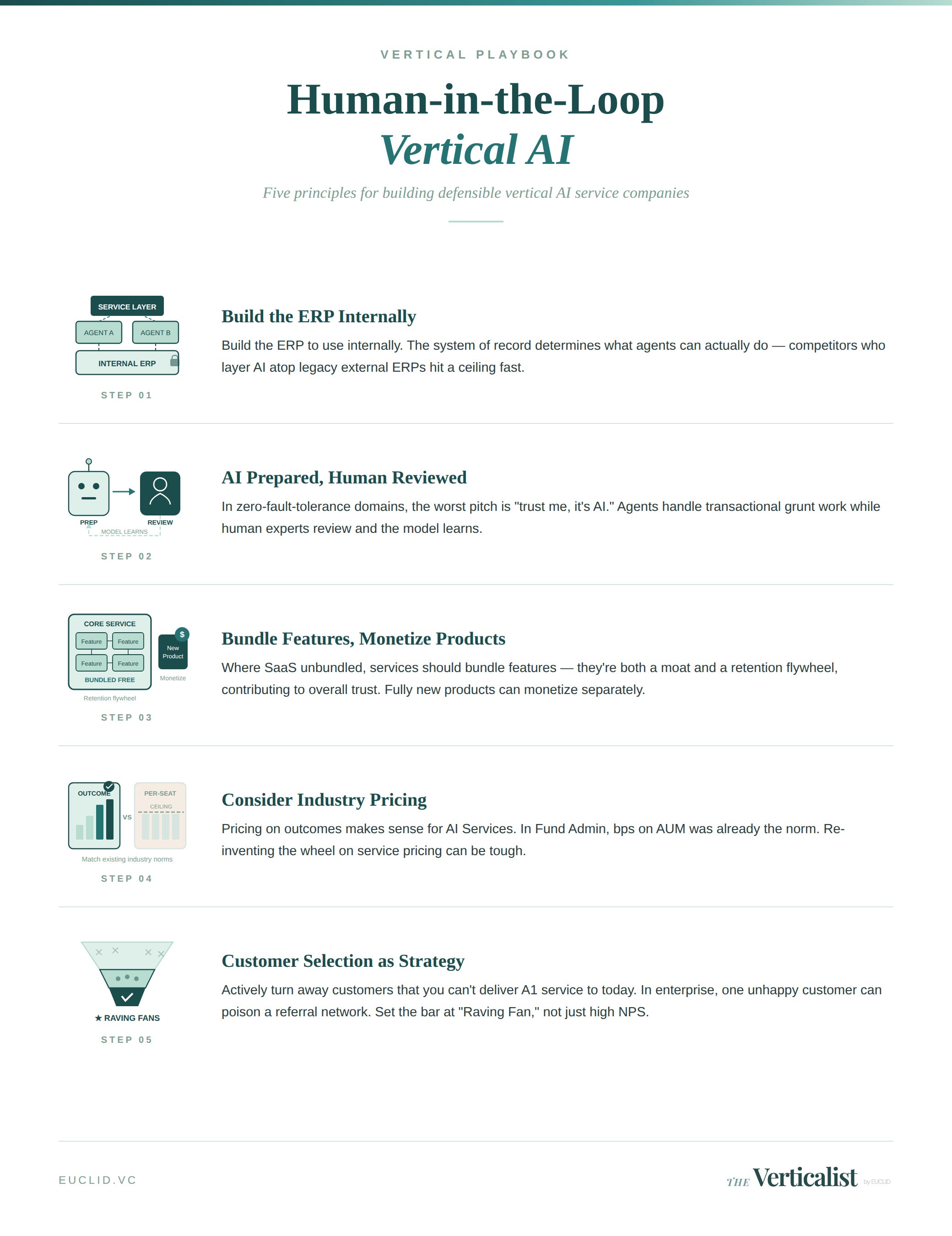
Step 1: Build the ERP Internally
Chris’s core architectural bet: own the system of record. Hanover Park built its own general ledger, document extraction engine, and reporting infrastructure from scratch. The system of record determines what agents can actually do — competitors who layer AI atop QuickBooks or a white-labeled legacy ERP hit a ceiling. As Chris frames it: without the ERP for the fund, you’re just a UI on top of somebody else. Don’t just bolt agents on top of someone else’s moat.
Step 2: AI Prepared, Human Reviewed
In a zero-fault-tolerance domain, the worst pitch is “trust me, it’s AI.” Hanover Park‘s paradigm: agents handle the transactional grunt work — cash reconciliation, document parsing, journal entry preparation — while human CPAs review and approve. One customer reported it felt like 25 people on their account when they had two. By automating low-level work, Chris can pay accountants more, give them equity, and recruit what he calls “the Navy SEALs of fund accounting.”
Step 3: Bundle Features, Monetize Products
Unlike the typical wedge-then-expand playbook, Chris refuses to sell any product standalone. Portfolio management, LP portal, KPI reconciliation, and money movement all come bundled with core fund admin at no extra charge. The logic: unbundled products are worse because they lack the source-of-truth data in the accounting system. The bundle is both a competitive moat and a retention mechanism that compounds switching costs.
Step 4: Consider Industry Pricing
Hanover Park charges basis points on AUM — not SaaS subscription fees. This aligns revenue directly with customer success: as a fund grows, so does the contract. Closed-end fund structures mean worst-case duration is ten years, and the best-case is a GP raising a $10B successor fund. Revenue quality mirrors subscription businesses without the artificial per-seat ceiling.
Step 5: Customer Selection as Strategy
Chris actively turns away funds below $100M. In a service where one unhappy CFO can poison a referral network, discipline on customer selection is existential. His North Star isn’t NPS — it’s whether every customer is a “raving fan.” That selectivity, paired with an always-get-on-the-plane founder-led sales motion, builds the trust required to rip out a CFO’s most important vendor.
The Takeaway for Vertical Founders
Hanover Park offers one blueprint for the AI-native services wave: build the system of record for internal use, vertically integrate the human + agent stack, price on outcomes, and bundle relentlessly. In a high-stakes use case like fund administration, there’s no room for hallucinations. The margin for error is low, as is the threshold for losing trust. At the same time, in such fields, if AI can be leveraged to deliver a critical service more reliably and accurately, that’s a trust-builder like no other.
So far, $15B in assets says Hanover Park is doing just that. Especially if gross margins grow and human-in-the-loop yields better automation over time, multiples could look increasingly software-like. This episode is a reminder that the most defensible AI Services companies aren’t necessary replacing humans — they’re making a tight cohort of them dramatically more valuable.
Thanks for reading the Verticalist and for tuning into the show! Drop us a line below with your thoughts. And don’t forget to subscribe to Verticals wherever you watch or listen:
Youtube • Spotify • Apple • Amazon
Keep Reading…
AI is Solving SaaS Product Adoption

In our last essay, “Emerging Playbooks in Vertical AI,” we discussed how LLMs are enabling new vertical software strategies to automate work-to-be-done and—in the process—laying the groundwork for a new generation of systems of record. These developments are already changing the way that founders, product managers, and investors think about software arc…
It has probably not been done in this end market but there is nothing unique in the approach. Anyone who has tried to do this in high stakes domains has had to contend with this. The "model learns" from human evaluation is the part that differentiates. Since the core LLM is frozen the learning is about the harness around it. That learning depends on customer willingness to share data. Curious to hear a bit more concretely how you avoid the cost of long tail automation and AI.