

Alex Oppenheimer is Founder and General Partner at Verissimo Ventures, a pre-seed and seed fund investing across the US, Israel, and Europe. Before launching Verissimo in 2020, Alex spent years at NEA, where he became a specialist in SaaS mechanics. He’s written 80+ checks since, backing vertical software, infrastructure, and fintech companies at the earliest stages. Tune in for a sharp debate on whether the vibe coding wave is actually a threat to Vertical SaaS, or just to the cheap end of it — and where the new lines of build vs. buy are being drawn.
Today’s Episode
Software is dead. We’ve all heard it. AI has made it trivially easy to spin up a tool — a scheduling widget, a personal CRM, a dashboard — and the natural conclusion is that nobody needs to buy software anymore.
While the conclusion is wrong, it’s not for the reasons most people assume. What AI can replace and what’s worth investing in are two very distinct categories. The cheap end of the market (discrete, small-scope tools) and the complex end (truly enterprise-scalable platforms) are night-and-day. They have wildly different build times, maintenance costs, and ultimately, economics. Many have assumed that all of software should take a hit — in reality, enterprise solutions may have gotten harder to build in the AI era, with rising expectations of interoperability and customization. While the simple solutions, designed for prosumers to execute on a small, repeatable task, have more-or-less lost pricing power altogether.
Alex has been investing in SaaS nerly his entire career. He joined NEA in 2013 when calling yourself “the SaaS guy” was meaningfully differentiating. He’s since written 80+ checks and founded Verissimo, investing at pre-seed and seed across three continents. His vantage point as a first-check software investor with deep finance roots, an engineering degree from Stanford, and a penchant for analysis aren’t foreign to the venture world — but his grounding in those fundamentals even as AI takes the world by storm, re-writing conventions, is somewhat refreshing.
The Cheap End Is Exposed
Vibe coding may be a tongue-in-cheek term — but its impacts are very real, both tangible and psychological. People who never thought of themselves as developers are now shipping functional (if not scalable or enterprise-ready) software. the claim isn’t that software development is completely democratized, but that the mindset of entrepreneurial people — builders with ideas but lacking coding expertise or budget — has shifted. even if they don’t build all their solutions, their expectations for ownership, flexibility, and scope are wholly new. Halfway through the episode, Alex pulls up a photo of his barber rebuilding his entire booking and scheduling system in ChatGPT in between haircuts.
A guy who cuts hair is shipping software. Most barbers or mechanics or teachers aren’t — and probably never will — spend their time on technology. But 1% of them will. and over time, we imagine that will change the psychology of industry. When people see that it is possible for fellow domain experts to mold the software tools of their trade (if not own them), that shifts expectations.
“It works for me” is a long jump from “it works for thousands of users”, however. Edge cases, compliance, integration depth, multi-tenant architecture: the requirements compound at every order of magnitude of software scale. Anyone who’s shipped enterprise software knows this. Anyone who hasn’t dramatically underestimates it, because their only reference point is themselves —an inherently, you’re more likely to forgive your own product for being clunky.
I would like to see somebody rebuild a very complex, enterprise-ready solution, vibe code it themselves as a non-developer, and then scale it up to be a billion-dollar business. Just not gonna happen.
Around small tools (which can be vibe-coded, cheaper, even nearly free) but also around the systems of record in their space (which should be more interoperable, flexible, and customizable).
There is an 800-pound gorilla lurking behind the vibe-coding wave: economies of scale. Salesforce is able to spread its infrastructure cost across tens of thousands of users. Alex painted the picture of what is probably happening to most of those barber-developers who first try to scale their product out to many more users: “I churned my Salesforce subscription and now it costs me $80K a year — I had to hire three developers instead of just paying Salesforce $25K a year and being done with it.”
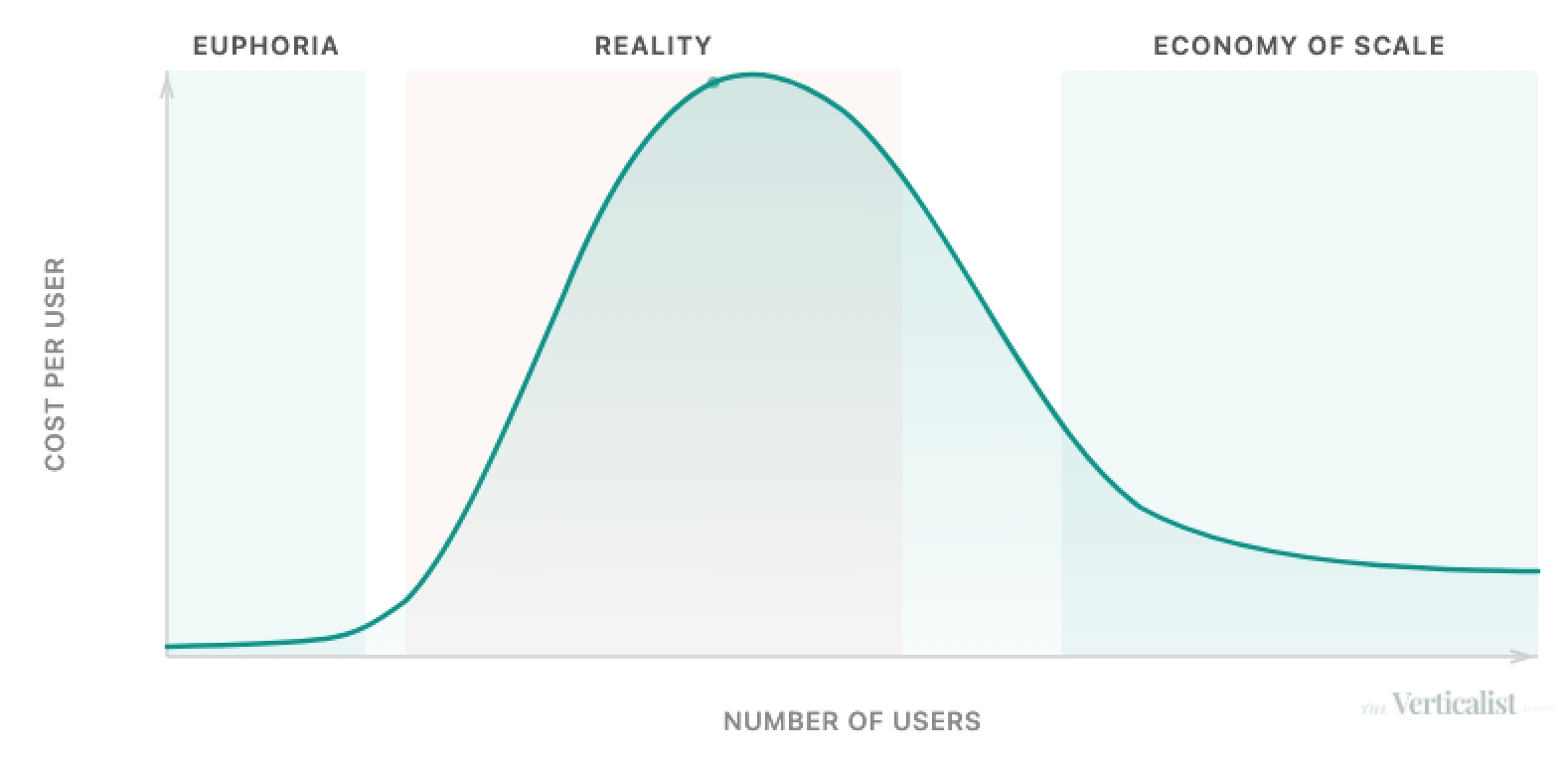
Beyond maintenance and product lift of solving edge cases for every new customer, you’ve got actual hard infra: your costs on Vercel, Supabase, etc. look free at first, then really expensive on a unit economics basis. Paying $1000 a month to support 10 users paying $50 a month isn’t sustainable — it works well if you scale to 100 users quickly, and it doesn’t if you grow linearly. Some builders will simply nail it and blow past the diseconomy of scale moment. Many more will tire out and keep a few select tools, pressuring their core system of record — whose price is getting commoditized down anyways — to enable integrations or open APIs.

A quick word from our sponsor, Parafin — they power embedded lending, cards, and insurance for the likes of DoorDash, Jobber, and TikTok, having extended $35B+ in offers to small businesses. Purpose-built for vertical platforms serving SMBs, no infrastructure required.
Explore a custom program for your platform today →
Big vs. Small, Not Vertical vs. Horizontal
The line on build vs. buy isn’t vertical vs. horizontal — it’s big vs. small.
This holds regardless of whether the software serves healthcare, logistics, or construction. A lightweight scheduling tool for a single barbershop? Buildable. A revenue cycle management platform for a hospital network? Not buildable. And while the operating enterprises themselves are more deep-pocketed, they face the same hurdle of economy as vibe-coders. Is your core competency building and maintaining technology solutions — and if not, do you want to commit to making it one? If the answer is no, you are ultimately going to continue to buy.
If it’s a small, very tangible solution where you can write up a summary of what it’s going to do in one page, that’s probably something you can build. But if it’s not your core competency, and it’s important and it’s complicated — that probably makes sense to pay someone else to do.
The reason is the oldest one in economics: specialization of labor. Does it make sense for an HVAC business owner to spend half their time on what is effectively software development? No. It makes more sense to pay someone who spends 100% of their time on that solution and can amortize the cost across hundreds of customers — especially now that traditional, broad-based SaaS is under significant pricing pressure. If a system of record refuses to lower their price? Someone will fill that gap and offer a cheaper solution, but that someone will still be an organization that is committed to scaling as a primary focus.
Attio is a great example. They are a 7-year old horizontal CRM that has raised over $100M in funding to date from GV, 01 Advisors, Redpoint, and Point Nine. They began as a vertically specific solution focused on the venture capital industry, but went horizontal due to TAM concerns. In doing so, they cut prices down to about a third of comparable solutions and stopped catering solely to VC. But with perhaps the most open APIs on the market, they are arguably more successful selling into VCs today than they were then they were horizontal. Openness and price won out.
The Second TAM Expansion
Years ago, Alex created a widely-shared presentation called “SaaS 101” comparing Vertical SaaS to horizontal SaaS. The framework was clean: vertical players had smaller TAMs but lower CACs. They grew more slowly but more efficiently into what everyone assumed were niche markets.
As Alex puts it, however, what were considered “niche” markets at the time turned out to be anything but. Software’s steady march into the economy meant TAMs expanded under investors’ feet while they were still anchored to old sizing models.
Now, it’s happening again. AI is creating a second TAM expansion for vertical markets. AI taps into and replaces services budgets, not just software budgets. When a Vertical AI product can do the work of a consultant, an analyst, or a back-office team, the addressable market expands beyond prior software spend to include the total cost of labor and services.
Some verticals still sit at single-digit SaaS penetration. A few may skip the SaaS generation entirely and go straight to AI. The retrospective pattern matching that led VCs to dismiss vertical markets a decade ago — “too small,” “too hard to sell into”, “not enough historical wins” — is the same pattern-matching causing them to underestimate Vertical AI today. In a past episode of ours (Why TAM is the Wrong Question) along the same lines, Nate Baker suggested the question most are inherently asking is: “is the initial wedge TAM big enough?” But here’s the one you should be asking: “can you durably keep expanding what you do for the customer?” AI is widening that answer — and even time it does, another market perceived to be too small, crosses the threshold of meeting venture-scale standards tomorrow.
Survive to Iterate
Alex tells every pre-seed founder they should have one mantra above the rest:
We survive to iterate.
These four words run directly counter to what most large funds will tell early-stage companies. “When the big funds come in at really early stages, their advice mostly centers around scaling,” Alex said. “Hiring and being aggressive around sales, without really understanding that the product’s not baked yet. And if you’re truly an early-stage investor, the market’s probably not ready yet.”
You have to be there when the market is ready. That means being there before it is. Which means it won’t look interesting right now.
This connects to a broader dynamic both of us observed: the current fundraising market is bifurcated. The average founder pitch has gotten better (more resources exist, polish is higher) but the median hasn’t moved much. Alex put it well: “the average has gone up, but the median has gone down in terms of quality.” You can raise $10M on three slides at an $80M valuation. Or you can raise at a multi-billion dollar valuation on real traction. But the middle, where most real companies live grinding from early product to product-market fit, is a valley of death.
The founders who survive that valley in verticals are the ones with earned insight. They didn’t graduate and decide to be founders. They spent years in an industry, identified a specific problem, and had the patience to iterate through years when the market was still forming. That type of judgment usually can’t be replaced by technical fluency alone.
The Takeaway for Vertical Founders
The build-vs-buy question will be asked again every time tools improve. And every time, the same mistake will be repeated: people will confuse what they can build for themselves with what can be built at scale for an industry.
If you’re building something simple enough to summarize on one page, you’re competing with every operator who can now ship their own version in a weekend — technical or not.
If you’re building something complex enough to require deep domain knowledge, multi-party workflows, edge case handling, solid scalable architecture, and years of data accumulation — vibe coding just isn’t a comp (yet). That said, they journey will never be the same. Low-end tools in your space are losing pricing power. Baseline systems of record are faced with unprecedented pressure to lower pricing. Expectations around interoperability and customization are rising, fast. The value of truly proprietary data — especially those that have near-term, defensible impact on outcomes — is an order of magnitude more important. And the market opportunity in vertical you’re serving isexpand again, as AI reaches beyond software.
The new dividing line of build vs. buy is big vs. small. Build accordingly.
See you next week.
Key Moments from this Episode
00:00 — Is AI making judgment obsolete?
05:38 — Why VCs still underestimate vertical markets
10:14 — The new build vs. buy equation
16:00 — Why software isn’t dead
20:34 — Where venture returns come from now
26:14 — Why fund size changes everything in VC
30:03 — The IPO problem and venture liquidity
33:55 — Why fundraising has become so polarized
36:25 — What founders should focus on next