

For much of modern Vertical AI, voice is a critical bridge from LLMs to doing the work in real-economy and Main Street industries. The opportunity is massive and obvious. An AI-handled call costs about $0.40 against $7–12 for a human agent — and Voice AI only touches about 0.25% of global voice minutes today.
Investors see the prize, having put $4.6B into voice AI since the beginning of last year. The view we’ll discuss today — alongside guest Mike Sharp at DialStack — is that the agent alone isn’t enough. While everyone is talking about agents and evals, owning the full telephony stack is the infrastructural step that allows Vertical AI to own the data: every call in and out, and the system those calls write to.
Today’s Guest
Mike Sharp has spent twenty years building phone businesses for software-heavy markets. He co-founded Jive Communications in 2006, served as COO and then CPO as it grew to 20,000+ business customers, and stayed on through its $342M sale to LogMeIn in 2018. He later served as President of PracticeTek, a healthcare software roll-up of 16 brands where, in his words, every practice “wanted the phone system.” Today he is co-founder and CEO of DialStack, which lets Vertical SaaS and AI platforms embed the entire phone system the way Stripe let them embed payments. He’ll share his view on why the opportunity for Voice AI has never been bigger — but why a voice agent on its own is only half the moat.
Half a Moat
Voice is one of the hottest wedges in Vertical AI today, and the economics explain why. Needham estimates an AI-handled call costs about $0.40, against $7–12 for a human agent1, and that voice AI already handles roughly 10% of B2C service calls. Investors have followed the math: $4.6B has gone into voice AI since January 2025, by Needham’s count. Sierra raised $950M at a $15B valuation in May. Since then, Vapi ($50M Series B, May), HappyRobot ($150M, August), Wispr Flow ($280M, August) and EliseAI ($350M Series F, late September) have together raised roughly $830M. And yet voice AI touches about a quarter of one percent of global voice minutes today.
The consensus playbook: ship a voice agent, answer the calls your customers miss, and learning how to turn that deadweight loss into value wins you the right to build more — and also a moat in doing the work. We’d estimate 20%+ of the Vertical AI pitches we’ve seen since last year at Euclid have had some version of this Voice AI vision on the roadmap.
The nuance is that most voice agents in applied AI today capture calls secondhand. The business keeps its existing phone provider and sets a forwarding rule (after hours, after three rings, overflow) that routes some calls to the platform’s agent. Mike explained the challenge that raises:
If you’re only doing voice AI [agents], it’s like you’re half pregnant. You only have some of the phone calls, you have some of the calling activity, and that means that things are fragmented for your customer.
The calls your customers’ front desk answers directly or makes outbound are completely unavailable to the startup. At least half of business calls still route through wireline or VoIP vs. mobile (not that mobile is a solve either, given iOS doesn’t let third-party apps record calls).
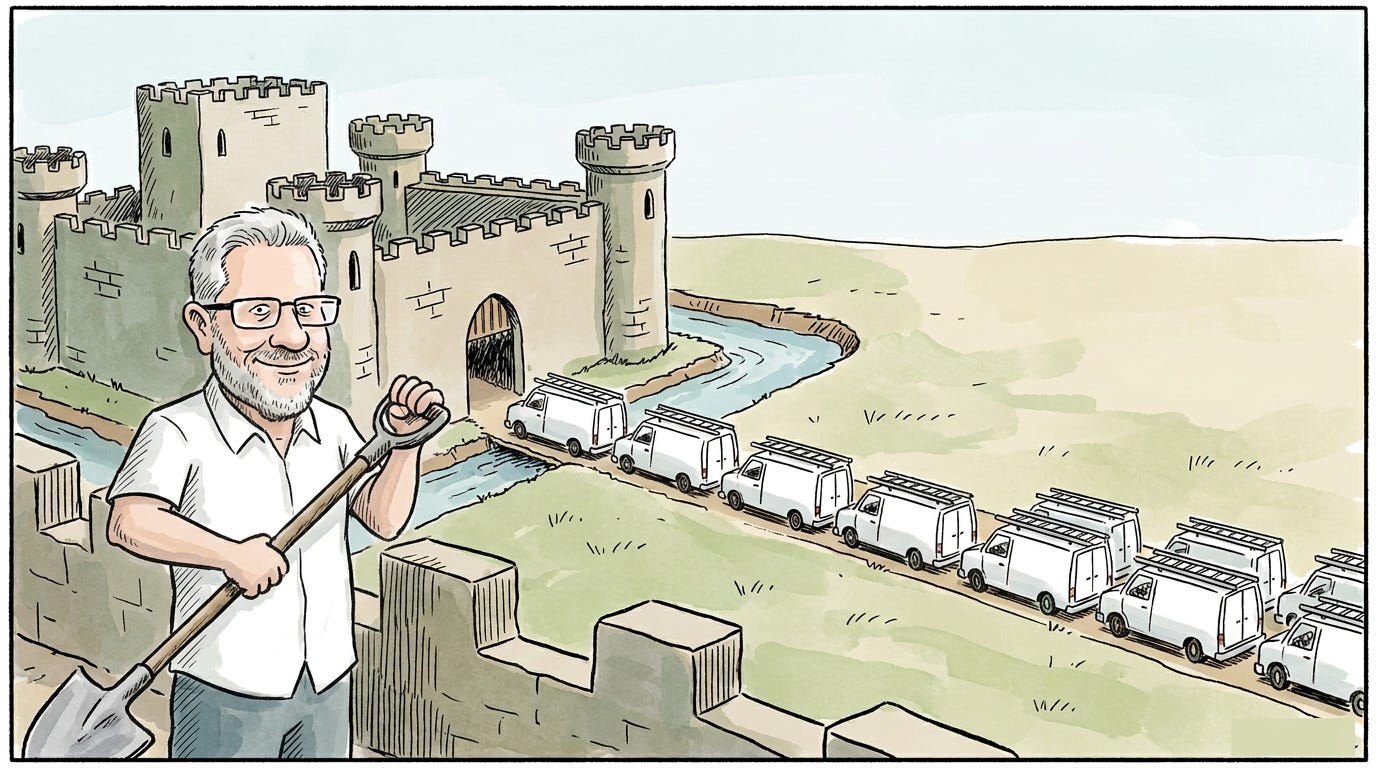
There’s a cost to that arrangement. A forwarded call goes into the phone provider’s network, back out, and into a Twilio or Telnyx number fronting the agent. That adds latency, extra failure points, and a three-way argument over whose fault the bad audio is. It also adds a per-minute charge on every forwarded call — some in the industry might call it a “hairpin tax.” Mike pegs it at a penny and a half a minute; Twilio’s list price is closer to 0.85¢ for a local number and 2.2¢ toll-free. Either way, it comes straight out of the platform’s margin on a product it is trying to price below a human receptionist.
Thankfully, commoditization of voice models is helping on cost. Retell, ElevenLabs, Vapi, Google’s Gemini Live, and more are competing and pushing down prices. ElevenLabs cut text-to-speech prices by up to 55% in May. Frontier speech-to-speech pricing has barely moved — though it will be a huge latency unlock for the ecosystem once models make progress. That said, phone line audio is even rougher than a laptop mic to parse. So the accurate claim is that good-enough voice is getting cheap, not necessarily that great voice is already a commodity. For a dental office confirming Tuesday’s cleaning, good enough is the bar. For more complicated interactions, we still have wood to chop.
Perhaps the most important issue in not capturing all voice communications of a customer, however, is that you really need the full spectrum in order to understand how the full job should be done. Let’s take auto dealerships, for example. Answering after-hours calls and transactionally scheduling service appointments is very unlikely to be a defensible use case long term. Understanding how that dealership services customers, interacts in order to sell new cars, follows up with prospects, calls suppliers to order parts — if you want to capture the value associated with doing the work soup to nuts, you need to have ambient access to all of these motions. And voice is a much more natural way to do that.
That leaves a simple way to think about the voice stack, which we’ll call Line, Agent, Record. The line is carriage: numbers, desk phones, E911, taxes, every call in and out. The agent is the model and orchestration on top. The record is the system the call writes to. The value is in what the platform can do with the live call, and that depends on the other two layers. In order to “do the work,” owning just one might not cut it.
The Four-Sided Race
Founders worrying about defensibility in this era usually look to the model labs. In Voice AI, you need to think bigger. As Mike shared on this episode: “if you don’t own the phone system, within a year, you will be competing with the phone system or the phone provider.” We see Voice AI as a four-sided race — each contestant with a different type of leverage.
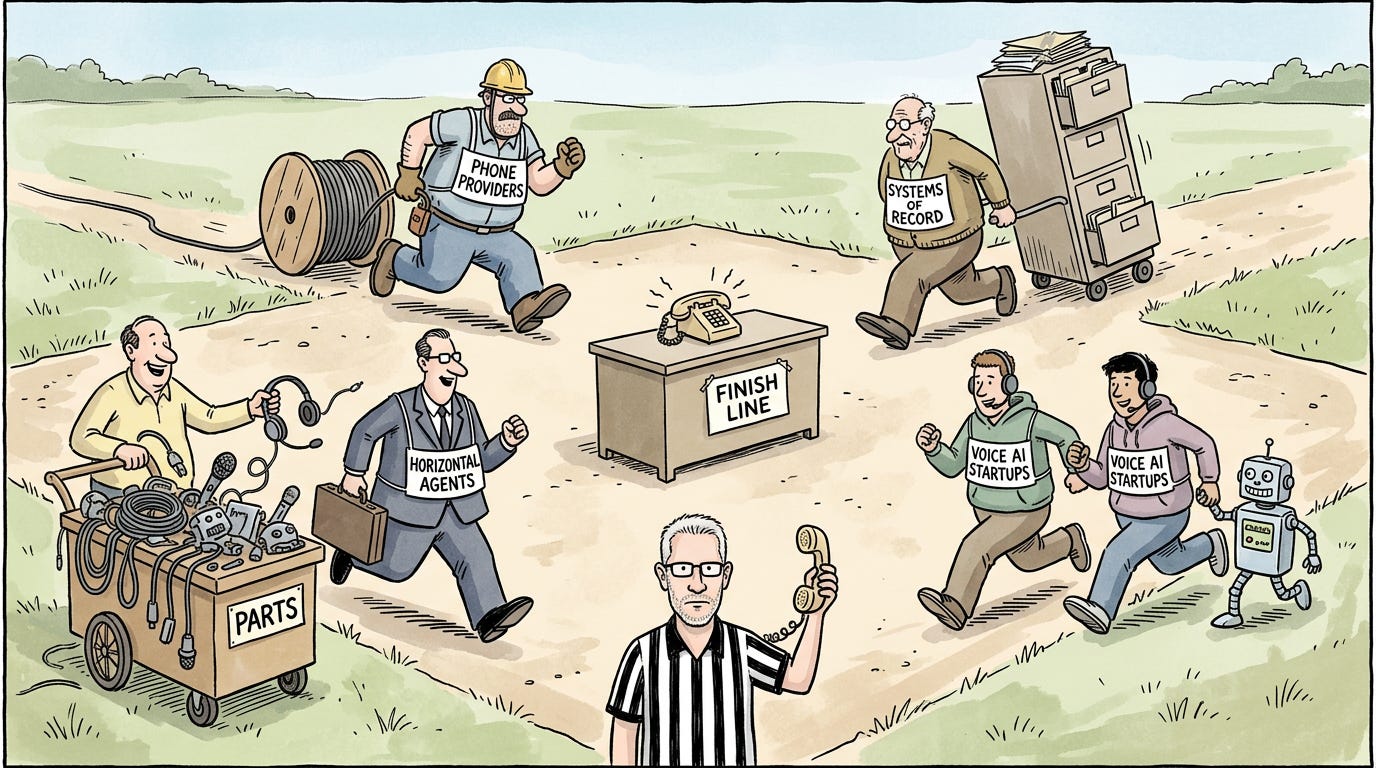
Phone providers (RingCentral, AT&T) own the line and the bill, and now sell an AI receptionist into it. Every call, no workflow.
Vertical systems of record (ServiceTitan, Weave) own the customer and the record, and increasingly the line too.
Vertical voice AI startups (Avoca, EliseAI) own the agent and sometimes the workflow, but usually hear calls through someone else’s line.
Horizontal agent platforms (Sierra, Salesforce’s Fin) own enterprise distribution. Salesforce paid about $3.6B for Fin, but the HVAC shop doesn’t buy from either.
While infra providers — Twilio, Telnyx, Vapi, Retell, ElevenLabs — are important players here, they aren’t really in the race, as much as they are selling running shoes and Gatorade on the sidelines. If we recall the Line, Agent, Record articulation of the stack: only a racer that holds both the line and the record can really win. Everyone else is renting their picks and shovels.
The phone providers, clearly worried about disruption, are leveraging their position to get a head start. RingCentral ended Q2 2026 with more than 16K paying AI Receptionist customers, up 400% year over year.2 About half its “AI ARR” came through the channel, including AT&T, which resells it to small businesses as Office@Hand. As Mike put it, their psychology is that “it’s their customer,” and every platform whose agent sits on top of them is “just creating pipeline.”
The systems of record are closing the gap. ServiceTitan sells its own phone system and voice agents. Last month, they reported that agent revenue and call volume each more than doubled QoQ. That’s a problem for Avoca, which raised at a $1B valuation in April selling AI call handling to the trades (and integrates with ServiceTitan). We wrote about the general version of this dynamic (owning a layer versus renting access to it) in Clear Eyes, Full Stack, Can’t Lose?. Voice AI is a particularly zero-sum case — after all, a customer can only have one phone system.
A Hole With No Bottom
If owning the line is so valuable, why don’t more vertical platforms do it? Because until recently, both available options were bad. You could build it yourself on Twilio — but in that case, in the eyes of regulators, you’re becoming a phone company. Mike described platforms that did exactly that and then received “a letter from the FCC or the California State Public Utility Commission” asking where their licensing and filings were. Note that “ephemeral calling” (tapping a button to reach your Uber driver) is lightly regulated — a general-use business phone line with 911 requirements is not. While regulating phone companies this heavily seems arcane, the incentives are clear. Mike counts 42K3 tax and fee jurisdictions in the US that “want a piece of the phone call.”
Though you might think “AI will help me navigate compliance,” it isn’t the only reason being the phone company is challenging. Incorporating complex, sometimes non-deterministic business logic into an applied Vertical AI use case brings a plethora of corner cases that need to be handled seamlessly. E.g., ring the front desk three times between nine and five, then send it to the agent, unless the billing rep is at lunch, and when they answer do X or Y depending on their accounts and recent customer sentiment scores. “It’s a hole with no bottom, man.”
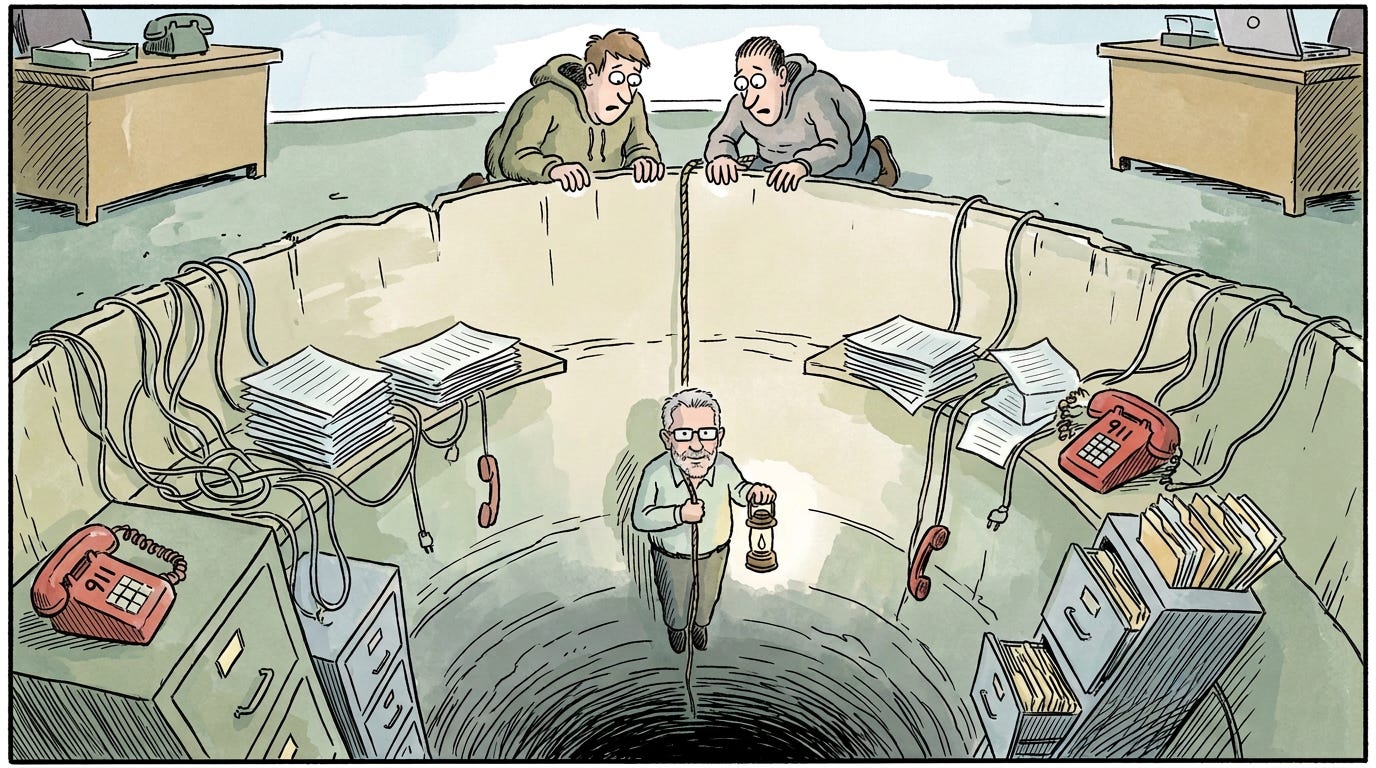
Mike describes DialStack’s bet as similar to the one Stripe made a decade ago: the regulated, corner-case-heavy plumbing should be one company’s problem, so every platform can own the customer-facing brand, functionality, and data they want to own. The analogy isn’t perfect — it shared scaling laws, even if there are different underlying scalers. Embedded payments turned Toast into a fintech company (about 82% of 2024 revenue) because payments scale with GMV — phone revenue scales with seats and minutes. Ultimately, Voice AI is more of a retention, data, and margin story than a revenue-mix story. As we discussed in our Payments as a Shadow System of Record piece, voice is a function many incumbents don’t own, making it a compelling first step to building a platform that can sit alongside, and perhaps eventually compete with, core systems of record. Most especially if that voice data allows you to abstract knowledge on how to do the work in a way no SaaS system ever could.
To date, the best public test case is probably Weave (NYSE: WEAV), which has sought to own the phone line in dental and optometry offices for years. Of course, they now also sell an AI receptionist on top of their stack. Weave did $239M of revenue in FY2025 at roughly 72% gross margin. But its net revenue retention runs at 92%4, and its growth accelerant lately has been payments, not phones. Owning the line didn’t make Weave immune to churn. Our read is that the line is necessary but not sufficient: it gets you every call, but the calls are only worth as much as the AI workflows they power.
The lesson is that, to capture the full Voice AI opportunity, owning one of the line or the agent may not be enough — but together, done right, they can be powerful.
Augment Before You Replace
Many see the opportunity in voice AI as synonymous with a replacement of current spend on labor: the front desk admins that still power most of voice business communications today. That consensus viewpoint, however, didn’t survive contact with Mike’s customer base.
He described voice use cases as a kind of hierarchy. At the bottom is a better voicemail: ring the front desk first, and send the call to an agent instead of a mailbox when nobody picks up. One step up is the smart switchboard, where the agent answers, figures out whether you’re paying a bill or asking about a new service, and routes you. Above that is transactional work, where the agent reads you your balance and texts a payment link. That final tier, in Mike’s view, is still “the shakiest,” especially from a human behavior shift standpoint. You could have several AI voice interactions that were seamless and helpful, but then just have one crappy one and remember the latter for a long time. Naturally, this is where evals come into play and why they are indeed incredibly important as Vertical AI founders think about agent construction.

While voice models will naturally improve, outside of highly transactional use cases, Voice AI founders still need to think deeply about the human-computer interface in their vertical of focus. Mike imagines an agent attached to every human call. The front desk gets a screen pop with the caller’s record (“is this Luke, calling about your appointment on Tuesday?”). Outbound quote calls get transcribed and logged automatically, which matters because, as Mike noted, call-logging compliance among sales staff is awful. One home-services platform on DialStack surfaces a warning mid-call that the furnace model under discussion is on a six-week backorder, along with two alternatives. Today, he’s seeing that on “the small business side, it tends not to be direct labor replacement.” It’s more so augmentation, both empowering human agents on the call and bringing them into the call only when there’s real human-to-human work to be done.
Which brings us to a bottleneck that all applied AI is learning how to navigate today. Human behavior. The IRS confirmation call is a good fit for AI; a call to a funeral home isn’t. Right now, we are in an interesting moment where voice AI is becoming more ubiquitous, but janky first use cases are actually increasing consumer skepticism about speaking with AI on the phone. With the advent of any new technology that makes volume cheaper, bad actors will take advantage. Thus, in the wake of blooming AI spam calling and texting, regulators are stepping in. Since February 2024, the FCC has treated AI voices as “artificial” under the TCPA, which means prior consent is necessary for any outbound AI calling. Inbound is significantly safer, both from a compliance and psychological standpoint (more on this in last week’s episode writeup, AI Is Making Sales More Human). Today, AI is largely winning when it amplifies what a human can do, and takes away the work no human wanted in the first place.
The Takeaway for Vertical Founders
If you’re building a system of record or action for a phone-heavy SMB vertical, voice may no longer be optional. Not necessarily, because voice is always the most important or valuable use case in your space (though sometimes it is); but also because it is the highest bandwidth mechanism by which to abstract the knowledge that you need in order to do the work. The agent (and the evals that go into it) is the most nuanced part, and necessary — but it’s also the easiest to own.
If you don’t have the data to properly inform and improve your Voice AI agent over time, however, you may never graduate from transactional, increasingly commoditized use cases. Own the line before the incumbent carrier and its channel partners sell your customers a good-enough agent for a song. Treat the call data as a strategic asset. As Mike warned on this episode, a carrier with your call data and an integration into an incumbent system of record “can probably [ship] a pretty good voice AI offering for… 75% of the verticals out there.”
As a Vertical Voice AI founder, you should race to own the transactional use cases, but position yourself to build for the most complex and transformational use cases of doing the work soup to nuts. If you fail to own the data and / or record, the exposure runs in both directions, from the carrier below you and the system of record beside you.
The bigger, defensible Voice AI vision owns a deep workflow, related system-of-record I/O, the agent on a constant eval-driven improvement cycle, and the infra that lets you capture the full spectrum of data to power it all.
See you next week.
Key Moments from this Episode
00:00 — Intro
03:29 — Why vertical SaaS should own the phone
11:32 — The voice AI use cases actually working today
23:00 — The overlooked opportunity in ambient voice AI
28:32 — Why voice AI is harder than text AI
40:07 — Why vertical SaaS hasn’t fully embraced voice yet
47:00 — Why vertical-specific voice AI could win
51:20 — The most interesting voice AI use cases
54:36 — Where the next voice AI boom could happen
Needham & Co., Cloud Communication Bytes, Vol. 1 (September 28, 2026), p. 4: ~$0.40 per AI-handled call vs. $7–12 for a human agent; voice AI ~10% of B2C service calls today; ~0.25% of global voice minutes.
RingCentral, Q2 2026 earnings call script (July 23, 2026).
Weave Communications, Q2 2026 Form 10-Q: net revenue retention 92%, gross revenue retention 89%.