

On September 23, we hosted the second annual Verticalist Summit in San Francisco, a half-day, invite-only gathering of founders, operators, and investors building Vertical AI. Last week, we shared the day's first session, where Euclid’s Nic Poulos covered the State of Vertical AI and walked through our research on where value is accruing in the AI application layer.
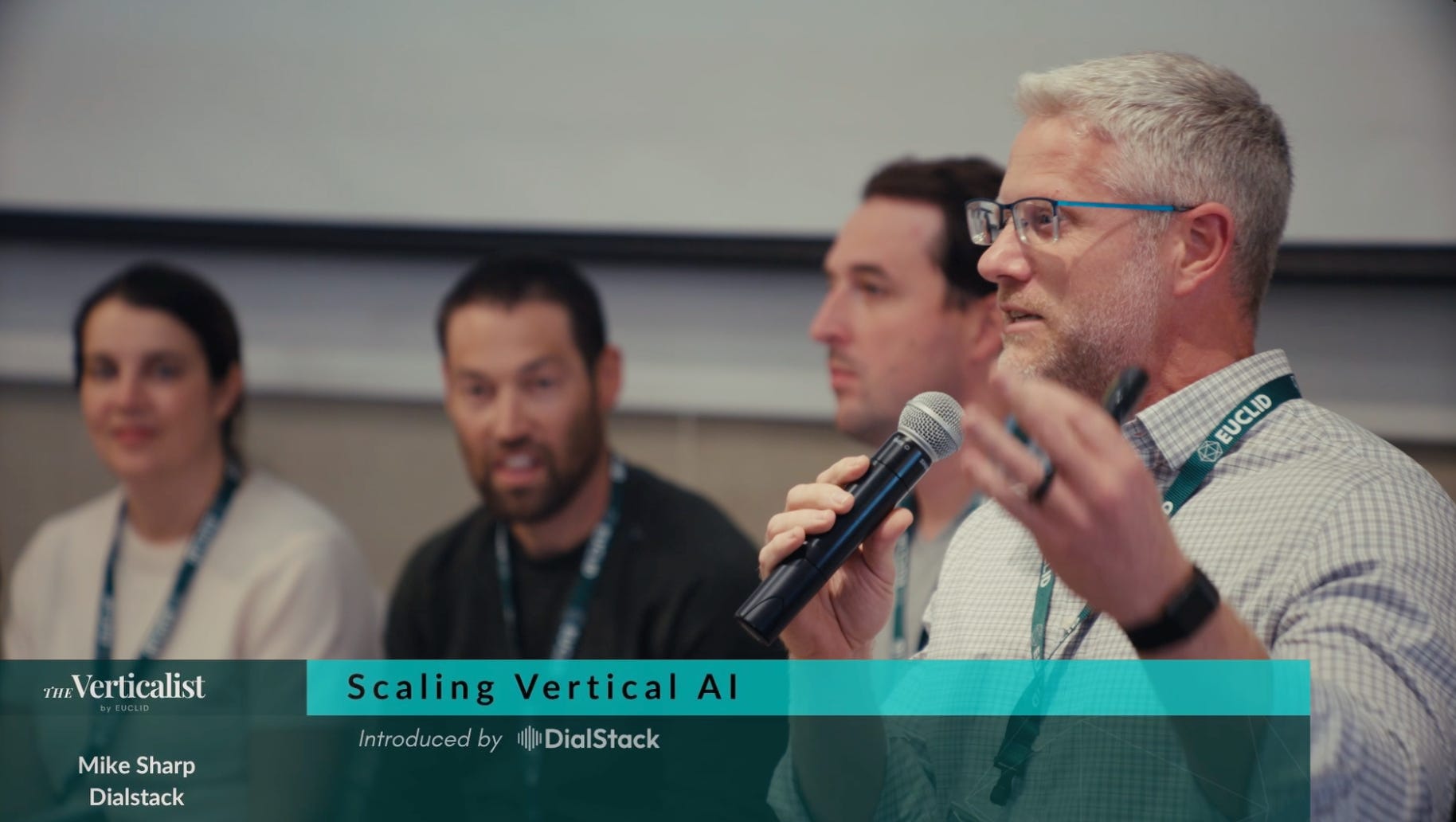
Today, we’re sharing our go-to-market panel, Scaling Vertical AI. It covers how sales and distribution are changing in the AI era, from founder-led sales to FDEs. Moderated by Mike Powers (BuildVision), panelists included Justin Levine (Shepherd), Kyle Norton (Lassie), Cecilia Ziniti (GC AI), and Roland Ligtenberg (Housecall Pro). Here are three moments you shouldn’t miss:
6:08 — “ARR per unit of go-to-market effort”
12:08 — Cecilia’s navy blazer story
20:31 — Super Pros, and why nobody sells to a plumber like a plumber
See our write-up below for a breakdown of the five key learnings every Vertical AI founder should take away from the panel:
Work every seat, then hire people better than you
Optimize for ARR per unit of effort
Sell the service, not the AI
Let your customers close
Warehouse everything your reps hear
And in coming weeks, stay tuned for three more panels from the Summit:
Nov 17: AI in Healthcare.
Moderated by Charles Hudson (Precursor Ventures) with Christophe Rimann (Camber), Mike Kopko (Pearl Health), Daniel Kador (OpenAI) and Eddie Czech (Indie Health).Nov 24: AI-Native Marketplaces.
Moderated by Mike Duboe (Greylock) with Matt Greenberg (Handshake), Ludo Antonov (SuperMe) and Andrew Silard (OpenRouter).Dec 1: The VC Panel.
How investors are underwriting Vertical AI, moderated by Omar Elayat (Euclid) with Dave Yuan (Tidemark), Brian Feinstein (Bessemer), Hunter Walk (Homebrew) and Nikhil Basu Trivedi (Footwork).
Big thanks to our sponsors for making the day happen: Stifel, Latham & Watkins, DialStack, Founder Shield, and Tight.com.
When Founder-Led Sales Stops Working
Cecilia Ziniti sold GC AI’s first $16M with herself and three reps. She’d been a general counsel for a decade and a lawyer for almost twenty years, and she had no idea how software sales was supposed to work. “I didn’t know that you couldn’t close a deal in 21 days for $80,000,” she said. So she did.
That’s founder-led sales: the founder knows the buyer cold and doesn’t know what’s supposed to be impossible. It stops working when the company needs more deals than one person can carry.
Mike Powers, founder of BuildVision (a Euclid company), moderated a panel on how to make that jump. Roland Ligtenberg grew Housecall Pro from selling in coffee shops to a sales team of 500 to 600 people. Kyle Norton ran revenue at Owner.com and had just started as CRO of Lassie. Justin Levine co-founded his second company, Shepherd, where he sells commercial insurance to construction and industrial companies. And Cecilia is in the middle of the handoff right now.
Top Five Takeaways from the Panel
Five takeaways that stood out to us from the panel:
1. Work every seat, then hire people better than you
Roland’s path is the textbook version. Back in 2015, he was selling Housecall Pro himself. Then he hired two SDRs to cold call while he played AE, promoted them to AEs, and moved himself to customer success, a little further from the deal each time. His argument: working every role is how you learn what good looks like, and how to spot someone better than you when they walk in. “The less ego, the better.”
Cecilia was candid that letting go has been the hard part. “Learning when to let go of control has been a journey,” she said. Her CRO didn’t come from a search firm. An investor made the intro.
Kyle had the other chair's view. Before his first day at Owner.com, he’d spent months advising the founder, so the handoff came with trust already built. He sees more good CROs doing fractional or advisory work before they commit, as a two-way vetting process. As he put it, “You vet out what of the founder’s pitch is real.” If you’re hiring your first sales leader, that’s a cheap trial run.
2. Optimize for ARR per unit of effort
This was our idea of the day. Kyle says it doesn’t really have a name yet, so he calls it ARR per unit of go-to-market effort. A $5M to $10M enterprise deal and a stream of transactional SMB deals can add up to the same ARR, but the human effort behind them is wildly different.
The company he’d just joined runs a six-to-seven-day sales cycle: a couple of calls, $15K to $20K ACVs, no solutions engineers. He sees a clear line to reps carrying $5M to $6M in ARR each. At that productivity, adding $50M in ARR takes about ten reps in a year. “That’s a pretty different business than how I had to build it a couple of years ago.”
Getting there isn’t only a sales problem. Kyle pointed at pricing, packaging, and GTM strategy as the levers. It’s also a tooling problem. Owner.com built its stack in the SaaS era, with Salesloft and all, and carried that tech debt. Starting fresh, Kyle thinks most sales tools are built for email-heavy or enterprise selling, not SMB, and expects to build a lot from scratch.
Compare that to Housecall Pro, where 500 to 600 reps still smile and dial for four-digit ACVs. Both models work, but they’re very different businesses at scale.
3. Sell the service, not the AI
Justin sells to two customers at once. Shepherd’s buyers are builders and operators of large assets, and almost all of them buy through brokers. They see that as an asset, not a problem. So Shepherd has to win the broker and the end buyer.
His bigger point applies everywhere. Founders in traditional industries often assume customers want to skip the humans and plug into an MCP. Justin thinks it’s the opposite. These are relationship businesses, and buyers want great service that feels different because better tools power it. Shepherd puts the AI in the hands of its reps and underwriters, so quotes, pricing, and servicing come back faster and more consistently than anything customers have seen in insurance.
Cecilia’s version is a navy blazer. For a milestone birthday, she splurged on a personal shopper, who ran discovery over email before they ever met. By the time Cecilia showed up at Neiman Marcus, a rack of navy blazers was waiting. She bought four, almost identical. Without that discovery, she says, there’s zero chance she buys four.
Now “get a navy blazer” is shorthand inside GC AI. Lawyers are arguably more scared of AI than software engineers, since AI is changing their livelihood. Her reps win by showing a buyer they understand their pain point and that the product makes them look like internal heroes. GC AI even teaches classes on AI for lawyers.
4. Let your customers close
Housecall Pro borrowed from Airbnb’s Superhost program and built a bench of “Super Pros,” customers who join live sales calls as references, not a case study PDF but an actual plumber on the call. “Nobody sells Housecall better to another plumber than another plumber,” Roland said. Housecall subsidizes their software and gives them early access to alphas and betas. In return, deals close faster, including ones that would’ve gone to ServiceTitan. A few Super Pros have it tattooed on them.
Kyle ran the same play at Owner.com. One customer loved it enough to do four closing calls a week. Owner paid him, subsidized his subscription, and flew him to a big Vegas expo every year, because he loves Vegas.
5. Warehouse everything your reps hear
Housecall Pro started with one product: a job timeline that could take card payments. It now sells 16 products, including some AI-native offerings built on its system of record. Cross-selling works because the company already knows what hurts each customer. Roland’s warning: keep the context your sales team generates, because it’s a long-term competitive advantage. Many teams can’t answer “are we still recording our Zoom calls?” without debating whether that’s IT’s job.
Cecilia has the opposite problem: the context lives in her head. GC AI turned out to be a great fit for convenience store chains, which deal with constant employment questions and need 50 permits every time they open a location (one of them is an egg permit). Five of the top seven chains are customers, including Love’s Travel Stops, a $26B business that, as she pointed out, is bigger than Palantir. Turning that pattern into how GC AI staffs sales, success, and its attorney-led solutions team is her biggest effort this year.
It’s the same lesson as the job byproduct data in Who Wins the AI App Layer?, pointed at GTM.
Sidebar — GTM in Voice AI
Big thanks to Mike Sharp, co-founder and CEO of DialStack, for introducing the GTM panel and partnering with us on the Verticalist Summit. DialStack is enabling vertical platforms to own their entire stack — customer numbers, desk phones, 911, caller ID — along with the call data underneath. Voice AI founders should take note.
As we covered in Why Your Voice AI Agent Isn’t Enough, current Voice AI infra options leave data and cash on the table. DialStack estimates platforms give up 25-30% of potential ARPU when customers buy their phones elsewhere. You should own the agent, but also the data that feeds it. Especially if your product value prop is increasing revenue or conversion, having all the context matters. As Mike put it on stage, don’t be “half pregnant with the phone call.”
What to Do With This
This doesn’t mean, of course, that big sales teams are dead. Housecall Pro’s 500 to 600 reps sell into a market with four-digit ACVs, and it’s built an incredible business that way. But for most Vertical AI companies selling today, the panel sends a clear message: pricing, packaging, tooling, and customer advocates do more for growth than hiring volume. Think twice before scaling to solve your problems.
Here’s a quick heuristic for Vertical AI founders. Take your last ten closed deals and divide each ACV by the human hours it took to win it: calls, demos, SE time, legal back-and-forth. That’s your ARR per unit of effort, as explained above. If it’s falling as you add reps: fix pricing, packaging, and tooling before you hire more. Finally, don’t sleep on “recruiting” your customers — in the early days, one who’ll get on a call for you is worth multiples of their ACV.
Finally, if you’re making your first sales leadership hire, borrow Kyle’s approach. Try before you buy. CROs doing advisory or fractional work in between — or even during — roles is more common than ever. Engaging with one before committing is a smart way to de-risk fit on both sides, before you make the leap.