

Per-seat revenue models are facing major headwinds as AI makes labor more efficient. Yet overall, Vertical AI platforms are more capable, performant, and impactful on B2B customers’ businesses than ever before. How are founders capturing that value? The hot answers today are outcome pricing and usage pricing — both economically attractive, but an imperfect (or unproven) fit in many use cases. One answer has been core to the vertical software business model for years: payments. Seats may shrink when agents do the work, but if those agents are effective, payments should only grow. Our guests on today’s episode of Verticals make the case that, in the AI era, more founders should look to payments-linked monetization — we’ll share their best tips on how.
The Takeaway
Payments scales with GMV, not headcount. It's less exposed to AI cutting seats.
Don't sell it at cost. Jo wants partners at scale above 25–30 bps, and 50+ bps when priced on value.
Your customers pay their suppliers too. Virtual card interchange runs 100–200 bps, but only on suppliers who take cards.
Only build that where the bills are big. Property management and school districts, yes; salons, probably not.
Agents will pay the bills. William's call: most B2B bills paid by agents by 2030.
The Episode
Jo Phillips and William Corbera met at The Cucaramacara, a Colombian salsa club in Miami — or more accurately, an apartment pre-game beforehand. Sixteen years later, they're co-founders and co-CEOs of Payabli, which gives vertical software companies the infrastructure to run payments as their own business, and the onboarding, underwriting and compliance work behind it.
William co-founded RevoPay with a brother in 2003 and bootstrapped it for 16-plus years, digitizing rent, HOA, utility and tuition payments before it sold to OSG in 2022. Jo was ServiceTitan's head of sales from 2015 to 2019, when the company was scaling fast following a breakout Series B. Its third-party processor, Jo says, was "butchering the customer experience. We weren't monetizing well. We didn't really know any better, frankly." Jo brought William in to help architect what became ServiceTitan Payments.
Payabli started without a product. For two years the founders resold a legacy gateway, pitching with an aspirational deck with ServiceTitan, Toast and Mindbody (though none of them were customers at the time). The story ran: these giants have figured out payments; we can help you do the same. Since then, Payabli has raised $60M across rounds led by QED and Fika, serving about 100K merchants today, with revenue up 4x YoY. Their team t-shirts still carry Jo's thesis:
If you're a software company, you're a payments company.
Founders considering payments should tune in. We’ll discuss where the 3% actually goes, what a good take rate looks like, and how the traditional Vertical SaaS payment revenue stream was only a fraction of the opportunity.
AI Is Shrinking Seats, but Growing Swipes
The fear is simple: seat-based pricing assumes a person per license, and Vertical AI is built to need fewer people. A front desk that books itself, a dispatcher that routes itself, an AP clerk that never logs in. Some of that fear is overdone, as we discussed in our recent essay False Profits. But the trend is clear enough — at Euclid, we’d estimate we’re seeing fewer than 20% of recent pitches monetizing on subscription, versus 75%+ just a few years ago.
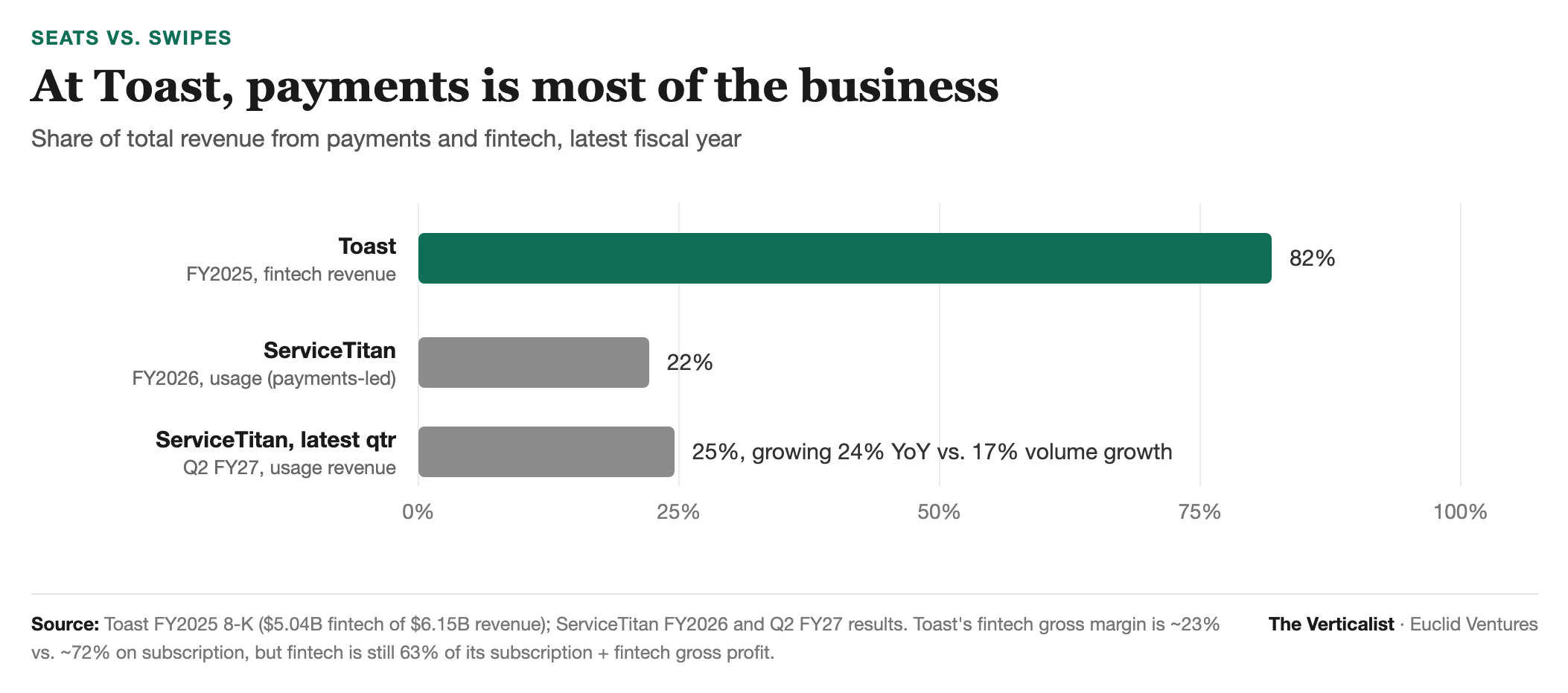
The last decade of Vertical SaaS proved payments as a core attractive revenue stream. Toast reported $5.04B of its $6.15B in FY2025 revenue from fintech, 82% of the total. At ServiceTitan, payments-led usage revenue is 25% of the latest quarter and growing 24% a year — with monetization growing faster than volume, at 17%. The two knocks on payments are variability and margins. Toast’s fintech gross margin is about 23%, against 72% on subscription, so a dollar of payments revenue isn’t a dollar of seat revenue. Even so, fintech is 63% of Toast’s subscription-plus-fintech gross profit.
Payments, however, is particularly well suited to the headless future many imagine for the post-AI application layer. Not all agree with that vision. In a survey from the recent Vertical Software Summit, 70–80% of founders were "refusing to surrender the UI." Even Vertical AI hasn’t left the per-seat party completely: Harvey charges a seat per lawyer, and Abridge a license per clinician.
Jo does share, however, that a small but growing number of Payabli partners are already going headless, letting customers work through Claude instead of the app (hence the recent release of Payabli’s own MCP server). When a customer's agent pays an invoice through their rails, they still monetize, no seat or login required. For payments revenue streams, the control point — in Payabli’s case, authorization and the vendor record — matters more than any screen.
Eight Moves for Making Payments a Business

1. Stop selling payments at cost
A lot of founders setting their take rates seek to undercut Stripe. For example, something like 2.8% plus 20 cents. Jo calls it "one of the biggest mistakes" founders make. If your payments experience is built for your vertical — providing unique value over and above horizontal solutions — you can charge more for it. Payabli has partners charging over 3.5% with very happy users. More often than not, founders start with discounted pricing, but earn the right to grow those rates substantially as adoption and product capabilities grow.
Move: price payments against the value of your integrated workflow, not against rate cards of the horizontal status quo.
2. Know your number
Founders need to know their take rate, and continually benchmark it.
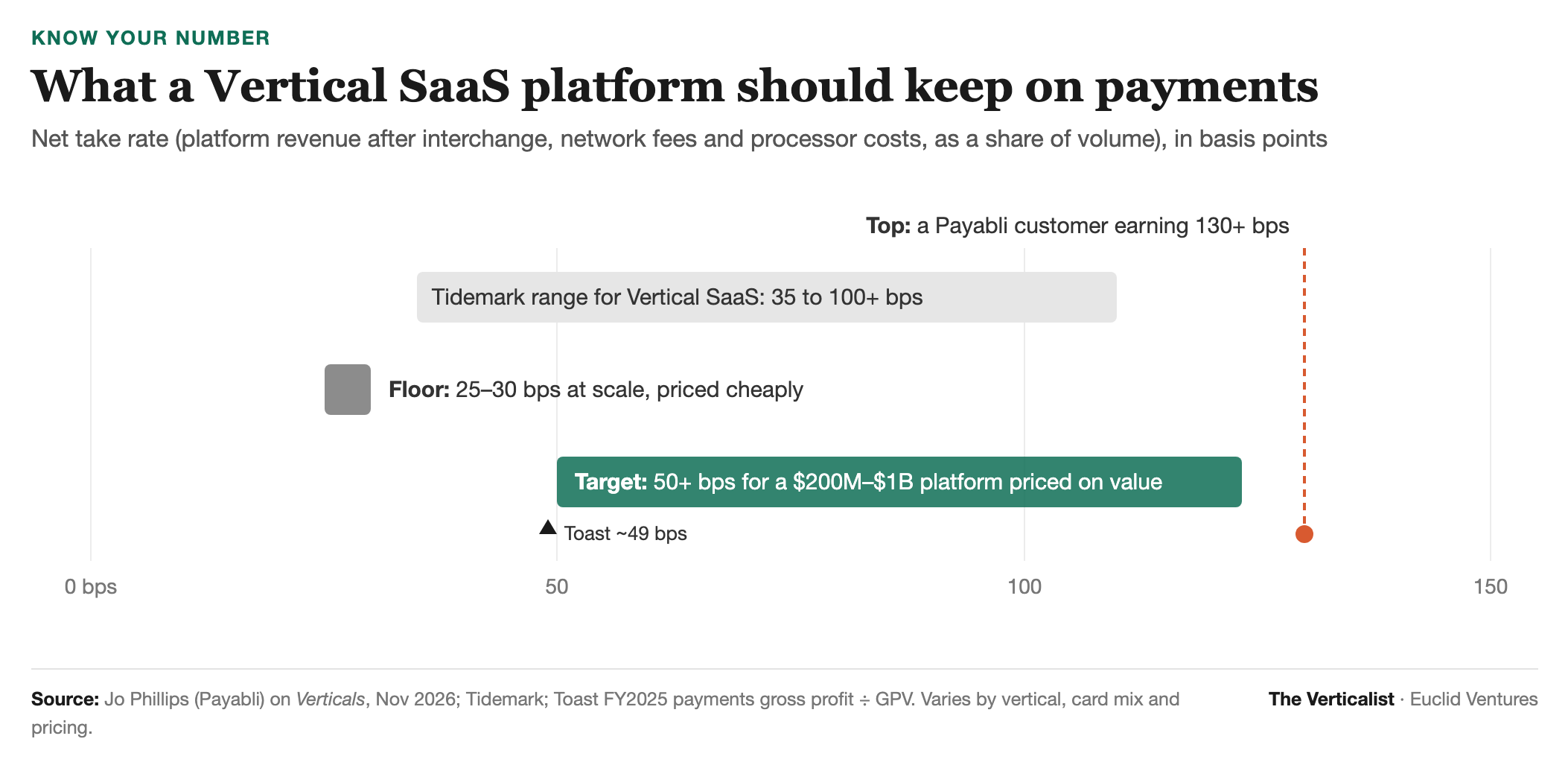
Tidemark puts Vertical SaaS net payments take rates anywhere from 35 bps to over 100 bps. Toast, by our math from its FY2025 payments gross profit, keeps about 49 bps. In our past episode on Vertical FinTech, ServiceTitan’s head of fintech Rahul Hampole told us 80–100 bps is a reasonable early target for card payments.
Here’s how Jo suggests founders think about take rates:
Floor: 25–30 bps is "the floor of what I want to see a partner receiving," at scale, and lower if you're early or priced cheaply.
Target: for a platform processing $200M–$1B, "anywhere in excess of 50 bps you should be getting" if you price on value.
Top: one Payabli customer makes over 130 bps.
At $500M of volume, the gap between 30 bps and 60 bps is $1.5M a year of revenue. For a Vertical AI or SaaS company with $1,000 ACVs, that's as much revenue as 1,500 more customers.
Move: compute your net take rate every month, and ask your partner for the card mix behind it.
3. Make your partner open the black box
On a card payment, most of that ~3% you charge isn't yours to keep. Interchange goes to the card issuer; network fees go to Visa and Mastercard; the processor takes its buy rate; and your platform keeps the spread.
At ServiceTitan, Jo says, the residuals arrived as "this large file" each quarter and looked like good revenue… until they were compared with volume. These payments reports can run 50+ pages. Jo's rule: if a partner won't walk you through interchange, network fees, its buy rate and who gets what, it’s a red flag.
Move: ask for residual reports that break your margin into those layers and explain month-over-month moves (card mix, downgrades, etc.).
4. Your vertical sets your ceiling
Jo splits verticals into two camps. "Need-to-pay" verticals (e.g. property management, education, utilities) get preferred interchange from the card networks and can often charge convenience fees of 3–3.5%, leaving a wide spread. More discretionary verticals (e.g. hospitality, e-commerce) pay higher interchange, thinning the spread.
Move: benchmark against your own vertical. A hospitality platform at 40 bps may be “outperforming” a utilities platform at 70.
5. Don’t sleep on the “money out” opportunity
Every customer that takes payments also pays bills: suppliers, vendors, utilities, contractors. William says that, depending on the vertical, the volume paid out can be about as large as receipts. Historically, most platforms have focused only on inbound.
The main way to earn on it is a virtual card. Your platform (e.g. Payabli) becomes the card issuer, pays the vendor with a card, and earns the interchange the vendor's processor pays. "Interchange generally ranges from 100 bps to 200 bps," Jo says, against the 30–40 bps a platform might earn on incoming payments. Vendors that won't take cards can be offered faster payments (real-time payments, same-day ACH) for a 1–1.5% fee. William says some Payabli partners already make "millions of dollars a year on payables."
The public numbers add a caveat. Blended across all the ways bills get paid, AP earns little: about 16 bps at BILL and about 37 bps at AvidXchange before TPG took it private. Most bills still go by ACH or check, and virtual cards are only about 7% of US B2B volume by one industry estimate. Of the suppliers that won't take cards, 68% blame the fees.
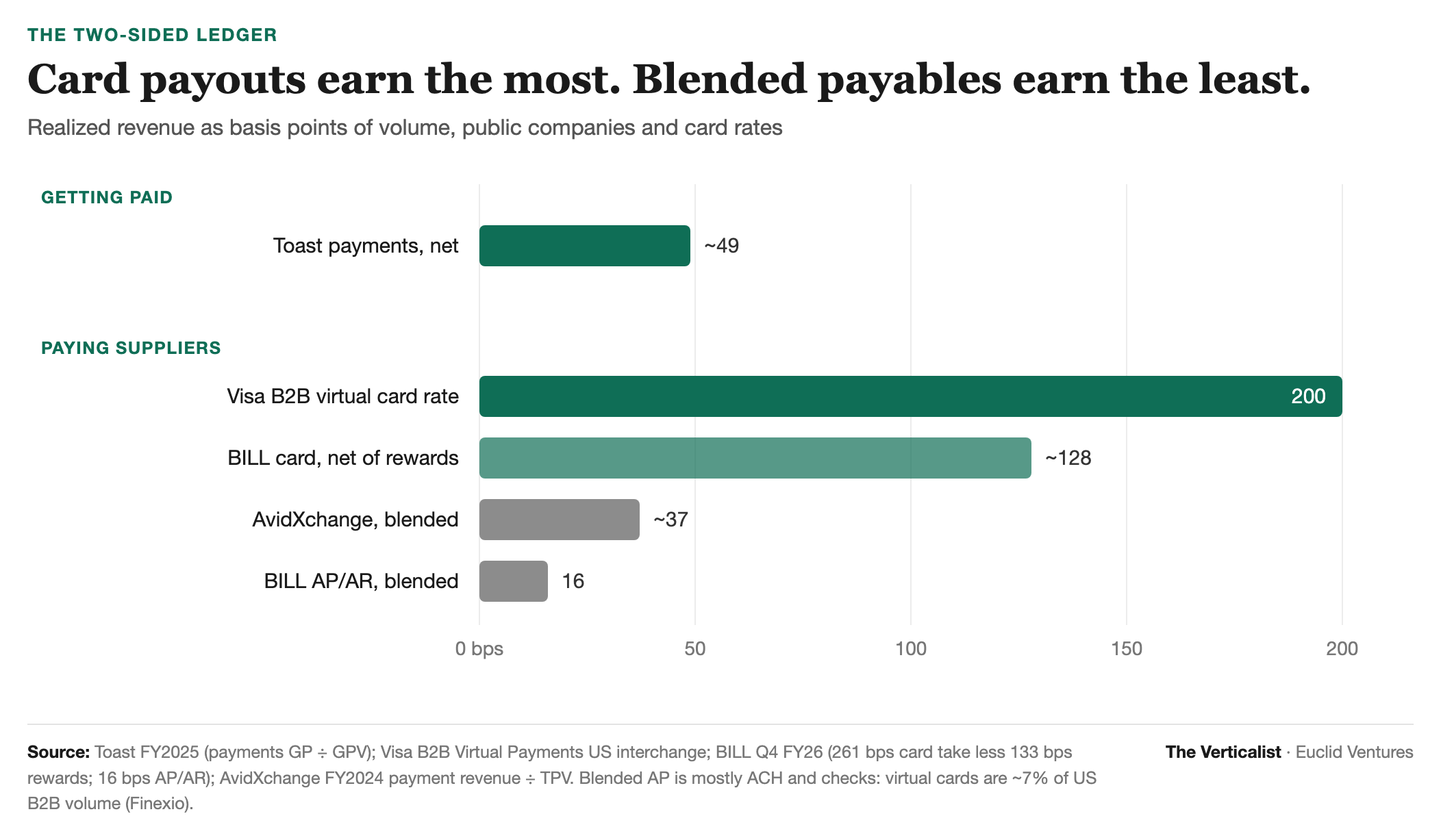
So card acceptance is the lever. By our rough math, if the card nets you around 130 bps, you need about a third of supplier spend on cards before AP matches a 40–50 bps take on incoming payments. That's why Payabli puts so much into vendor enablement, down to voice agents that call suppliers and ask them to take a card (more on that in move 8).
Move: pull a month of your customers' outgoing payments (from their accounting integration or a survey) and size it next to your incoming volume.
6. Build where the bills are big
Outbound payment flows and behaviors vary wildly between verticals. Car dealerships, schools, and local governments, for example, run serious volume — sometimes across tens of thousands of individual checks. A platform serving salons or HVAC companies may have a more modest opportunity on money-out.
This also means different verticals need differently structured products. A general-purpose card probably won’t work for a property-management AP product handling outflows to critical utilities, at high frequency, across thousands of doors.
Even where the payments revenue is small, however, it has clear retention value. In more complex flows, it can even spawn peripheral products that can be independently monetized. Jo shared that several of their partners have built their own invoice ingestion and approval flows on top of Payabli's payouts platform — in effect a Bill.com inside their product — and charge a subscription for it.
Move: rank your verticals by bill volume and how painful paying them is today. Build where both are high.
7. Manage partners: negotiate and plan your exit
Payment partnerships are often negotiable, with many levers to pull. Jo's top two fees to push on: monthly minimums and 1099 compliance fees. If pricing is so complex you need to pull in team members to understand it, Jo said, that’s another red flag.
At Toast scale ($195B of payments a year), becoming your own payment facilitator and owning the stack end to end is a fair call. It’s one expression of the verticalization consideration we discussed at length in Clear Eyes, Full Stack, Can't Lose? Achieving 15%+ market penetration, of course, is no easy feat. For earlier-stage founders, Jo's advice is to pick a partner you can eventually graduate from, without a mess.
Move: before you sign, ask how you'd take over boarding, underwriting and risk later, and what it costs.
8. Build agents around painful payments motions
Gartner expects 90% of B2B buying to be agent-intermediated by 2028. William took it a step further, predicting that by 2030, AI agents would pay the majority of B2B bills. "It's aggressive, but it's real and it's happening."
We argued B2B would lead agentic commerce in The Dark Marketplace — Payabli is building for that future. Jo’s favorite example, right in line with our essay, is two agents negotiating a surcharge: the buyer’s agent offers 1% instead of 3%, and the vendor’s agent accepts. Already, Payabli’s agents can find the right payment contact and portal for each vendor, and call vendors to ask whether they'll take a virtual card for invoice 12345. Nor are they the only ones. In October, Visa, BILL and Billtrust launched pilots for agents paying invoices through supplier portals.
While they seem even more antiquated, checks likely have more staying power. The AFP's 2025 survey puts them at 26% of B2B payments today. William guessed they wouldn’t run below 10% of payments until maybe 2035 — in large part because payers like the float.
Move: make sure your payments stack can be driven by an agent (APIs, MCP, clear permissions), with vendor verification built in. On payouts, as William put it, "once it's gone, it's gone."
The Takeaway
Seat pricing isn't going away next year, and payments isn't a cash cow for every vertical. But if Vertical AI does what it promises, each customer will do more work with fewer people, resulting in more net money moving hands. Any way you cut it, a revenue stream that scales with volume rather than headcount is increasingly interesting.
Vertical AI founders exploring payments should treat it like a business unit, with its own P&L, rather than just an add-on feature. Take it seriously: know your net take rate, price on the unique value, and don’t forget the money-out side of the ledger. In the right verticals, payments already out-earn subscriptions — and with agents doing more of the paying, opportunity may be expanding faster than you think.
See you next week.
Key Moments from this Episode
00:00 — The hidden revenue opportunity in SaaS payments
01:11 — How a Miami salsa club started a fintech partnership
06:53 — Opening the black box of payment processing
09:15 — Why the cheapest payments provider isn't always best
12:50 — What makes a payments infrastructure partner different?
15:13 — What is a good payments take rate?
19:49 — The money-out opportunity most founders miss
20:37 — How to monetize supplier and vendor payments
23:29 — Building an embedded accounts payable business
26:04 — Virtual cards, interchange and new revenue streams
29:25 — Can money-out become as big as money-in?
32:03 — How AI is changing payment infrastructure
41:30 — Will vertical SaaS become headless?
44:08 — The payment fees every founder should negotiate
45:18 — When should SaaS companies own their payment infrastructure?
46:29 — Will AI agents pay most business bills by 2030?