

On a call with investors last quarter, Marc Benioff unveiled Salesforce's next big idea: pricing on true business outcomes.
We’re moving to not just kind of outcome-based pricing, which is [like,] ‘We completed this many phone calls, therefore, give us $2.’ We want to be able to say, ‘No, we improve revenue by this much, so give us $2 because we made you $20 or we made you $40.’1
Not just actions taken, but a share of revenue lift. Salesforce has spent 25 years telling customers its software grows their revenue. Now it wants a cut of the growth. What, then, were all those seat subscriptions paying for?
He went further on Jim Cramer’s show shortly after: “[we’ll] build the system for nothing and we’ll take a percentage of your business outcome,” whether that’s profit, revenue, or savings.
Marc isn’t alone. OpenAI is reportedly offering outcome-based pricing to a handful of enterprise customers (The Information’s reporting calls it an “industry-wide movement”). Sequoia’s pricing deep-dive with Paid founder Manny Medina recommends that founders move up the “pricing maturity curve,” from activity and workflows to outcomes.2 Bill for results instead of seats or minutes, the thinking goes, and you’ll align incentives perfectly with your customer. And, of course, capture the surplus value your product creates as the work gets cheaper. The logic is simple and alluring: pay-for-performance in its purest form.
We think outcome-based pricing is bad advice for most Vertical AI founders. It’s rare for a reason:
Both sides have to measure the result and agree on it, perpetually
Outside of a few tried-and-true use cases, this is rarely achievable today
It assumes technology diffusion, category creation, and a new pricing model all coalesce within the next several years (which is unheard of)
So why are so many AI leaders and investors pushing founders to adopt it now?
Lots of Talk, Few Takers
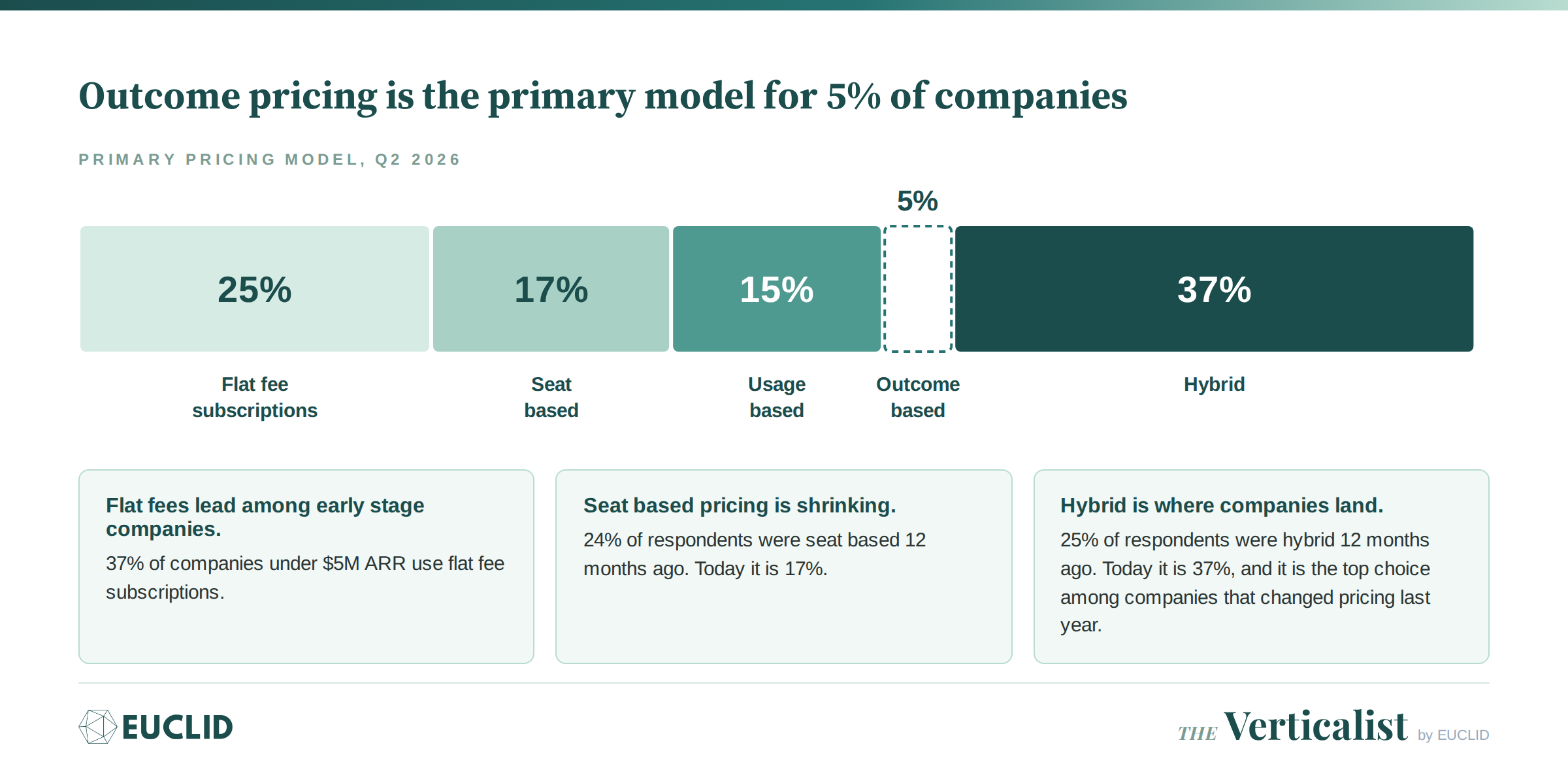
For something everyone’s talking about, outcome pricing barely shows up in the real world. In Kyle Poyar’s 2026 survey of 230 software and AI companies, just 5% named it their primary model. That’s the same share as in his 2025 survey and up from 3% in 2024. If this is where the market is headed, it's taking the scenic route. The most common model is hybrid pricing, at 37% of respondents, with some adding usage or outcome fees.
There are two reasons outcome pricing sounds more popular than it is.
First, because everyone counts it differently, everyone can claim it. ICONIQ’s State of AI 2026 puts outcome pricing at 23%, but allowed respondents to pick more than one model. Bessemer’s 2026 pricing playbook describes EvenUp’s fee per demand package as outcome-based.3 Poyar, on the other hand, counts that as a fee for completed work and saves outcome for success fees.4 Stripe's 2025 pricing survey says 32% of businesses offer outcome-based pricing, and Stripe calls its own pricing "outcome-based at its foundation," since you only pay when a charge goes through. By that logic, so is Visa. Count loosely enough, and everything’s an outcome.
The second reason is that it’s great marketing. If AI is so good, and its builders so confident, that it can be priced only on the P&L impact it produces, it must be next-level powerful. And when everyone else, including the model labs, is singing its praises, those pricing the “old way” must be behind the curve.
The pitch works even better on investors. Price on the value you create, and your market is unbounded: sized against the customer’s entire P&L, not their software budget. Apparently, AI applications will be the first software market where rivals never undercut each other and customers willingly hand vendors the surplus.
How AI Software Is Priced Today
“Outcome-based pricing” should refer to two different things:
A fee for completing an agreed job: e.g., $X per resolved customer support ticket
A share of the value created by a product: e.g., a % of recovered collections
In either model, the customer is charged only when an agreed-upon success condition is met. The first kind is deterministic, giving both sides a clear billing event. The second kind, a share of value (Benioff’s pitch), asks both sides to agree on what the result was worth and how much of it the vendor caused. Per-minute billing, per-document fees, and a percentage of payments processed pay out whether or not that condition is met, which makes them something else.
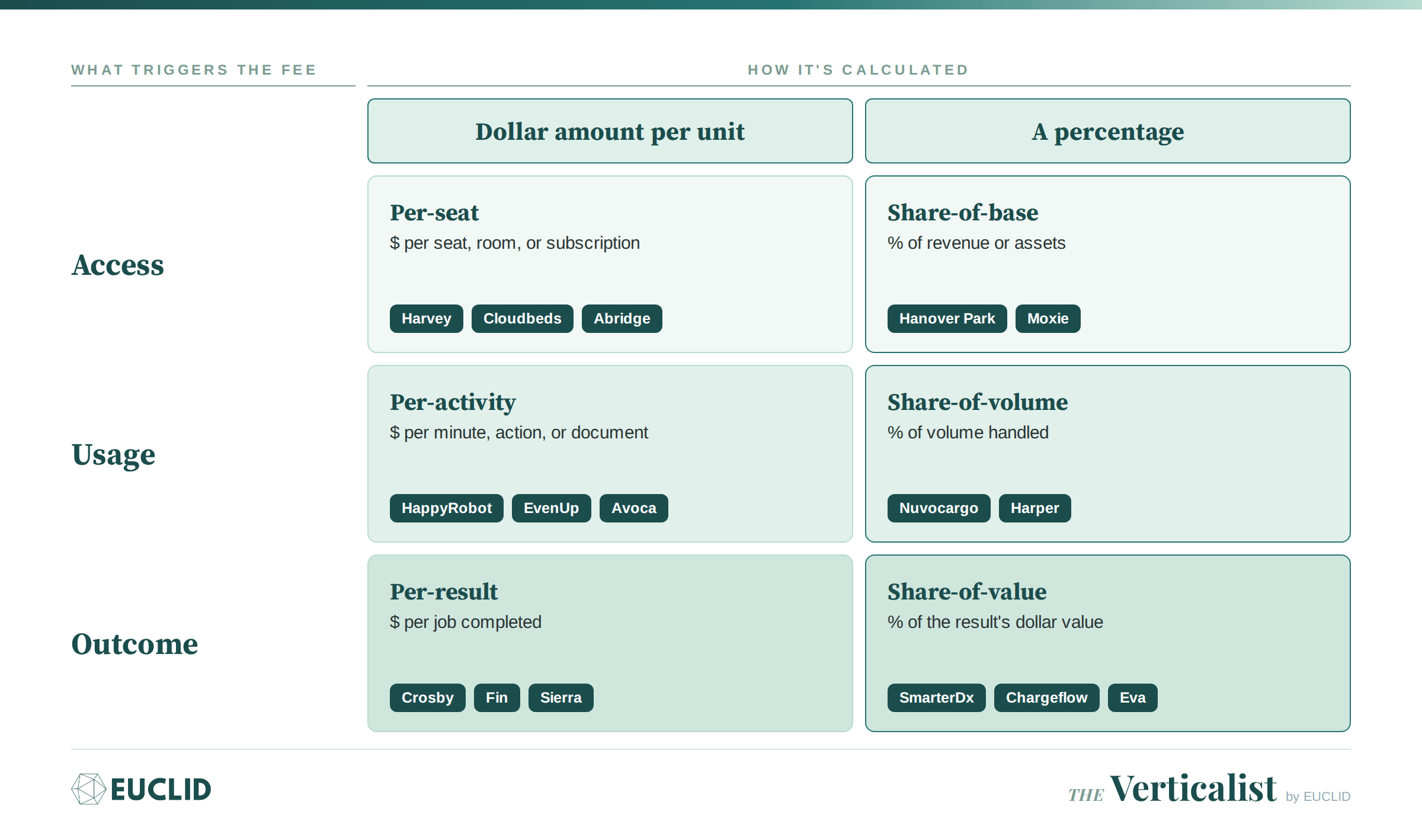
To clarify the differences, we categorized Vertical AI pricing models into six buckets— per-seat, per-activity, share-of-base, share-of-volume, per-result, and share-of-value — along two dimensions: (a) what triggers the fee (access, usage, or an outcome) and (b) how it is calculated (a dollar amount per unit or a percentage). Because most pricing is hybrid, treat each cell as an archetype, and we place each example by its primary model.
1. Per-Seat
The pricing model AI is supposedly killing. While it’s certainly declining, some of the biggest names in Vertical AI still use it. Customers pay a flat per-unit fee for the right to use the product: a seat per lawyer at Harvey, a license per clinician at Abridge, or a price per hotel room, per construction project, or per unit in an apartment building. There’s a reason why the per-seat model has been the mainstay of SaaS for 20 years. Both buyer and seller get predictability.
Per-seat pricing carries two risks. The first, which we covered in The Dispatcher Problem, is that customers use AI to do the same work with fewer people, so seat revenue shrinks when your product outperforms. The second is cost: when usage grows faster than the fee, margins shrink. Seats, in other words, can be a poor proxy for customer value. Martin Roth, who led the revenue org at Levelset before it was sold to Procore, told us on Verticals that they priced by the number of projects (rather than seats), a metric contractors could understand and that grew as their business grew. Identifying industry-specific pricing units can help startups better match expected customer value and mitigate revenue shrinkage from labor efficiency gains.
2. Per-Activity
Per-activity charges, unsurprisingly, are for quanta of a given activity: minutes on a call, actions an agent takes. HappyRobot bills per action credit, Avoca per minute, and EvenUp per case or document. The customer pays whether or not the job gets done: a voice agent who spends six minutes with a caller and never schedules the appointment still bills for the six minutes.
Usage pricing’s weak point is efficiency. When a better model completes a task using fewer credits or minutes, revenue per job may fall. Units tied to the work itself, like EvenUp’s per-case fee, don’t shrink that way, since a case is a case no matter how good the underlying product gets. Cheaper inference on its own does the opposite: if billable usage and prices hold steady, margins improve.
Still, the benefit of usage-based models is that they lower the threshold for adoption, since a buyer can start small and pay more as volume grows. That’s a big part of why AI-native companies like it.
3 & 4. Share-of-Base and Share-of-Volume
Share-of-base charges a percentage of the customer’s revenue or assets. Hanover Park charges basis points on the assets it administers, and Moxie takes a share of a med spa’s revenue.
Share-of-volume is its close cousin: a percentage of only the volume the vendor handles. Nuvocargo takes a cut of the freight spend it manages, and Harper earns a commission on the premium of each policy it places, first when the policy binds and again at each renewal. Phil takes a revenue share on the branded prescriptions it gets approved and fills for drug manufacturers.
The same goes for commerce and payment companies like Toast, Shopify, and Stripe, which take a percentage of processed payment volume (even if Stripe calls that outcome-based). The fee grows with the customer's business, so you get some of the upside of outcome pricing without the fight over attribution.
That's exactly why Moxie chose it. Dan Friedman told us they considered taking a percentage of the profits they helped generate, but dropped the idea because profit is too easy to manipulate. Moxie's fee rises with the clinic's revenue instead.
For service businesses, share-of-base and share-of-volume have a quiet advantage. Nuvocargo and Hanover Park do the work themselves, and their fees are tied to the freight Nuvocargo moves and the assets Hanover Park administers. When AI cuts the cost of that work, revenue holds, and margins expand. That’s the surplus outcome pricing promises.
5 & 6. Per-Result & Share-of-Value
These are the two forms of outcome pricing. A per-result fee is earned upon completion of the agreed job. Crosby charges range from $250 to $1,000 per contract, scaling roughly by page count and complexity. Unlike a usage-based model, customers pay a flat rate per review, no matter how many rounds the negotiation takes.
Outside Vertical AI, result pricing took hold early in customer support, one of the few categories where attribution and measurement are possible. Intercom launched its Fin agent in 2023 at $0.99 per resolution, and Sierra followed suit with outcome-based pricing.
Share-of-value is the second form of outcome-based pricing. Vendors take a percentage of the result’s dollar value and are paid only if the result occurs. SmarterDx collects only on new billable revenue it identifies for hospitals. Chargeflow keeps 25% of the chargebacks it wins back for e-commerce sellers, Eva takes 10% of the reimbursements it recovers from Amazon, and Incerto takes a share of the denied surgery claims it overturns. Eilla, an AI-native M&A advisor, collects a 5% success fee on executed deals.
Look at where outcome pricing works, and a pattern jumps out. These startups didn’t impose a new pricing model. They inherited one from the service firms they’re replacing: per-result fees from BPOs and law firms that already billed per ticket or per contract; share-of-value from collection agencies, RCM firms, and other service providers that already worked on a contingency basis. Both need the same two things: a clear billing event or dollar result, and buyers already used to paying that way. Without them, the result is harder to define, and even when you can count it, good luck agreeing on who caused it.
The Pricing Revolution Will Not Be Televised
In a perfectly rational market, every product would capture its fair share of the value it creates. Real markets are messier, so here’s how we’d price in them.
1. Avoid One More Thing to Sell
Outside familiar markets, outcome pricing adds a hard negotiation to every sale. Both sides need to agree on the success condition, its value, and how much credit the vendor deserves. The more the result depends on the customer’s decisions or on work elsewhere in the business, the harder that agreement becomes.
It also creates payment uncertainty. A startup can incur the cost of doing the work and receive nothing if the agreed-upon result never materializes. Separately, a fixed fee can leave the vendor absorbing more work than expected, as Crosby’s repeated review rounds illustrate. Subscriptions can expose vendors to that cost problem too.
The buyer has its own version of that problem. A seat price is easy to budget. Usage pricing is less predictable, but the buyer can at least watch the meter. An outcome fee can be hard to understand and even harder to forecast. Finance teams don’t love bills they can’t predict.
And agreement on a billing event doesn’t settle quality. A customer who gives up looks a lot like one whose support issue was resolved. A sloppy legal review looks just like a thorough one, until a missed clause costs the customer money. The vendor agreement still needs to specify the standard the work must meet, how the output will be measured, and how errors will be remedied.
2. First, Find Someone Who’ll Pay
For pre-PMF founders, that negotiation starts before you’ve shown you can deliver a result. A simple pricing discovery process with design partners or POCs might look like this: first, gauge willingness to pay by presenting a range of possible pricing models in initial conversations. Second, during the pilot period, define measurable deliverables upfront that simplify quantifying value delivered, while gathering candid feedback on pricing anchors. Third, set a clear timeline to move from free or pilot access. As Bessemer’s primer on design partners explains, “indefinite free access is an advisory relationship, not a validation signal.”
Start with a model buyers understand. As Deepak Chhugani explained in our episode on the Four Ps of AI Services, Nuvocargo adopted the familiar 4PL approach of charging 2-4% of freight spend, a model buyers are familiar with and could evaluate. He also cautioned against trying to capture every dollar of value in the first contract. You can lose the deal before earning the opportunity to expand it.
Keep the mechanics simple. Inference costs may be an obvious billing unit to match your cost structure but meaningless to your buyer. Outcome pricing sounds intuitive until you have to agree on completion conditions and attribution. This is where hybrids earn their popularity: a base fee covers platform and onboarding costs, while a usage-based charge scales with the work.
3. Revisit Pricing as the Product Improves
All startups should continually revisit their pricing models as their offering evolves and markets mature. Outcome pricing is one tool for that, not a graduation ceremony you need to rush toward. As the product becomes more capable and efficient, and therefore able to take on more of the customer’s work, more complex value-aligned models can be tested.
One option is to keep the same pricing for your core product while experimenting with new models on the products you layer on. If you want to test outcome pricing, try it at the edges first. Cloudbeds is a case in point. CEO Adam Harris told us he plans to keep per-room access pricing for the core system of record. But as Cloudbeds launches new AI tools that help hotels win more reservations or sell upgrades, it plans to experiment with commissions, a share-of-value model its hospitality customers already know from online travel agencies. In traditional Vertical SaaS, product extensions into payments and transaction flows have been a tried-and-tested strategy to expand to either share-of-volume (and occasionally, share-of-value) pricing.
It's the same pattern as before: new pricing model are applied to new products, but the paradigm is borrowed from something the market already understands (e.g., commerce, payments, etc).
Even Salesforce, the company that made per-seat pricing the SaaS default, has moved to hybrid pricing. Enterprises can pay for AI agents per action, per seat, or a combination of both. The company with the most to lose from shrinking seat counts went hybrid. Even if Salesforce does add some form of outcome pricing (which is a big if at this stage), we’d wager it looks more like Cloudbeds experimenting at the edges rather than a total paradigm shift.
The Moat Matters More Than the Meter
The outcome-pricing truthers rest their case on two flawed assumptions, one about TAM and one about surplus:
Labor and service budgets dwarf software budgets, so charge a share of the spend you replace, and your market becomes the customer’s whole P&L. As we explained in our piece on agents in Vertical AI, calculating TAM based on potential labor offsets is incongruous with every historical example of automation.
As delivery costs fall, boom, you get even more profitable and keep more of the value. Insight Partners’ Mike Hayes summarizes this view, calling outcome pricing the “holy grail,” where startups can create shared value with a customer and “divide that value in half.”
Name a platform shift where the vendor captured and maintained anywhere near half the economic surplus. When delivery becomes 10x cheaper, the old price anchor doesn’t hold up because the lower delivery cost is available to every competitor too. Long-distance calls went from dollars a minute to nearly free once the internet arrived. Stock trades went from being subject to a broker’s commission to near-zero. The exceptions, like Apple’s App Store cut or Google’s ad auctions, came from deep moats, not from a clever meter.
If the cost of task-specific intelligence continues to decrease, the arbitrage window will eventually dissipate as the intelligence layer approaches infrastructure-style pricing … Pricing will be driven not by how many people can be replaced and what they cost, but by market competition.
Once a rival can deliver the same work for less, buyers, especially in the enterprise, will use that offer to claw back the savings at renewal. Switching to outcome pricing doesn't fix that. A rival can undercut a per-result fee as easily as a per-minute one. That's the same dispatcher trap, but with a different meter.
Pricing power comes from defensibility, not the billing unit. In vertical markets, the sources are specific: workflow gravity, proprietary data, and integrations into everything else the customer runs. A cheaper model doesn't count because your rivals will soon be using it too. Start evaluating prospective moats in the earliest days, with a hypothesis you can test and revise. Our prior essay on moats in Vertical AI highlights how founders should prioritize potential moats as they scale.
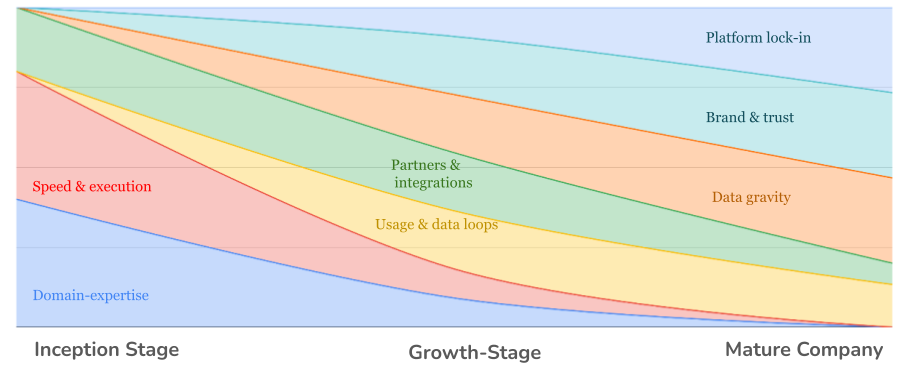
Yet the venture consensus treats outcome pricing as the inevitable destination, …something customers will accept as AI products become more autonomous and their impact easier to measure, and the way startups will finally capture the value they create. We think that gets it backward.
Better models do make outcome pricing more workable, and pay-for-performance is as alluring as ever. But the last time software changed pricing models, alluring took two decades.
That shift was from licenses to cloud subscriptions. SaaS pioneer Salesforce was founded in 1999, yet by 2012 the global SaaS market had only just crossed $15 billion, roughly 12% of enterprise application spending. Adobe and Microsoft moved their flagship products to the cloud in the early 2010s.
Let’s think about what that shift entailed. Salesforce was Siebel in the cloud. Photoshop was still Photoshop and Office was still Office. Software economics moved from buying to renting; buyers could still compare total cost of ownership side by side, and SaaS still didn’t cross 50% market share until 2022.
Outcome pricing asks for much more. Vertical AI founders already have to convince an industry to adopt AI, often creating categories that didn’t exist 24 months ago. They also need to build towards long-term defensibility. Asking them to evangelize a new pricing paradigm adds another burden, without solving either problem.
If that’s the bet the consensus wants founders to make, we’ll happily take the other side.
There’s no prize for the coolest rate card. The prize is becoming hard to live without and even harder to replace.
Laura Bratton and Kevin McLaughlin, ‘How Salesforce Is Overhauling the Way It Charges for AI’, The Information, 30 August 2026.
Sequoia Capital, Pricing in the AI Era: From Inputs to Outcomes, with Paid CEO Manny Medina, Training Data podcast, episode 39. The “pricing maturity curve” framing appears in Sequoia’s episode summary.
Bessemer Venture Partners, ‘The AI pricing and monetization playbook’, 10 February 2026.
Kyle Poyar, “The state of B2B monetization in 2026,” Growth Unhinged, May 13, 2026. Survey of 230 software companies, conducted in April and May 2026.