

Adeel Khan is the Founder and CEO of MagicSchool, the leading generative AI platform for K-12 education. It grew from zero to 7m users — and >$10M in ARR — in less than a year. Adeel is a true domain-expert founder: he spent his career as a teacher, principal, and school founder. After launching MagicSchool’s MVP in May 2023, the company hit 1M users in just five months — all organic — and today partners with districts representing one in five children in America. And Adeel did it with a sales team that is 85-90% former teachers. MagicSchool has raised $65M across seed, Series A (led by Bain Capital Ventures), and a $45M Series B led by Valor Equity Partners. Tune in to hear how Adeel turned a career in classrooms into the fastest-growing Vertical AI in education ever — and why his hyper-vertical GTM strategy allowed him to turn an AI wrapper into a category-defining platform.
Today’s Episode
In VC circles, K-12 education has a reputation as a startup graveyard. ACVs are small. Buying cycles are fickle and cyclical, following the school calendar. Decision-makers are risk-averse by necessity: incentives for innovation are limited and the downside of a bad technology bet is a room full of nine-year-olds staring at a broken screen. The sector has produced vanishingly few large software outcomes in the modern era, and the even EdTech VCs are often skeptical of the category.
MagicSchool AI — after launching a ChatGPT wrapper in 2023 in K-12 — went from zero to tens of millions of ARR, 7M teachers, and district partnerships covering one in five American children, all in less than three years.
The obvious question is how. The answer, in large part boils down to two things. The first is some combination of timing and luck, which frankly, all hyper-growth startups need. The less obvious — and more instructive — answer is that the founder leaned heavily into his vertical domain expertise. MagicSchool was built by teachers; and from inception to today, it’s sold by teachers. 85-90% of Adeel’s GTM team have backgrounds as educators — teachers sell it, implement it, and show up when a superintendent needs to understand what AI means for her tens of thousands of students. That hyper-vertical GTM was critical to MagicSchools breakout success.
Leaning into Your Domain Expertise
We’ve written extensively about how founder backgrounds correlate with Vertical SaaS success. The data is unambiguous: domain expert founders capture 84% of exit dollars and raise more, from higher-signal investors. Adeel Khan is a case in point — though he’d be the first to tell you it was far from obvious in early days.
When MagicSchool was raising its seed in 2023, the deck was stacked against it in every conceivable direction. Application-layer AI companies were, in Adeel’s words, “at their absolute bottom.” EdTech wasn’t anyone’s darling. And then there was the founder himself: a former school principal with no technical co-founder, no software background, no Stanford pedigree. As we explored in The Fundability Trap, VCs pattern-match on consensus profiles — and Adeel matched none of them.
Even the ed tech VCs... they were just like, we don’t have the pattern of a teacher founder or a principal founder. Whether or not they said that out loud, it was kind of a thing that I saw. — Adeel Khan, MagicSchool
Ironically, the very thing that made investors nervous — a non-technical founder who’d spent his career in schools — is what made the product work. Adeel’s first customers in Colorado weren’t buying software. They were buying him. His reputation, his understanding of their problems, his ability to walk into a CIO’s office and speak the language of someone who’d been burned by the last five EdTech vendors. Adeel isn’t the post-pedigree founder — he’s the strong-pedigree founders, just one without the typical pedigree VCs favor.

Parafin is the partner and sponsor that makes the Verticals podcast possible. They are a breakout in their own right. With credit backed by Goldman Sachs, Parafin extends embedded lending across partners like Amazon, DoorDash, and Walmart. If you’re a vertical platform looking to offer capital products to your SMBs (without becoming a bank), Parafin has over $25B in experience. They also recently made the Forbes Fintech 50 list! See if a custom Parafin program could make sense for you.
Vertical GTM: Hire the Expert, Not the Seller
This is where MagicSchool diverges from the standard “domain expert founds company” narrative. Most vertical founders leverage their expertise at the top — in product vision, in early sales calls, in pitch decks. Adeel built his entire organization around domain fluency.
85-90% of MagicSchool’s GTM team are former classroom teachers. “When they go in and they can speak the language of the buyer,” Adeel said, “they can talk about real experiences they’ve had deploying in a district that they were working in… it makes all the difference.”
Their solutions architects — the closest analog to a forward-deployed engineer — are former district technology implementers, pulled directly from the schools they now serve. When a solutions architect walks into a superintendent’s office, they’re not demoing features. They’re describing problems they’ve personally lived. While acknowledging the trade-off, Adeel framed the logic this way: a former teacher can learn how MagicSchool’s prompt architecture works; a career SaaS seller can’t learn 15 years of navigating school board politics in an onboarding sprint.
The companies that invest in domain-fluent GTM teams compound trust faster than those that bolt on traditional sales orgs. As we’ve explored across our founder-led sales analysis, that difference shows up in pipeline velocity, win rates, and retention, especially early. It’s not the solution for every market. In some — especially those with faster-cycle, more trasnactional sales — pure sales athletes can work best. That’s what worked at Owner, a platform in the restaurant space, as CRO Kyle Norton shared in a prior episode.
In K-12, the buying decision is as much psychological and emotional as logical. MagicSchool’s competitors — and there are dozens, from legacy SIS providers to curriculum companies to horizontal AI copycats — have launched products that “even look like ours,” as Adeel puts it. Features can be copied. An organization that speaks the buyer’s language and knows how to grow into AI with them cannot.
Monetization: Just Get Them to Sign
MagicSchool’s monetization story is a case study in creative pricing for risk-averse markets. The product was entirely free until January 2024 — eight months after launch, with a million users already on the platform. Adeel’s reasoning was disarmingly simple: “The biggest companies in the world that I know were free.”
When monetization came, the team didn’t hire enterprise sellers or build a traditional pipeline. They invented a pilot structure designed to remove every possible objection: $1,000 for a single school, $2,000 for an entire district — regardless of size. Miami-Dade, with 350K students? $2,000.
The catch was in the contract. Each pilot agreement included the full renewal price, timed to the district’s natural buying cycle in July. The spring semester pilot was a zero-risk trial with a committed upsell baked in. “The goal was sign a contract with us. If you sign a contract with us, we’ll figure the rest out later.”
The open question — for MagicSchool and for Bain Capital Ventures, which led the Series A before renewals came due — was whether districts would convert at full price. Adeel’s COO predicted 50%. Adeel predicted nearly 100%. BCV landed somewhere in between.
Adeel was right. Near-universal renewal at full ticket price. The pricing strategy worked because of three things that don’t generalize easily: a million organic users already in the buildings providing bottom-up pressure, a product teachers genuinely loved (94% were enthusiastic fans, per internal NPS), and a team that could walk into a renewal meeting and speak the buyer’s language from lived experience. Strip out any one of those, and instead of a hyper-growth Vertical AI story, MagicSchool might’ve been proof-positive of the poor retention rates of most AI wrappers.
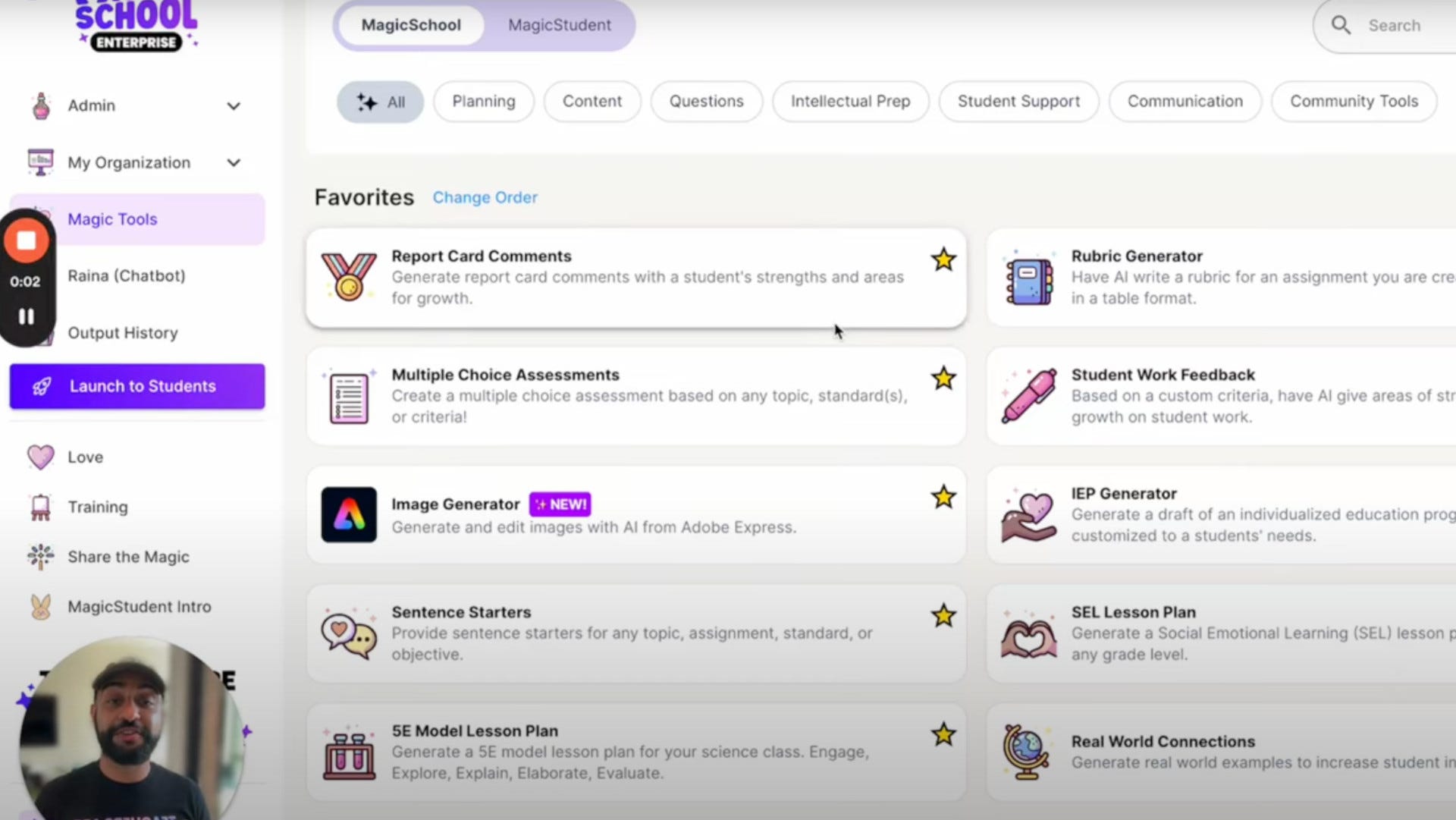
The GPT Wrapper That Won
In 2023, “GPT wrapper” was the most derogatory label in venture capital. Adeel concedes the point freely: “In the most derogatory way, we were certainly a GPT wrapper. And so was everyone else.”
A prevailing thesis at the time was that horizontal platforms — ChatGPT, Claude, Gemini — would eventually subsume every application-layer product. Users would learn to prompt; platforms would make it easier to customize the UI, harness, and skills. Killing the wrappers in the process. Even Adeel, at the time, thought it was a real possibility. And as it turns out, it wasn’t altogether wrong — plenty did die.
Three years later, however, the opposite has played out for MagicSchool. Getting real value from horizontal AI tools now requires connectors, projects, context ecosystems, custom skills, etc. And while some users can string these together in their free time, teachers have one or two hours a day at their computers and none of the expertise to execute. They’re not building context architectures for fun. And as MagicSchool grew, it found ways to become less vibe-codable.
The structural insight — one we’ve explored in Software Is Dead — Long Live Software — is that as the underlying models get more powerful, the complexity of extracting domain-specific value increases, not decreases. A horizontal platform doesn’t know yesterday’s quiz scores, the district’s curriculum standards, which students are on IEPs, or how their teacher-users are likely to think or decision. MagicSchool does (or at least gets closest). Adeel is adamant, the moat isn’t the model. It’s the context layer on top of it — and the domain experts who built it know exactly what context matters.
Adeel shared a great example: Jasper — front of mind for every AI founder in 2023 — never materialized in education. Why, given it’s clear overlap around the content creation value props MagicSchool et all centered around? Jasper’s users were marketers and writers who lived on computers all day, cycling between tools as better ones emerged. Teachers aren’t tool-hoppers. They adopt what works and stay put. The “GPT wrapper” wasn’t a liability. It was the fastest path to becoming the trusted, contextually aware platform that no horizontal product could replicate. And like in most great Vertical AI businesses, there were vertically specific dynamics key to this story that wouldn’t held up on other markets. Adeel saw them early.
The Takeaway for Vertical Founders
MagicSchool’s trajectory compresses about a decade of normal vertical software company-building into three years. Explosive PLG, creative monetization, near-perfect conversion, the transition from order-taking to strategic sales, a highly vertically trained GTM team, and the emergence of legacy competitors who copy everything except the one thing that matters — teacher’s love for the product.
The lesson isn’t “hire domain experts” — that’s obvious enough to be useless, and as mentioned, won’t extrapolate to every vertical. The lesson is that, when compounded across an organization, domain expertise is infinitely more valuable. One domain expert founder gets you early customers and a good product. An entire GTM team that’s lived the buyer’s daily reality gets you a trust advantage that copycats can’t reverse-engineer. The competitor can match your feature set. They can’t match the fact that your solutions architect used to run IT deployments in the buyer’s own district. And in MagicSchool’s case, it’d be very difficult to catch up on district lock-in and brand. First-mover advantage is provably unreliable — but it had real value here when paired with excellent continuing execution.
Adeel put it well when describing how schools choose technology partners: “So much of the work that we’re doing with Magic School isn’t just about the app or the product. It’s also about the people and the partnership.” This episode is a great reminder that in Vertical AI, the org chart can be a true, tangible moat.
See you next week.
Key Moments from this Episode
00:00 — Intro
01:30 — From school principal to AI founder
05:17 — Launching MagicSchool during the ChatGPT moment
08:59 — Why domain expertise matters more than ever
14:11 — The fundraising challenges of a non-technical founder
20:13 — How MagicSchool’s product-led growth exploded
23:41 — The free-to-paid strategy that unlocked enterprise sales
29:02 — Transitioning from order-taking to real sales
34:07 — The biggest lesson from scaling to millions of users
36:14 — Why GPT wrappers became more valuable, not less
43:01 — Competing with legacy education software companies
46:46 — Is there still room to build in education AI?
48:05 — Why education remains one of the biggest opportunities in software
Don't forget that Adeel was a principal. Most EdTech startups are founded by teachers who target other teachers (who don't have a budget). The handful of successful EdTech companies target both the buyer (principal/superintendent) and the user (teacher). The key is to show value to both.
thanks for the article. it's totally that as models get more powerful, extracting domain value gets harder, not easier, so the context layer is the moat