

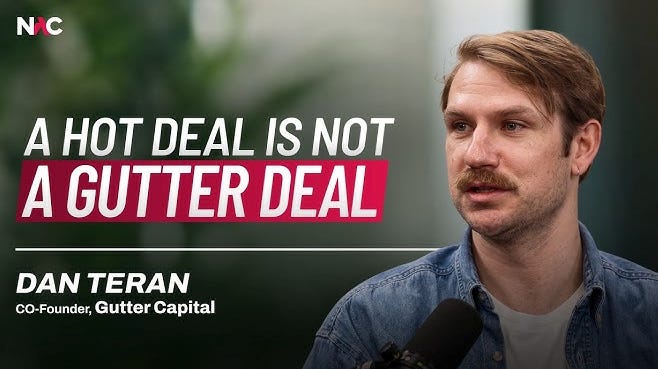
Dan Teran and James Gettinger are the co-founders of Gutter Capital, a New York-based fund that just closed its $75M Fund III focused on pre-seed investing. Previously, Dan founded Managed by Q — a vertical SaaS platform and B2B marketplace for office services — that he sold to WeWork for >$200M in 2019. James is a computer scientist turned professional gambler. Together, they made 100+ angel investments, launched Gutter, and most recently Elbow Grease: an accelerator that invests $300K into startups and spend 10 weeks working alongside them in Gutter’s NYC office. Tune in to hear our discussion on the changing profile of Vertical AI founders — and learn the three counter-intuitive founder signals Dan & James are leaning into.
Today’s Episode
Most VCs will tell you they’re “founder-first” investors. In practice, that usually means they’re pedigree-first — screening for model lab resumes, repeat founders, and known technical programs as proxies for competence. The logic is understandable: at inception (indeed, often at pre-seed), there’s little else to evaluate. But Gutter Capital’s Dan Teran and James Gettinger argue the default is not just lazy — it’s empirically wrong. The biggest venture outcomes in history were built by founders who would have failed today’s pattern-matching. And AI is widening the distance between who looks fundable and who actually ships.
We’ve written about the fundability trap before — the recursive loop that sees investors pattern-match on the founder archetype most likely to raise the next round from downstream investors, making that archetype more common, reinforcing the pattern. But inherently, this behavior is retrospective. In a world changing this quickly, the founder profile best suited to win is changing too. Gutter’s entire model is a rejection of this tautological thinking in founder profiling. What emerged from our conversation are three signals Dan and James have found actually predict founder performance from Day Zero — and none of them are resume-standard.
Evidence Density Over Narrative Polish
Dan revealed that when Gutter backtested all of their Elbow Grease applications — using AI to analyze what actually predicted which founders advanced — the single strongest signal was what they call “evidence density.” Not narrative quality. Not market size. Not pedigree. Evidence density: the amount of hard, specific proof per word in a pitch.
How much hard evidence — per word in a pitch — is there was the biggest predictor of if we were actually going to pass them on to an interview.
Most founders spend their prep time perfecting the story — the narrative arc, the vision slide, the TAM chart. Gutter is saying the story matters less than the stack of receipts behind it. Specific customer names, metrics, quotes: “We reduced this from X to Y for Bob. And you can call Bob and here’s his phone number. And by the way, Bob has a cousin Jim, and Jim converted too.”
Gutter’s pro tip for founders takes it a step further: before an investor even asks for references, proactively send them three recorded customer conversations. A pitch to a prospect. A QBR with a design partner. A particularly insightful customer discovery call. The point is that it’s live, unscripted, and features a real person the investor could theoretically call. Most investors won’t. But knowing they could changes the calculus entirely.
Their experience aligns with ours here at Euclid: the strongest founders aren’t always the smoothest presenters — they’re the ones who demonstrate an uncanny aptitude for turning over every stone in their focus area. They can answer any question about their customer’s workflow in granular, unrehearsed detail. They’ve put in the work to understand the key objections and the right first ICP. Even if they aren’t from the industry themselves, they can talk the talk.
Evidence density is really a proxy for customer obsession. And as we’ve argued over and over again in our past work — and heard frequently from top vertical founders — customer obsession unlocks moats. It enables deep workflow integration, uncovers distribution advantages, powers referrals, and informs future extensibility of product and TAM. Nothing deflates interest in a deal like signs that a founder is less than completely obsessed with their vertical and customer.
A quick word from our partner on the Verticals podcast, Parafin. Recently named to the Forbes Fintech 50, Parafin has extended more than $25B in financing to their customers’ customers, powering embedded capital for platforms like DoorDash, Gusto, and Kajabi. Purpose-built for vertical platforms serving SMBs — lending, cards, and insurance without building the infrastructure yourself. Explore a custom program for your platform today.

Bad References, Good Founders
While evidence density was the most important pattern-match we dug into with Dan and James, there were several others worth noting for founders. One involved references — the cornerstone of inception-stage VC diligence.
Many treat reference calls as pass / fail. Get on the phone, ask banal questions, and if the answer is lukewarm, the deal is dead. Gutter takes a more interesting position — and it starts with asking the right question. Dan told the story of an Elbow Grease founder whose past references weren’t exceptional. But when they double-clicked with the CEO of the founder’s prior company, that “bad reference” was completely reframed:
Is the question ‘would I hire him back into the job in which he worked for me,’ or ‘would I bet on him as a founder?’ Because those are two completely different questions.
Dan speaks from experience. When he started Managed by Q at 24, he shared, his references weren’t particularly strong. He’d been a paralegal. James jokes that Dan offered him, a friend at the time, up as a reference because there just weren’t that many to choose from. Yet Homebrew led Dan’s first round pre-product because they didn’t mistake an absence of evidence for evidence of absence, as the saying goes. James — a former pro poker player turned angel — also understands the value of unconventional backgrounds better than anyone.

The broader point: at inception stage, you’re not hiring someone into a job. You’re betting on them in a role they may not have ever had. A reference that says “difficult to manage” might be the signal, not the noise. Not thriving in a large, slow organization, managerial intransigence, a desire to make the big decisions — these are all supportive of CEO potential. The question isn’t whether a founder was a good employee. It’s whether there’s evidence they will be a relentless, resourceful builder. Those are different skill sets, and conflating them is a fundamental investor mistake.
The Five-Kid Vibe Coder
There’s a prevailing narrative that AI has made the 19-year-old technical founder the apex predator — native to the tools, no legacy mental models, infinite energy. Dan pushes back: “When everyone’s telling you that the best founders are the teens, we also want to keep an open mind that that might not be true.”
Dan pointed to one of the standout founders from Elbow Grease’s first cohort — the founder of a company called Punch. Five kids, sixth on the way, based in Atlanta. His wife gave him permission to come to New York for 10 weeks. He was in the office every night and every weekend because, as Dan puts it, “his attitude was, I know this is my shot.” He ships product faster than anyone in the Gutter portfolio.
We explored the age question in No Country for Old Founders, and AI is accelerating the trend. While YC has elevated the youth profile, the numbers suggest that experience and expertise matter greatly. At Euclid, we generally find a balance between youth and experience to be the most common sweet spot. Gutter believes that AI has opened up opportunities for mid-career operators, even those outside the tech sphere or straight from industry. Domain experts who spent a decade without engineers or butting heads with them — who understood their industry’s workflows cold but couldn’t build the solution themselves — now have the tools to start independently. They’re not burning time gleaning their customer’s problems from user interviews because they lived them.
For Dan and James, it’s not that every person in every field will become a well suited startup founder. It’s that a rarefied slice of domain experts who had the tenacity and vision, but lacked a natural catalyst are now unshackled. Gutter often sees them as better positioned than any CS grad because they already have the customer relationships, the industry context, and the specific insight that makes a Vertical AI product right rather than just functional. As Dan put it, “People who have chafed at engineers their entire career now don’t really need to deal with them that much to build something that actually might be really great.”
The Takeaway for Vertical Founders
The founder profile that wins in Vertical AI is shifting, and most of the ecosystem hasn’t updated its priors. At Euclid, we still believe presentation, references, and youthful velocity are important. But we’ve always felt it’s more important for founders to be authentic — and to lean into what makes them a unique founder — than to mold themselves to trends on Hacker News or whatever platform funds choose to market around that year.
If you’re raising at inception stage: stop optimizing your pitch for narrative polish and start optimizing for evidence density. Every slide, every answer, every follow-up email should be stacked with specific names, specific numbers, and specific proof that you understand the problem better than anyone. Send customer call recordings before they’re asked for. Make the evidence so dense that investors don’t need to trust your story — they can verify it.
And don’t hide from your unconventional background — lead with it. Truly first-principles funds are increasingly embracing the “post-pedigree” founder as AI changes everything. Euclid and Gutter are aligned on one thing: domain and customer obsession are paramount. If you spent 15 years in the trades and just learned to vibe code — yes, you’re still going to have to justify why you are best suited to do everything a startup founder has to do to build a big business, and that’s no joke. But it doesn’t have to be a weakness to paper over either. With proper self-awareness, it’s a strength to build around. Most investors, like most humans, are allergic to inauthenticity. When someone leans into their reality, perceptions-be-damned — that is a rare and powerful trait.
If you’re a VC who outsources their diligence to consensus perceptions of pedigree, you might be missing out on some of the biggest contrarian winners of this AI era. At minimum, take note: a professional gambler and an exited founder just raised $75M to bet against you. And they aren’t alone.