

This episode is sponsored by Parafin, the embedded finance infrastructure powering capital products for vertical platforms. Backed by Ribbit Capital, Thrive Capital, and GIC (with a $100M Series C bringing their valuation to $750M), Parafin supports customers like Amazon, DoorDash, Jobber, and NMI. Click here to learn how Parafin can support you.

The AI agent boom promised to transform freight. Voice agents that negotiate with carriers. Document agents that process customs paperwork. Scheduling agents that book appointments autonomously.
The demos have been phenomenal. Retention… not so much.
As Deepak Chhugani tells it, logistics companies adopting these tools are hitting the same wall: change management is brutal, every broker’s workflow is different, and customers blame the vendor when things break. The result is a growing cohort of well-funded agent startups struggling to renew contracts. Perhaps a story not unfamiliar to AI-native founders working to bring agentic solutions to complex legacy industry.
Deepak is the Founder / CEO of Nuvocargo, an AI-native logistics platform that has raised >$85M from Tiger Global, QED Investors, NFX, and Y Combinator. His answer to the retention problem is in line with our recent essay: don’t sell the agent. Between Mike Powers at BuildVision (on Verticals here) and Chris Hladczuk at Hanover Park (on Verticals here), it’s a story we’re hearing more and more.
Nuvocargo sells the outcome. They are literally a licensed freight broker — one of their three offerings with ~40% gross margins — touching 300k carriers. The distinction, as Deepak illustrates, is that his partnership with clients goes even deeper than traditional brokers can. As opposed to a pure vendor, they build a deeply internal relationship with clients, not only further aligning incentives, but also making the service harder to replace and easier to extend:
Freight brokerage: “Quote me a rate from Dallas to New York.” Traditional vendor: transactional, commodity-prone, external. Price is the main differentiator, which is why so many freight brokers blew up post-2022.
AI-managed supply chain partner: “Here’s my $50M freight budget. Run it for me.” An incentives aligned partner with high internal access to customers. Plug into the customer’s ERP, replace 15 SaaS tools, and execute the right strategy for the customer — not just the the most profitable point-in-time deal.
On this episode of Verticals, we unpack exactly how selling the outcome works at Nuvocargo, Deepak’s path to where he is today (from investment banking in Mexico City to YC) — and how his framework breaks down into “Four Ps” that all founders building Vertical AI Services should ask themselves to stress-test their models.
The Vertical Playbook
The 4 P’s of Vertical AI Services
A litmus test for founders building defensible AI Services companies.
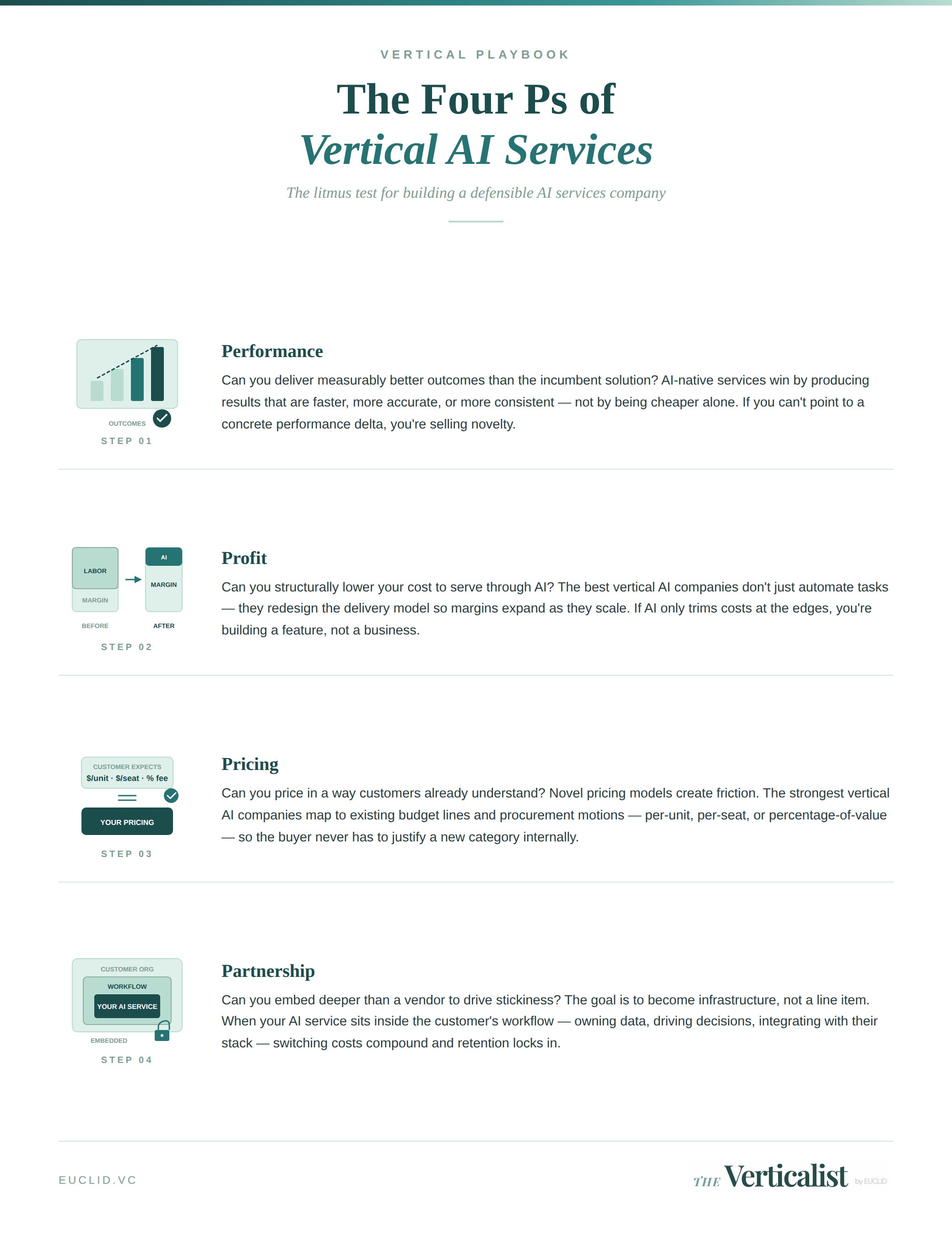
Performance
Can you deliver measurably better outcomes than the incumbent? Nuvocargo runs 12+ narrow, task-specific AI agents inside NuvOS, each performing a single function: scheduling appointments, processing documents, negotiating carrier rates. If one fails, a human unblocks it and the pipeline proceeds. Critically, the customer never engages with the agents. Instead, they see results: seamless delivery and — for one early customer — a 12% reduction in a multimillion-dollar freight budget in year one. If you can’t point to concrete ROI, you’re selling novelty.
Profit
Can you structurally lower your cost to serve through AI? Deepak draws a sharp line between his model and the boom-bust cycle of traditional freight brokers, who hire aggressively in good times and fire in bad ones. By embedding AI agents inside NuvOS rather than relying (fully) on headcount, Nuvocargo is shifting its P&L from a labor-heavy service business toward a consumption-based model. As Deepak puts it, the question every AI services founder must answer honestly: does your technology actually make each unit of work cheaper?
Pricing
Can you price in a way customers already understand? Managed transportation is an established business model — multibillion-dollar 4PLs have charged shippers 2–4% of freight spend for decades. Nuvocargo adopted the same fee structure rather than inventing a novel pricing model that would force customers to justify a new budget category internally. The pitch is simple: pay the same rate you’d pay the legacy provider, but get a modern technology stack executing on every shipment. As Deepak shared, he learned the hard way that squeezing every dollar of value upfront kills deals and discounts your ability to expand over time.
Partnership
Can you embed deeper than a vendor to become infrastructure? This is where Nuvocargo’s model diverges most from the standalone agent playbook. When the company integrates with a shipper’s ERP and begins consuming purchase orders directly, Deepak’s team isn’t just quoting a lane — they’re questioning whether a shipment needs to go at all. The customer replaces 15 SaaS tools, multiple broker relationships, and the headcount to coordinate them. That’s a very different switching cost than canceling an “agent.” As we’ve written on the commoditization risk facing AI services, startups that remain external vendors competing on cost will watch margins compress. The ones that become an orchestration layer — owning data, integrating with the customer’s stack — build moats with compounding potential.
The Takeaway for Vertical Founders
Performance. Profit. Pricing. Partnership. These four tests separate durable AI services businesses from “agents” and LLM wrappers. Nuvocargo passes all four not because the AI is more sophisticated, but because the business model was designed to leverage AI invisibly: delivering outcomes customers already know how to buy, at structurally superior margins, with customer “internality” that builds real stickiness.
Thanks for reading the Verticalist and for tuning into the show! Drop us a line below with your thoughts. And don’t forget to subscribe to Verticals wherever you watch or listen:
Youtube • Spotify • Apple • Amazon