

Every vertical software incumbent faces the same two paths ahead: rebuild the product for AI (and likely pay a vendor to help you do that) or buy a platform to spearhead your AI strategy. So far, few are taking the latter path. But that will change. In this episode, your hosts — Luke Sophinos, CEO of Odyssey and Nic Poulos of Euclid — debate M&A in Vertical AI. Why it’s been more of a trickle than a flood thus far, the pressure points that are influencing acquisitiveness, and how founders should think about the coming years.
Today’s Episode
The SaaSpocalypse obituaries ran early. The IGV software index fell 24% in Q1 2026, its worst quarter since 2008, then clawed back most of the way since. Infrastructure software and consumption-priced names from MongoDB to RingCentral are riding the agentic wave, while 26% of horizontal apps are net-contracting, and vertical apps are faring variously based on their industry of choice and its AI exposure.
As it turns out, software customers aren’t really leaving. Our latest public comps review has vertical software at a 109% median NRR against 105% for horizontal apps. The market is uncertain, however, how long that will last. “Legacy” systems of record — plenty of them PE-owned — spent ten-plus years cobbling together end-to-end suites, and now they’re caught in a pincer. Vertical AI businesses that started as wrappers (e.g. Legora, MagicSchool) are coming in the front door and putting up growth rates that make SaaS look sleepy. And AI-native services are slipping in the back to do the customer’s work, disintermediating their direct relationship with the product.
At the same time, the AI that incumbents are adding to their products isn’t not working. Microsoft has sold 30M Copilot seats, Salesforce has grown Agentforce past $1.5B ARR, and nearly all AppFolio customers use Realm AI. But after three years, Copilot reaches <7% of Microsoft 365 seats and Salesforce’s organic growth is still about 6%. AppFolio’s growth — which largely comes from payments and screening — slowed from 18% to 14% last quarter, even with the success of its AI. Most incumbent AI bolt-ons are smart defensive moves: they dissuade against 3rd party AI wrappers and bundles model usage into a contract the customer already has. But they aren’t reinventing the core product, and are unlikely platforms for transformational new growth. So what happens when more disruptive Vertical AI visions come along? Long-term, it’s unlikely users want to work inside old SaaS systems of record at all. What happens when someone rebuilds them AI-natively, agents unchaining users from logging into anything?
Eventually, something will give. Incumbents understand that software customers are sticky and that it won’t happen overnight. But it remains an existential threat to those that don’t have the talent, velocity, and executive mandate to think big — and perhaps even to cannibalize cash-cow SaaS product lines. The most natural way to accelerate a proper AI growth platform would be an acquisition. Today, we ask: who, if anyone, is taking this approach, and why aren’t more doing so just yet?
The Ball & Chain of SaaS Success
There’s much more to software than a relational database and a decent UI. But when a Vertical AI startup that truly understands the specific workflow enables much of that clicking, data entry, dashboarding, etc. to be handled by agents, the system of record risks losing the “time in platform” stickiness that was once so important. And for an incumbent doing billions in topline, it takes incredible political capital to launch a product to risk what made everyone rich in the first place.

In our discussion, Luke shared his take on incumbent ability to move:
They’ve gotten so good at the SaaS playbook that that’s what they do. They’re still running four-week sprints and capacity planning. I’ve run this playbook successfully in three roll-ups because I’m a PE-backed CEO. It’s really hard to change.
It’s not laziness or incompetence. It’s incentives. PE-owned vertical software — as an example — spends a much thinner slice of revenue on R&D than its venture-backed peers. The CEO’s bonuses tie to stock price next year, not next decade. So margin expansion is easier than re-platforming. A play that risks a big portion of a healthy, probably even growing installed base might result in a CEO search firm on retainer.
Some might argue that current incumbent LLM-based products are merely wedges that will evolve organically into larger AI strategies. After all, looking at some of the early Vertical AI breakouts, there are plenty of cases in which wrappers worked. As MagicSchool’s CEO shared in a prior episode, the company broke out because educators were Googling “ChatGPT for teachers” when LLM adoption was brand-new and still felt off-limits at work. OpenEvidence offered a discovery and research solution for MDs that was simply more accurate and trusted when it came to medications. Both nailed vertical-specific distribution. And both quickly moved to build advantages on top of those wedges that put them on a more defensible path: MagicSchool with a platform moat and OpenEvidence with a network effect of pharma advertisers.
It’s hard to see how a wrapper helps an incumbent drive massive new adoption or build a new moat. More or less, these bolt-on products are chatbots that pipe questions or simple BI / data requests about existing SaaS ERPs through a model lab API. Most are leagues away from a headless system of record. The question really is, where do incumbents go from there?
Whatever it is, it would require speed. In the current AI era, it’s easy to look at the scale and growth rates of OpenAI or Anthropic and assume that all giant companies can grow that fast. But their growth is predicated on the LLM, a singular novel product. And while they iterate that product brilliantly, it’s not exactly proof that massive companies suddenly have a velocity and innovation advantage building and launching wholly net-new products. OpenAI itself gives us several examples of the opposite, between the flops on Sora and ads. Between burgeoning bureaucracies, sacred cows, varying investor and shareholder needs and pressures, the historical truth remains unchanged — success can be a ball and chain.
Why Aren’t They Buying?
So if acquisition is an obvious way to inject novel AI products, DNA, and velocity into an incumbent eager to stay ahead, why aren’t we seeing more Vertical AI M&A? We landed on two major reasons.

1. The targets are young
Per our annual Vertical Report, Vertical AI still mostly lives at Series A. Growth-stage AI-native companies are thin on the ground, and the handful that exist (EvenUp, Abridge, EliseAI) were founded years before ChatGPT. What we’re seeing in vertical is still mostly at-scale vSaaS, making the Vertical AI cohort particularly thin:
Clio took vLex for $1B, and Waystar bought Iodine at a $1.25B enterprise value, both in 2025. SaaS buying SaaS.
Autodesk agreed to buy MaintainX for ~$3.6B in May: about 26x forward ARR, and the biggest check in Autodesk’s history. That said, Autodesk is a rare example of an incumbent vertical software player who is just really good at M&A.
Procore bought Datagrid in January. Datagrid had built construction agents mostly on Procore’s own data, so this one practically wrote itself. But it’s a good example of how incumbents should think about staying ahead.
CCC paid $730M for EvolutionIQ, which we pulled apart in January as the template for what comes next — a public incumbent that isn’t necessarily paying up for an AI-native company before it hit scale.
Of course, these are just a few examples. But so far, we’ve mostly seen late-stage SaaS-SaaS merger type buys (Clio), newer-generation SaaS players (Procore) defending turf, or existing frequent acquirers (Autodesk) doing their thing in the AI era. More of that will come, but we expect the aperture of who buys to grow as does the Vertical AI market as a whole.
2. The buyers don’t have the cash
The narrative would run that stocks got hammered in Q1, equity isn’t free, cash feels scarce. For PE-backed, debt-laden platforms wired for cash, that’s easier to see. For most SaaS, however, cash hasn’t been a problem.
After 2022, many have been on unprecedented cash-generating tears. Veeva’s operating cash flow was $1.4B in FY26, up from $911M in FY24. Procore’s FCF rose 507% year over year in Q2. To the extent cash reserves are dwindling, the bigger reason is that they feel it’s better spent elsewhere. Toast’s cash fell this year mainly because of $412M in repurchases. AppFolio spent $125M on buybacks in Q1. Even Veeva bought back $170M, a first for them.
This year, software incumbents pouring into buybacks has been a defining feature of the year, seeing some of the largest buybacks in the sector’s history: Salesforce ($25B, its largest ever), Adobe ($25B, about 24% of its market cap), Intuit ($8B), ADP ($6B), and ServiceNow ($5B). All despite the SaaSpocalypse. While outside the application-layer realm, Nvidia — setting the stage for much of our economy these days — authorized a $150B increase just a few days ago, marking the largest in history. M&A makes little sense if you’re convinced the best investment opportunity is your own stock.
Not to mention, you don’t always need cash to acquire. Beyond financing, most such deals have equity components. So the “we’re broke” argument falls a bit flat, at least for larger public incumbents. Which brings us to rationale #3.
3. The buyers are proud
We’re squarely in the “build-and-partner” phase of AI adoption. Following the “we can do it ourselves” phase, which never really lasts. It’s a natural reaction from any company, most especially those used to a strong moat in their vertical that provided them plenty of time to replicate or elbow out competition. August’s Claudeforce announcement is a perfect example: rent the frontier, wrap it in your suite, tell the Street you’ve got it handled. The question is whether they’re still asleep or wide awake and simply… stuck. Chained to a legacy system with thousands of customers, where nobody gets promoted for putting recurring revenue at risk.
In the history of disruptive technology, there’s a recurring pattern that feels relevant here — you could call it the “Incumbent Adoption Cycle:”
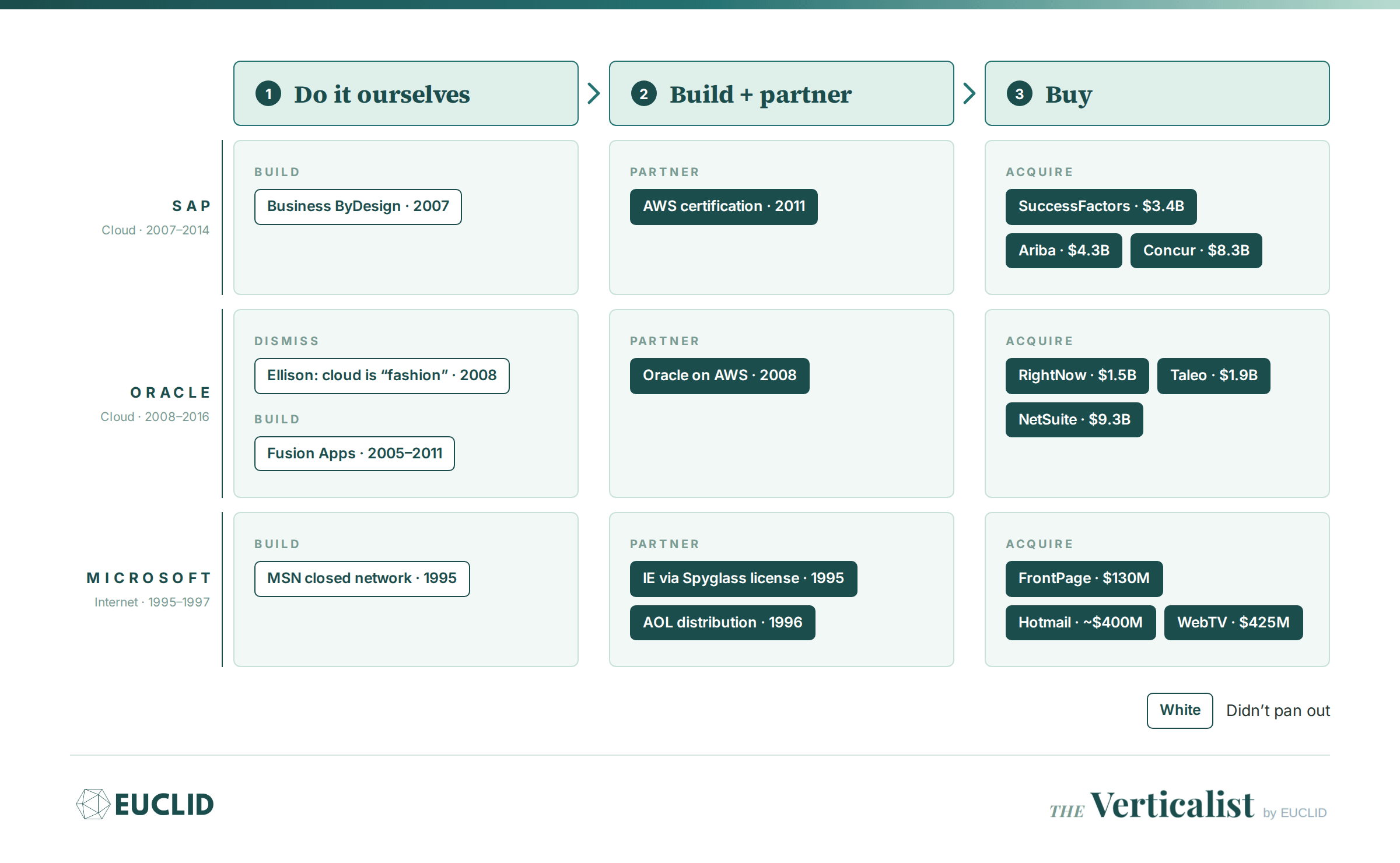
Every platform shift has played out the same way inside incumbents: we’ll do it ourselves, then build and partner, then buy. Microsoft first answered the internet with MSN as a closed network, then licensed Spyglass’s browser code to ship Internet Explorer, and by 1997 had bought FrontPage, Hotmail and WebTV. Oracle’s Larry Ellison dismissed cloud as “fashion” in 2008, and after six years building Fusion apps in-house, bought RightNow, Taleo and NetSuite. SAP’s own cloud ERP never took off, so it partnered with AWS in 2011 and then bought SuccessFactors, Ariba and Concur. Each company bought once its own build had fallen behind, and bought only when the writing had long been on the wall — and the price tags hefty. Today’s vertical incumbents are somewhere between the first two steps. The questions are whether this time is different, and if not, when we get to the third step.
In Vertical AI, everything is moving faster. Building is proving a lot harder than the partnership press releases let on. Emergent threats are stacking ARR faster and the need for an AI story is growing. So our guess is that M&A will start to emerge sooner rather than later.
What Makes You Worth Buying
If the wave is coming, founders should ask: what kind of company gets bought, and at what prices? In our conversation, Nic laid out four ways Euclid is seeing to go after an incumbent. We’ve covered some of this ground in prior episodes. Let’s take a look at these competitive angles in an M&A lens.

1. Go head-on
NinjaOne picked MSP endpoint management, a PE-rolled-up category where Kaseya and ConnectWise each held about a quarter of the market. It built faster, leveraging cloud-nativity to go straight for the system of record. In June, it raised at a $12.3B valuation on ~$500M of revenue. It’s now number three in the category at ~10% share, growing 50%+ a year. Harder to afford from an M&A perspective at this point, but value creation is value creation.
2. Irreplaceable point solution
Plug into the SoR and get big enough inside their customer bases that cutting you off would dent their own retention and piss off customers. This is a classic setup for a strategic deal like Datagrid: agents built on Procore’s data, acquired by Procore. The key here is to own functionality that the SoR doesn’t, and cannot easily replicate. Either due to technical prowess, not being a core competency, or because an independent third party between stakeholders is necessary. Brellium is a good example of the latter, sitting between provider, patient, and payer on clinical compliance. Their product would be impossible without data from each party that none of them has any incentive to provide to the other.
3. Do the work, then become the SoR
Forward-deploy, automate every workflow you can get your hands on, build ARR momentum on a product that plays nice with SoRs, then build your own SoR (probably on the sly) once you have the capital, installed base, and data to do so. Luke explained in our episode:
You look like an employee at the company you’re servicing, but you’re just automating with AI as much as humanly possible in every single workflow.
EvenUp was drafting personal-injury demand letters before AI-Native Services was a category. It’s now valued at $2B+ and creeping toward the full stack of a plaintiff law firm. Obviously, the weaker or more fragmented your incumbents, the easier this is. In fund administration, Hanover Park went from $1B to $15B in assets under administration in under a year — but in a market where services, not SoRs, were the primary draw.
4. Build a valuable data asset
In the Vertical AI era — as we will share more on in our upcoming State of Vertical AI pieces — data moats are key. Those require, very often, some form of reinforcement learning, which in turn requires rewards data, or decision traces. Not all such rewards are simulatable (like coding) or purchasable (like annotated case law). And beyond incumbents, the model labs are acquirers here now too. So far they’ve paid for people, not datasets; OpenAI’s 2026 deals for Hiro (personal finance) and Torch (health records) were acquihires or feature grafts. As Figure and others show in robotics, significant dollars are going into producing this data from scratch. Platforms that capture it as exhaust of the job — where training data is otherwise visibly scarce and that data helps solve important problems — are building enterprise value beyond ARR.
The Price of Waiting
Which brings us to the proud buyer’s real problem. Emergent Vertical AI is learning to build the one thing some imagined only model labs could.

Harvey closed $550M at a $15.5B valuation this month, following its launch of Tenet. A proprietary LLM, post-trained on Moonshot’s open-weight Kimi K3. Cursor built Composer in coding, the labs’ home turf, before agreeing to a $60B all-stock sale to SpaceX. Coding is about the worst place on earth to try this. Endless data, all of it simulatable — but Composer was still quite serviceable, reportedly a contributor to the company’s hitting breakeven early this year. If an app-layer company can still get to near-frontier quality, without a massive pre-training budget, then proprietary data (in data sparse spaces) is much more valuable than we’re giving it credit for. That’s a tremendous margin and moat opportunity for Vertical AI. We discussed this further in The Open-Weight Unbundling.
Of course, it’s rare a Vertical AI company has the data to build any sort of advantaged in-house model from day one. So far, it’s been a growth-stage exercise. But for prospective acquirers and sellers alike, it’s a worthwhile consideration. Waiting to find out what a startup with a proprietary model costs, versus just the ability to build it down the road, will be costly.
The Takeaway for Vertical Founders
The M&A wave is coming. In fact, looking at history, it’s just about on schedule. Few believe everyone can simply build their own enterprise applications wholesale any more. We’re in the build / partner phase now, in which incumbents are still holding onto the dream that they can own everything AI in their space, without paying up. The dilatory factors here — the relative youth of Vertical AI, the lack of evidence that AI bolt-ons aren’t the answer, the confidence that buybacks are all they need — could all change relatively quickly.

For now, Vertical AI founders can stay focused on what matters. Nail distribution. Build customer depth. Navigate your incumbents carefully and have a plan to create independent advantage. And if all goes well, either sell at a premium once the buyers wake up… or get so big nobody can afford you.
See you next week.
Key Moments from this Episode
00:00 — The SaaSpocalypse is over… now what?
02:02 — What the software market data actually says
05:05 — How AI startups can attack legacy SaaS
10:20 — Why AI-native services are such a powerful wedge
16:16 — What should legacy SaaS CEOs do right now?
21:29 — Can incumbents actually reinvent their products?
23:39 — Is the Vertical AI M&A wave finally coming?
25:14 — Why AI acquisitions could accelerate
27:12 — How startups can position themselves to be acquired