

Dom DiNardo is the Founder and CEO of Aforza, a Vertical AI platform for consumer goods companies now operating in 70+ countries. Dom’s career spans three tectonic shifts in enterprise software: he was the third employee at Salesforce UK in 2002, where he spent a decade building their global sales engineering organization from pre-revenue anxiety to a $200B+ juggernaut. He then joined Veeva under Peter Gassner, absorbing the vertical playbook that turned $7M in funding into a $50B+ public company. As Head of Europe at Vlocity, he helped scale the multi-vertical platform before Salesforce acquired it for $1.3B in 2020.
Dom founded Aforza in 2019 to tackle a market vertical SaaS never did: CPG. Since, it’s raised $22M from Bonfire, DN Capital, and Salesforce Ventures. It began in a seat-based world — but today, a third of the company’s revenue comes from its AI agent, Ava. Tune in to hear why AI-native and AI-first aren’t always synonymous… and why Dom’s foremost lesson from Veeva matters more today than it ever did in the SaaS era.
Today’s Episode
Consumer goods is a $30B software market with no Veeva — no globally dominant vertical platform to serve its unique needs. This alone is interesting, given those needs are indeed quite idiosyncratic. Much of the work happens offline, in convenience stores and bars and supermarket aisles where refrigerators block cell signals and basements kill Wi-Fi. In distribution alone, players have to navigate complex promotion logic, discount rules, and order capture. And most of this is handled real-time by field reps who don’t have time to reference spreadsheets or call into HQ.
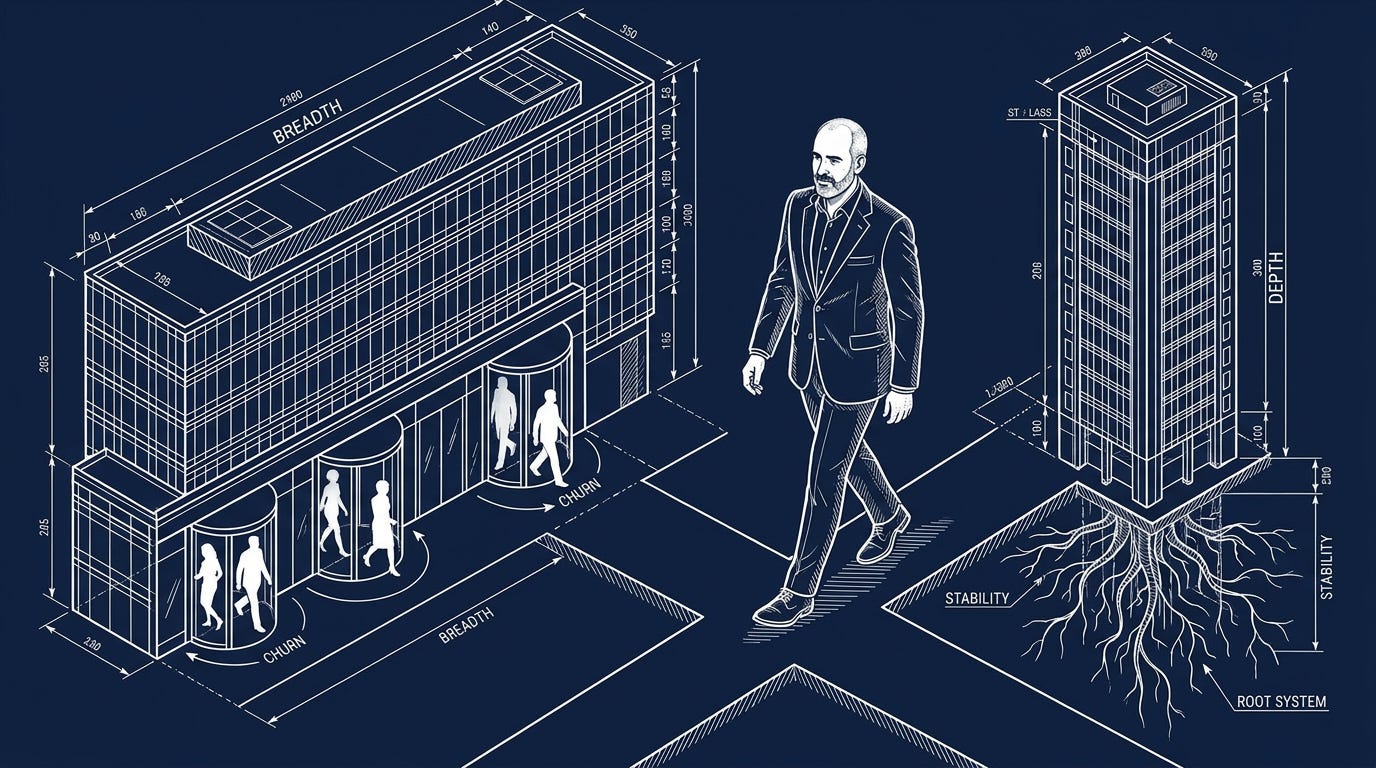
What led Dom to pick CPG? He spent three decades living through the evolution from horizontal SaaS to Vertical SaaS, working at the category defining companies of each. While his lessons compounded, there was always one key net-new insight that allowed the next era to do what the prior couldn’t — an insight that the predecessor might’ve seen as heretical. Veeva eschewed the universality of Salesforce, and it was perhaps the single most defining aspect of their strategy. Now Dom is betting that what worked for Harvey and MagicSchool in the era of Vertical AI 1.0 won’t for Aforza. Today, we discuss that breakpoint.
Vertical Intimacy: The Salesforce Anti-Lesson
Dom spent a decade at Salesforce, long enough to internalize the growth model: hire salespeople by the dozens, chop territories, reassign accounts, ram the machine forward. This isn’t to say Salesforce’s model wasn’t thoughtful when it came to verticals. They developed industry-specific sales forces — effectively internal consultancies — that helped enterprises mold the CRM to their unique purposes. It worked in an era where SaaS adoption was new. But it created a specific kind of friction: Salesforce was continually reliant on customers to re-educate AEs on the changing workings and needs of their industry. The core Salesforce product never accumulated real “expertise” in any single vertical because it was fundamentally designed to be malleable to any.
At Veeva, Peter Gassner ran the opposite playbook — one that today, sounds incredibly familiar. Focus on a single, large industry. Embed the sales team beside the customer and leave it there. Understand depth, the processes, the vertical alignment. Create a persistent feedback loop between the customer that drives product development, rather than just implementation, customization, or customer success.
Dom calls this vertical intimacy. At first, many felt Veeva’s go-to-market motion was more systems integrator than SaaS. But it produced a company that raised $7M, spent $3M of it, and went public at a $4.4B valuation.
Vertical Advantage Outside the Desk-Core
While forward-deployed is ubiquitous these days, there’s one element of vertical intimacy that we expect to see more of in Vertical AI. That is, the alignment of product form-factors and entry UIs with modality of work.
Some of the fastest-growing names in Vertical AI to date share a very similar product interface: a chat box. Harvey, MagicSchool, Legora, Open Evidence — even if the platform has since expanded beyond it, the initial customer touch-point felt like a GPT-wrapper. We discussed this in our original analysis of emerging playbooks in Vertical AI: for white-collar professionals who largely stick to a single location with a laptop nearby (e.g. lawyers, teachers1, doctors), chat is a natural entry point because it meets them where they are and how they work.
Aforza’s users in the CPG industry mostly operate outside the desk core — they’re in the field, selling beer and ice cream, in convenience stores in the East End of London and traditional markets in Kenya and Taiwan.
A guy who’s got to do 20 visits a day doesn’t want to sit and talk to ChatGPT. He just wants the answer in front of his face — where he’s going next, what he should do, and why he should do it.
As Luke pointed out in our episode, so far, the Vertical AI league tables have been dominated by white-collar, desk-core industries. One exception, Rilla (which we covered in Voice-First Playbooks in Vertical AI) saw success anchoring on voice, a non-chat interface that matched the nature of its end-users in the trades. The Vertical AI UI question is not “chat vs. no chat.” It’s “what is the highest-bandwidth way to get intelligence to and from a specific worker in a specific workflow?” It’s not always as straightforward as “do they work at a desk or not.” There are plenty of white-collar workers in CPG — it’s just that the roles that actually move the needle in terms of day-to-day distribution are in the field.
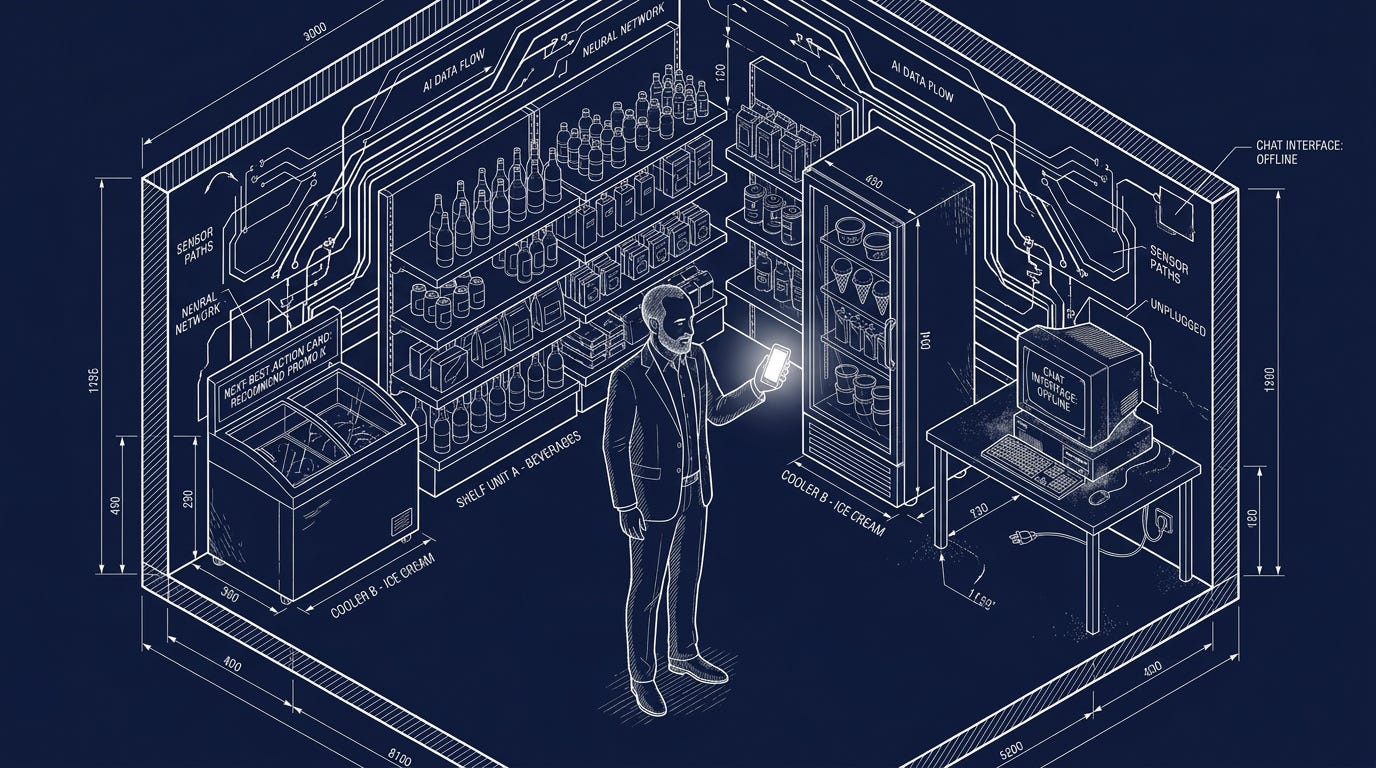
Nor is this form-factor consideration constrained to “desk vs. not.” In some cases, AI is able to take on the full work stream and execute the action. In other cases, AI must arm workers with the right information, at the right time, to do so… and capturing the right feedback from users for context along the way. The reality is that we are still very far away from removing the human altogether, in most workstreams.
So the question for Vertical AI product-builders considering human interface must aim to maximize bandwidth. We discussed this in our prior episode with Mike Droesch at Bessemer Venture Partners. What product modalities — visual, vision, voice, audio, tactile, text — create the highest bandwidth of desired information input and output when interfacing with users? And even before that: which users and roles should our product interface with to have the greatest potential impact on the underlying business, and where & how do they work?
Answering these questions requires the kind of deep vertical intimacy Peter Gassner first championed at Veeva two decades ago.
Dom believes that — compared to Vertical AI that properly embraces vertical intimacy — horizontal AI players (e.g. Copilot, Agentforce) face a structural disadvantage that goes well beyond interface design. They can’t build the use case library, because they don’t know the use cases. They can’t weave AI into the workflow, because they haven’t mapped the workflow. And they can’t price it simply, because they don’t know what the AI actually costs to run in a given vertical.

A quick word from our sponsor, Parafin. Fresh off a new partnership with Tekion bringing embedded finance into automotive, Parafin now extends >$35B in offers to small businesses across platforms like DoorDash, Jobber, and Walmart. Parafin is purpose-built for vertical platforms serving SMBs. Explore a custom embedded program for your platform here →
Pricing: Know the Outcome, Hide the Token
Aforza was founded pre-ChatGPT. Combined with his years of experience across Salesforce, Vlocity, and Veeva, this puts Dom in a unique position to comment on Vertical AI pricing. We asked him a question on the minds of every founder whose product isn’t consumption-based-native:
How do you charge for AI when you started as a per-seat SaaS company?
Let’s take a look at Aforza’s pricing:
Field sales CRM + AI — Per user, per month. The customer has 50 reps. They want a simple line item on a spreadsheet. Aforza knows the use cases and token consumption well enough to bundle the AI cost into a flat PUPM rate.
Automated claim matching — Per item. The customer processes 5K promotion claims a year. They want Ava to match claims to promotions autonomously. Price: 5K times X dollars.
Trade promotion planning — Pegged to business size. Scenario planning and promotion optimization, priced relative to scale, not compute.
In all three cases, the customer never hears the words “tokens.” Dom thinks most enterprise buyers see complex consumption-based AI pricing as “fairy dust” — impossible to forecast or budget. He believes that, in the enterprise at least, it’s on founders to do math and present deterministic pricing schema that allows customers to properly budget in advance. That’s no small task — nor a riskless one in a world where AI COGS are rapidly shifting and no founder wants to degenerate into a cost-plus model that dilutes their value capture as like-for-like tokens get cheaper.
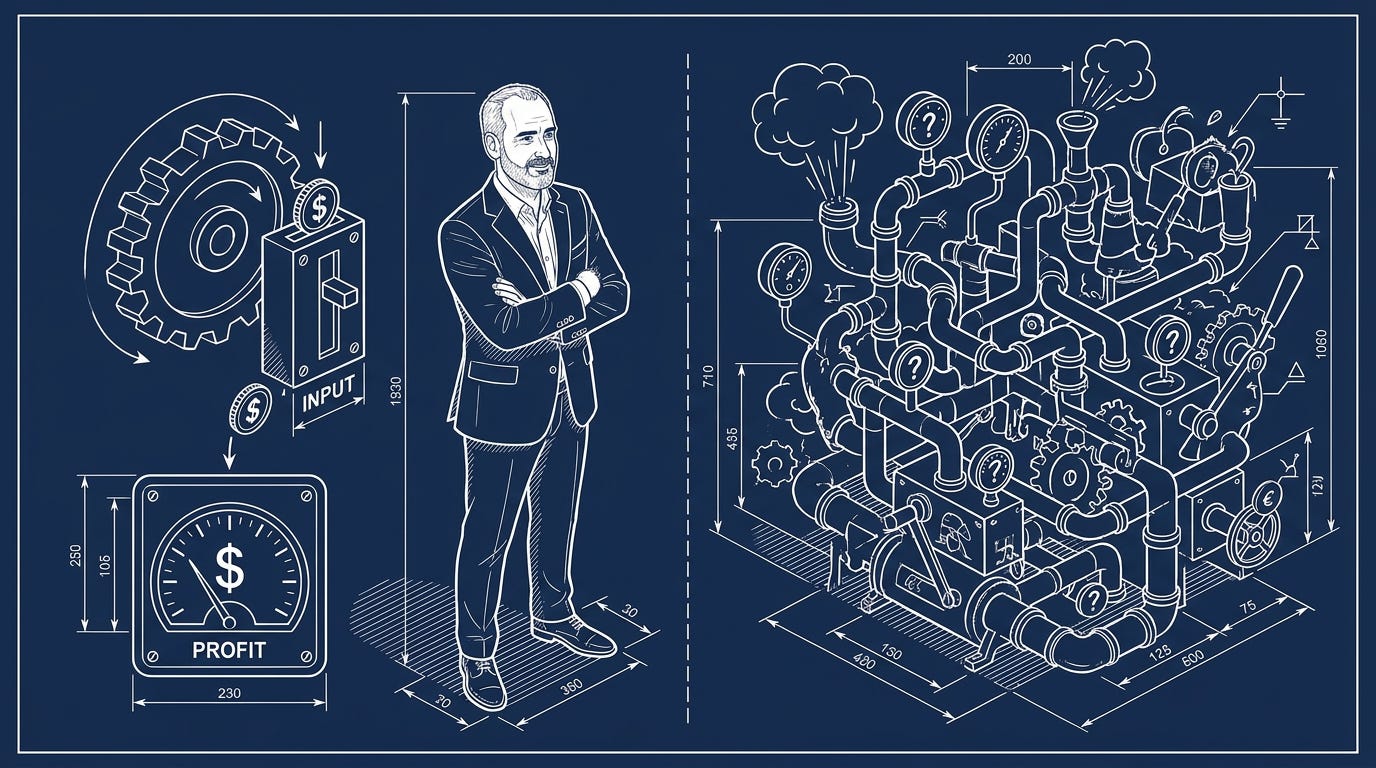
The economics of pricing AI by outcome require knowing the outcomes. Salesforce, as Dom recounted, runs multiple trainings on pricing before each new release — and he bets they’ll never achieve AI pricing appropriately tailored to industry-specific ROI. Because they simply don’t have the vertical intimacy to know.
Pricing complexity might be the most underrated drag on enterprise AI adoption right now. Enterprise buyers in industries like CPG, where IT organizations run leaner than banks or pharma, need predictable costs before they’ll commit. In this phase of nascent AI enterprise adoption — where overwhelming demand lives alongside existential cost fears — Vertical AI businesses that can absorb compute variability and translate it into outcome-based (or at least consumption-aligned) pricing hold a real edge in procurement cycles.
The Takeaway for Vertical Founders
From Salesforce to Veeva to Vlocity to Aforza, Dom has seen how the enabling priciples of a business model evolve. Like the go-to-market model that allowed vertical SaaS to differentiate diverged from horizontal SaaS wisdom, and the interface that works for white-collar AI may be the exact wrong prescription for work outside the desk-core. Both breaks share a root cause: insufficient intimacy with the customer’s actual workflow.
Veeva walked so Vertical AI can run. Product can incorporate AI where users already work… which may be something beyond the prompt. Knowing vertical use cases well enough to price by outcome, not by token, can lend a pricing advantage in the enterprise. Teams can be so woven into customers’ operations that Vertical AI product becomes indistinguishable from how they work — rather than a product to be molded ex post facto.
Vertical intimacy is the one input a founder can't shortcut. It accrues over cycles beside customers, which is why the best Vertical AI founders are often people who've already spent time absorbing industry knowledge, even if peripherally. At some point though, it can become easy to lose sight of the goal: not just accelerating whats already there, but building something transformationally new. Which brings us to Dom’s final advice, after two IPOs and a >$1B acquisition, all of them other people's companies: don't leave your legacy too late.
See you next week.
Key Moments from this Episode
00:00 — Why this decade belongs to vertical AI
02:23 — From horizontal SaaS to vertical SaaS
07:18 — Veeva & the power of vertical intimacy
09:43 — Why Dom chose the $30B consumer goods market
13:19 — Why horizontal software struggles with vertical problems
16:56 — How Aforza evolved from SaaS to AI
18:27 — How vertical AI transformed a real sales team
24:40 — Why generic AI copilots struggle to create ROI
28:22 — How to price vertical AI without selling tokens
32:36 — Why the future of AI isn’t just a chat interface
38:33 — The enterprise workflow AI can completely change
46:04 — Scaling enterprise AI across 40+ markets
48:27 — How to make enterprise implementations actually work
51:10 — Which SaaS companies are most threatened by AI
52:16 — A second, final lesson Dom learned from Veeva
As we discussed in a prior essay / episode with Adeel, founder & CEO of MagicSchool, teachers aren’t exactly in front of a computer all day in the same way lawyers are. But they still have access to a computer and generally operate in a discrete “office” with screens and wifi. These days, at least.