

Most founders think the hardest part of growth is getting to the first $1M in revenue. Martin Roth’s story is a reminder that a revenue leader’s job doesn’t get any less challenging as a startup scales—it gets harder in many ways, easier in some, and most importantly, what it takes to win changes radically.
In this episode, Martin walks us through his lessons scaling sales at Levelset from “we couldn’t even spell ARR”… to a $500M+ acquisition by Procore.
He breaks down what actually changes as sales teams scale (0-1, 1-10, and 10+); where teams tend to overcorrect; and why structure and incentives still beat tools—even in the current AI era. This episode is also a great reminder that all startups have their seasons. As Martin put it, reflecting on Levelset’s journey:
$0 to $1M took 18 months. $1M to $10M took 6 years. $10M to 20M took 18 months.
A Word from Our Sponsor: Parafin
Everyone in vertical knows the value of payments & finance—in growing revenue, retention, TAM, etc. If you’ve ever considered a partner to help you launch embedded finance in your product, we’d kindly suggest you check out our incredible partner on the show: Parafin. They’re purpose-built for vertical platforms and operators like you.
I) Vertical Market Pulse
GC AI raises to double-down on in-house legal
AGC AI raises $30M Series B led by Scale VP | Edi Danalache & Jeremy Kaufmann @ Scale
The center of legal AI gravity has been traditional law firms (think Harvey selling into Latham & Watkins). GC AI’s round highlights that the opportunity outside of Big Law might be just as… well, big. The in-house counsel is a different animal: different incentives, different workflows, different adoption path. And perhaps, a greater appetite. After all, when time isn’t billed by the hour and legal a pure cost center, efficiency truly matters.
One detail that stood out about GC AI: they started out by living where lawyers already work. We wrote on the power of this strategy (and AI’s unique ability to do so) in our Emerging Playbooks in Vertical AI and Voice-First Playbooks essays. Microsoft Office (Word redlines, contract workflows, etc.) may strike you as an application of the past—I’m sure many lawyers feel the same way. But institutional inertia is very real in a world where professionals are reliant on latent consensus from peers, like in law. GC AI’s native MS office integration meets users in their “natural habitat,” reducing friction to adopt and maximizing ability to capture the authoring layer.
Founder Implication
Take a First-Principles Approach to TAM: As we’ve said before, massive categories like legal, finance, and healthcare are better thought of as collections of dozens or even hundreds of verticals, rather than as one homogenous industry.
Prioritize Adoption: In vertical AI, distribution might require that you think about “better workflow embed” or “easier adoption” before “better / ideal technology.” The staying power of Word / Excel—even when Google Docs / Sheets is free and arguably better collaboration-wise—is a reminder to pick your rip-and-replace battles wisely.
A guide to vertical monopolization
#109: 9 Keys To Monopolizing Your Industry | Luke Sophinos @ Linear
You may be familiar with one of the advantages of vertical platforms: they can “monopolize” and industry, with incredible retention and stickiness, even when NPS lags. So while 20–30% market share is excellent, that may actually be the wrong way to think about it from the start. In this piece, Luke explains how the best vertical platforms aim for near-100% in a wedge… and then expand outward.
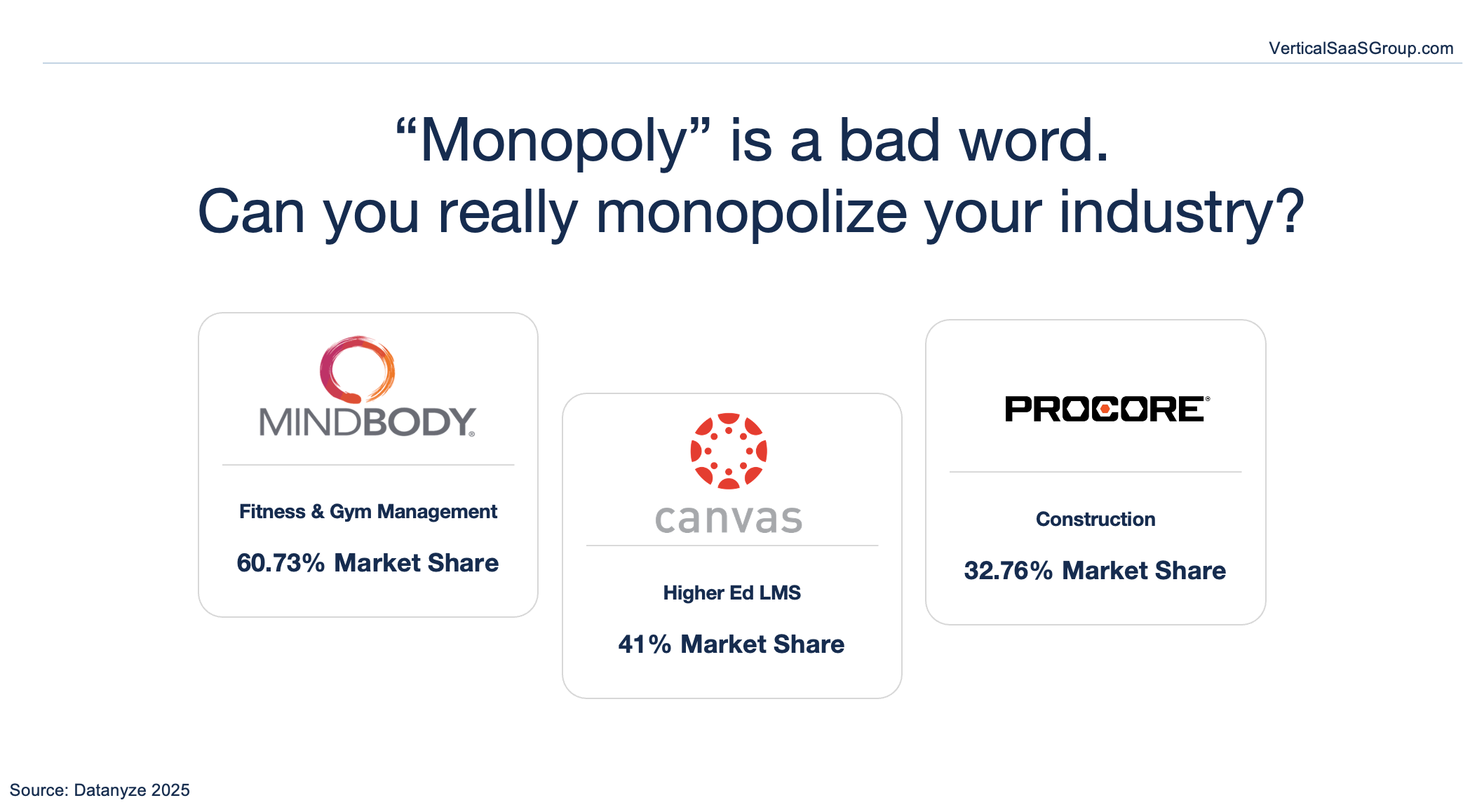
His nine-key guide to vertical monopolization:
You can monopolize in vertical SaaS—plan like it.
You must become the platform / ERP (system of record), or you’ll get eroded.
Delay is fatal: there will always be reasons not to expand scope—swallow the frog.
Customers want a one-stop shop (especially in low-tech industries).
Platform dominance goes beyond software—AI is commoditizing speed and cost.
Real moats are non-software assets: ecosystems, communities, embedded workflows (payments/HR), and painful switching.
Shrink your ICP before expanding—dominate a tiny cohort, then move outward.
Hire for industry proximity—pair SaaS talent with deep industry experts (“industry engineers”) to compress the learning curve.
II) Vertical Titan
Martin Roth — Former CRO @ Levelset
The backstory
Martin joined Levelset when it was still called Zlien: a New Orleans construction-tech startup with transactional revenue, a scrappy content engine, and essentially no modern SaaS playbook.
He was employee #7 and the first sales hire—without prior sales experience—tasked with turning inbound demand into real recurring revenue. The early motion was equal parts inbound and brute-force outbound: a Dream 100 list and relentless follow-up. His mantra was simply, “do whatever it takes to get the meeting.”
The team got to ~$1.5M in recurring revenue in ~18 months. But the more important lesson came next: scaling wasn’t about working harder—it was about picking a focus, then building a machine around it. $1M to $10M took 6 years. Once they hit $10M ARR, however, doubling again took only another 18 months. It was a lesson in focus, scale, and revenue repeatability that all revenue leaders can learn from.
The hardest part
Flying two planes at once: trying to run an enterprise motion and an SMB motion in parallel created messy messaging, messy onboarding, and constant context switching.
Hitting the “growth rate stall” around $4–5M: revenue didn’t stop, but the channel ceiling showed up.
Being too broad: serving everyone (from pool companies to huge suppliers) made rep ramp brutally slow.
Under-investing in structure early: tooling, CRM discipline, and clear rules of engagement weren’t optional once complexity arrived.
Waiting too long to professionalize expansion: leaving upsell/expansion on customer success delayed a major growth lever.
Memorable lines from Martin
The Dream 100 list: “Go put 100 logos in a list… and do something to get their attention once a week, every week.”
“Cross-sell is the eighth wonder of the world.”
“Stop trying to chase the people that don’t want to use. Focus on the people that stay.”
$0 to $1M ARR: stop looking for “channels,” build conviction
Martin’s zero-to-one advice was dead simple:
Have a point of view you want the market to believe.
Write (and ship) content until your fingers bleed.
Run Dream 100 relentlessly.
His point was that early-stage “channel strategy” is mostly a distraction. What matters is proving people will buy, get value, and renew—to yourself, not through partners—then you can control your own destiny by scaling what’s already working.
$1M to $10M ARR: focus is the growth unlock (not more activity)
When Levelset tightened its go-to-market focus—locking in on a clear SMB motion and running enterprise off the side of the desk—the business started to behave.
The operational changes weren’t sexy, but they were decisive:
Get every potential customer in your CRM (vertical markets are finite).
Specialize messaging, training, and enablement for one segment.
Invest in inbound and content as a compounding asset.
Use conferences the right way: smaller, tighter events where every attendee is a likely buyer (not just expensive booths and hope).
$10M+: specialization, rules of engagement, and expansion motions
At scale, the org gets more “designed”:
Dedicated teams by segment (SMB vs mid-market vs enterprise).
Clear ownership and rules of engagement.
Install-base selling becomes a first-class motion (and it’s a growth engine).
One of the biggest inflection points: shifting upsell/expansion away from customer success and into a real sales motion—without losing customer trust. It took time to get right, but it unlocked the sleeping giant in the install base.
The data “switch” that made outbound finally work
Inbound was the engine early. Outbound was initially hard to make economical. What changed was intent and timing.
Levelset built a uniquely valuable dataset based around public-record lien data, which gave them a strong signal on upcoming projects and hence likely prospects. Once they could anticipate who was about to get slow-paid (which their product helps with), outbound stopped being guesswork. That’s when the economics clicked and the team could scale outbound with confidence.
This can be a critical vertical GTM advantage: when your product naturally generates proprietary, industry-specific signals, you can turn those signals into pipeline in a way few horizontal players can.
Packaging: the value metric mattered more than pricing philosophy
Martin was blunt about seat-based pricing: he hates it.
Levelset anchored pricing to a value metric that matched the workflow: number of projects in the system. The logic is durable—even as AI shifts interfaces—because customers don’t mind paying when they understand what they’re paying for.
The broader lesson: early packaging mistakes can haunt you for years (including wildly underpriced “legacy” customers). Tight value metrics early are a go-to-market accelerant that shouldn’t be ignore, especially when your customer is unlikely to care about “AI” or “SaaS.”
AI in sales: what does it change and what stays the same
Martin shared his perspective that AI changes interfaces faster than it changes the fundamentals of a strong go-to-market.
Switching costs for many AI wedges are low, and that’s the danger. The moat can’t just be “the model” or “the feature.” It has to be deeper: embedded workflows, community, brand, data, and the kind of operational integration that makes replacing you painful.
The playbooks that mattered 20 years ago—focus, value, service, expansion—still matter now. While in our episode he does share the key AI inputs to his sales engine, he still considers the right focus (and right team incentives) to be paramount.
III) Vertical Playbook
Selling the Vertical Wedge
Why it works
Vertical markets reward depth, not breadth. By choosing the right wedge and narrowing your ICP scope early on, you can:
Build messaging that actually lands.
Train reps without killing them with context switching.
Create repeatability (and repeatability is what scales).
Turn customers into a compounding asset: reviews, referrals, expansion, and data.
This is how vertical companies get to “market-share gravity” that horizontal SaaS rarely touches.
How to run it (Levelset-inspired blueprint)
Start with a strong point of view and ship content weekly.
Build your Dream 100 (or Dream 500) and run it relentlessly.
Treat your market as finite: map it, tag it, own the list in your CRM.
Pick one ICP wedge and commit (messaging, enablement, sales process, onboarding).
Instrument a real value metric early (and price around it).
Build signals that create timing advantage (data, workflows, usage, public records, integrations).
Split motions as soon as complexity demands it:
Net new vs. install base
SMB vs, mid-market vs enterprise
Product lines with different buyers
Add expansion earlier than you think—don’t leave it “extra credit” for CS.
Only then: expand scope (“swallow the frog”) toward platform status before someone else does.
Founder litmus tests
Can you name your “one wedge” ICP in one sentence—and does your whole team agree?
Are reps selling one clear story, or switching between three buyer personas a day?
Do you know every serious buyer in your market (or are you still guessing at TAM)?
Is your pricing aligned to value delivered, or to convenience (like seats)?
If a competitor copied your software tomorrow and cut the price in half, what would you still have?
Are you delaying platform expansion because it’s hard—or because it’s truly unnecessary?
What we debated on-air
Whether AI application valuations are getting ahead of retention reality (and how much early growth “earns” a premium).
The system-of-record question for vertical AI point solutions: coexist alongside the ERP, or eventually replace it?
Subscription vs usage: Martin’s view was that customers don’t care about the philosophy—they care about clarity and value.
Tools vs structure: modern tooling is incredible, but incentives, segmentation, and disciplined execution are still the unlock.
Next week on VERTICALS
Tune in next week for a special episode!
We bring on two close friends of the show—another VC and another founder—to weigh in with a long list of 2026 Predictions.


